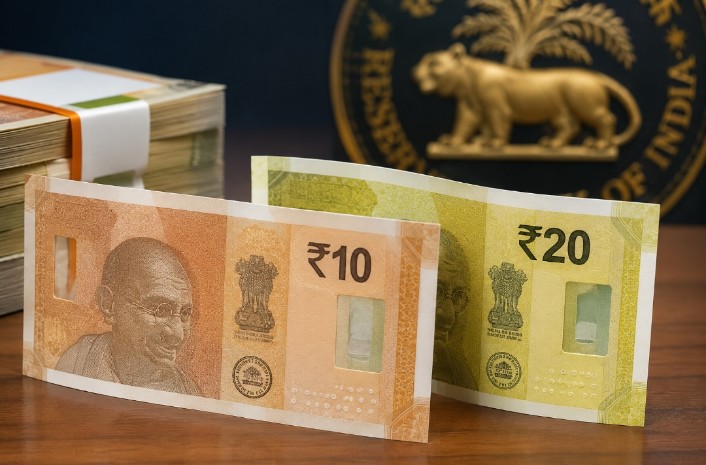
Government approves RBI’s pilot for 2 billion polymer ₹10 and ₹20 notes.
Paper currency will continue as the trial tests durability, cost and public acceptance.
Highlights
- Centre approves RBI’s field trial of 2 billion polymer ₹10 and ₹20 notes.
- Existing paper currency will continue; there is no plan to replace it immediately.
- Polymer notes will be tested for durability, crease resistance and performance in different weather conditions.
- RBI says polymer notes last 2.5 to 4 times longer than conventional paper notes.
- Longer-lasting notes could help save thousands of crores in printing, transportation and disposal costs.
- BRBNMPL has already begun sourcing polymer substrate sheets with advanced security features for the pilot.
The Central Government has approved the Reserve Bank of India’s proposal to conduct field trials of 2 billion polymer currency notes in the ₹10 and ₹20 denominations, marking a significant step towards modernising India’s currency system.
The approval has been granted under the RBI Act, 1934, and is only for a pilot project. The government has clarified that existing paper currency notes will continue to remain in circulation, and the proposal does not aim to replace them at this stage. If the field trials are successful, the RBI will consider the regular issuance of polymer notes in the future.
Replying to a question in the Lok Sabha, Minister of State for Finance Pankaj Chaudhary said the polymer notes will circulate alongside paper notes during the trial. He also stressed that the move is not expected to disrupt India’s rapidly growing digital payment ecosystem, adding that cash and digital payments complement each other.
The RBI will evaluate the polymer notes under different climatic conditions across the country. The trial will assess factors such as durability, resistance to folding and wear, handling quality, public acceptance and overall performance. Since India experiences extreme heat, humidity, dust and heavy currency usage, the pilot will help determine whether polymer notes are better suited for long-term circulation.
Preparations for the project are already underway. Earlier this month, Bharatiya Reserve Bank Note Mudran Pvt Ltd (BRBNMPL) floated a global Expression of Interest to procure polymer substrate sheets embedded with advanced security features for the trial.
Although polymer notes cost around 20–24% more to manufacture initially, international studies suggest they last 2.5 to 4 times longer than conventional cotton-paper banknotes. Their longer lifespan can significantly reduce the RBI’s expenditure on printing, transporting and disposing of worn-out notes. With annual currency printing costs running into thousands of crores, a successful rollout could generate substantial long-term savings for the central bank while improving the durability and quality of India’s currency.