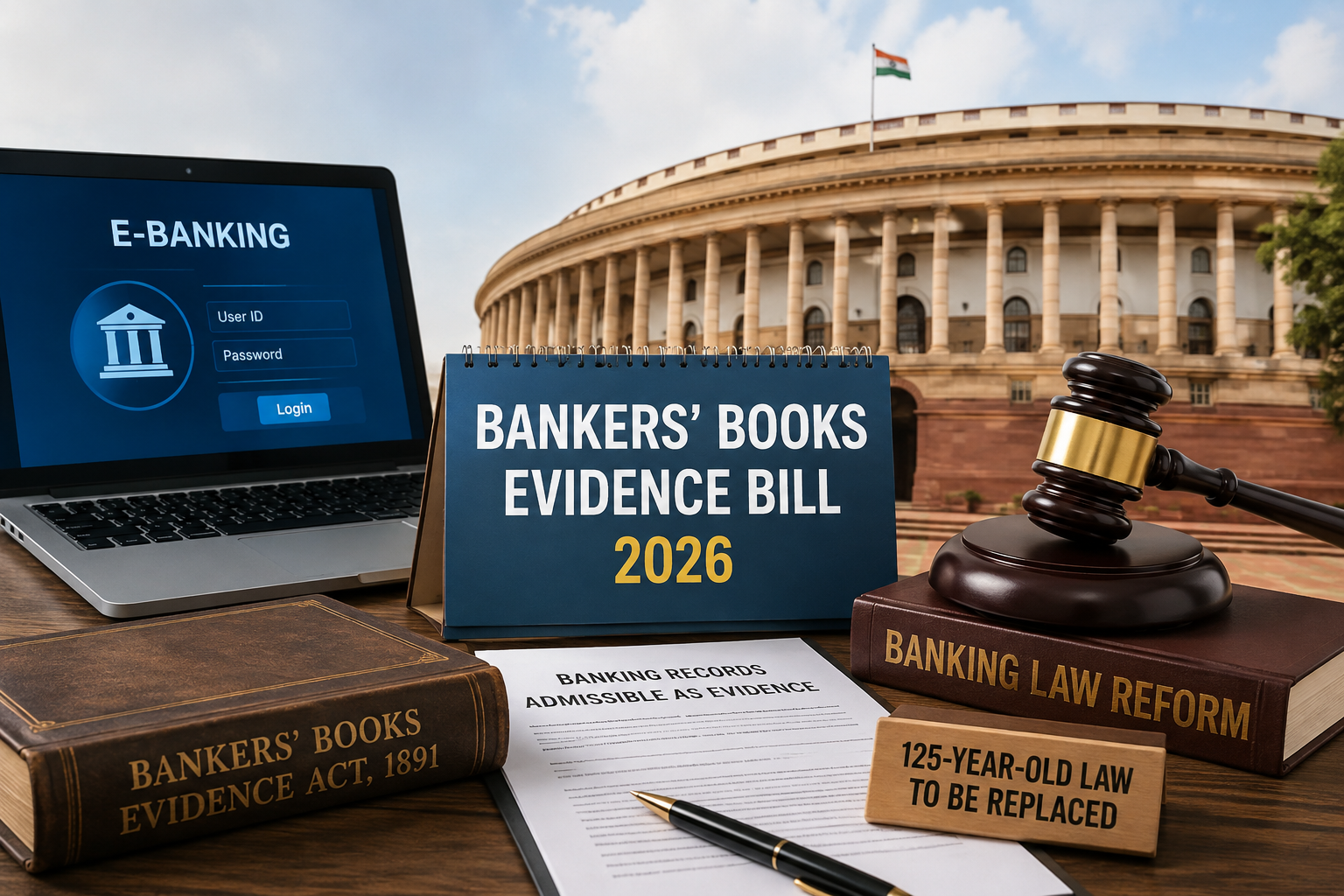
125-year-old law to be replaced for digital banking
Key Highlights
- Government introduces Bankers’ Books Evidence Bill, 2026.
- Bill replaces the 125-year-old 1891 legislation.
- Digital and cloud-based banking records to get legal recognition.
- Standardised authentication for electronic evidence proposed.
- Bank officials protected from unnecessary court summons.
- Centre empowered to extend law to other financial institutions.
- Bill aligns legal framework with digital banking practices.
The Central Government has introduced the Bankers’ Books Evidence Bill, 2026 in Parliament to replace the 125-year-old Bankers’ Books Evidence Act, 1891, marking a major step towards modernising India’s legal framework for banking records in the digital era.
The proposed legislation seeks to update laws governing the admissibility of banking records as evidence in courts, reflecting the rapid expansion of digital banking, electronic record-keeping, online financial transactions, and the growing incidence of cyber fraud.
One of the most significant provisions of the Bill is the introduction of the concept of “Special Cause.” Under this provision, courts will be able to summon bank officials or require them to produce banking records only through a written order specifying valid reasons, provided the bank is not itself a party to the case. The move is intended to protect bank employees from unnecessary litigation and repeated court appearances while ensuring access to banking records when genuinely required.
The Bill also significantly expands the definition of “Bankers’ Books.” Unlike the 1891 law, which primarily focused on physical records, the new legislation includes records maintained in physical, electronic, digital, virtual, cloud-based, or any other technological format. This technology-neutral approach is designed to accommodate future advancements in banking systems and financial technologies.
To strengthen the use of electronic evidence in judicial proceedings, the Bill introduces standardised certification procedures for digital banking records. Authentication will be permitted through manual, digital, or electronic signatures, allowing certified electronic records to be presented before courts in either physical or digital form.
Another key feature of the proposed legislation empowers the Central Government to extend the provisions of the law to other financial institutions or classes of regulated entities, subject to prescribed conditions. This could help create a more uniform legal framework for handling digital financial records across the broader financial sector.
The existing Bankers’ Books Evidence Act, 1891, was enacted during the colonial period to allow certified copies of bank ledgers to be admitted as evidence without requiring production of original books in court. However, with banking operations now largely digital, the government believes a modern legal framework is necessary to reflect current technological realities.
If passed by Parliament, the new law is expected to simplify legal procedures, improve recognition of digital banking records, strengthen judicial efficiency, and support India’s rapidly evolving digital financial ecosystem.