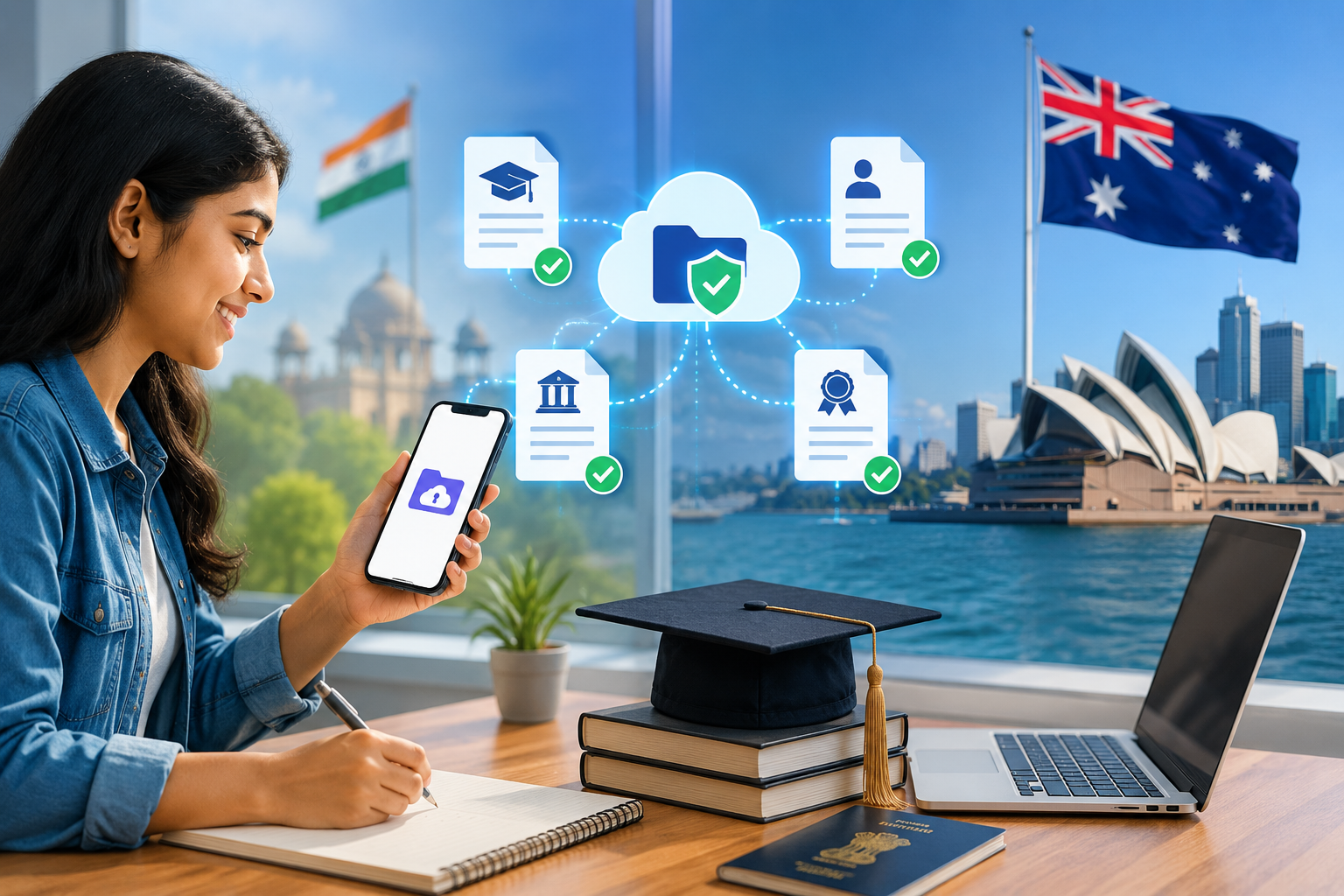
Indian students applying to Australian universities can now use DigiLocker-linked AAERI Verify for academic, identity and financial document checks.
The consent-based system aims to cut paperwork, speed up applications and reduce the risk of fraudulent documents.
Highlights
- AAERI Verify integrates with DigiLocker to verify students’ documents from trusted issuing sources.
- Indian students can digitally share academic, identity and financial records for Australian university applications.
- Student Check will verify credentials before the university application process begins.
- Sponsor Check will verify financial authenticity after a student receives an admission offer.
- Students must provide explicit consent before their DigiLocker records can be accessed.
- DigiLocker has more than 72 crore registered users, according to MeitY.
New Delhi: Indian students planning to study in Australia may no longer have to depend heavily on physical paperwork and lengthy manual document checks while applying to universities.
The National e-Governance Division (NeGD), under the Ministry of Electronics and Information Technology (MeitY), has partnered with the Association of Australian Education Representatives in India (AAERI) to launch AAERI Verify, a new digital credential-verification platform.
The platform was unveiled at the AAERI Annual Convention in New Delhi on August 7, 2026. It has been integrated directly with DigiLocker, allowing students to securely share source-verified digital records for their Australian higher-education applications.
For students, the biggest change is that academic certificates, identity documents and financial records available through the system can be digitally authenticated instead of relying on repeated submission and manual verification of physical documents.
The process will operate in two stages.
The first, called Student Check, will be conducted before a student begins the university application process. It is designed to authenticate the student’s credentials at an early stage.
The second, Sponsor Check, will start after the student receives an admission offer. This stage will focus on checking the authenticity of financial records linked to the student’s education funding.
Privacy remains an important part of the process. Students will have to provide explicit consent before DigiLocker facilitates access to their digitally signed records from original issuing authorities.
This could help universities receive more reliable documents while reducing the possibility of forged or altered credentials. For applicants, it could mean fewer verification-related delays and a simpler admission process.
NeGD Director JL Gupta said the partnership demonstrates how India’s Digital Public Infrastructure can be extended to solve challenges in the international education ecosystem.
DigiLocker is one of the flagship initiatives under the Digital India programme. It allows citizens to securely access, store, share and verify digital documents issued by authorised organisations.
According to MeitY, DigiLocker currently serves over 72 crore registered users.
The AAERI partnership represents another international use case for India’s Digital Public Infrastructure and could make the document-verification stage easier for thousands of Indian students seeking higher education opportunities in Australia.