Different parts of Africa have different appetite and liberalization norms for ‘Services’. There is a need for region-specific trade and services negotiations, if India has to gain maximum from an agreement. Historically, reasons for emergence of regional integration arrangements in Africa were political exigencies and economic needs. It is often argued that India should look at Africa not as an aggregation of individual economies, but of regional blocs. This is believed due to macroeconomic weaknesses and small market size of individual African economies. Africa has three major regional economic arrangements- Economic Community of West African States (ECOWAS), Southern African Customs Union (SACU) and Common Market for Eastern and Southern Africa (COMESA). Let’s first understand how European Union (EU), Africa’s biggest trade partner looks at these three. EU’s Approach EU has region specific trade agreements with Africa. An FTA was signed between EFTA and SACU, signed in 2006 and entered into force on May 1, 20081. Economic Partnership Agreement between EU and ECOWAS was finalized in February 2014. And, the EU signed two financing agreements with COMESA- Trade Facilitation programme and Small Scale Cross-Border Trade programme, worth 68 million euros. India’s position India continues to contribute sluggishly to Africa’s total imports, with the share in total imports hovering around 4.5%2 for last three years. FDI stock, however, slowly increased from 12% in 2009 to 15% in 20143. India currently has two memorandums of understanding with ECOWAS and COMESA. If India plans to aggressively take up trade agreements and investment projects in Africa, two identifications are necessary. One, the disparity between different regional blocs of the continent, and the similarities within each such bloc. We now examine the disparity in terms of products and services. Products After analyzing the top 15 exports list of COMESA, ECOWAS and SACU, it can be found that there is a long list of products for each regional trade community, distinct from other blocs. Table 1 lists the product chapters found in top 15 exports to the world by respective regional blocs, which are distinct from other two blocs. COMESA ECOWAS SACU 74, 9, 24, 62, 7, 17, 61, 81, 31 18, 52, 40, 44, 12, 15, 25, 16, 89, 41 87, 84, 72, 76, 22, 73, 28, 38 Table 1: List of distinct product chapters of each bloc 1. Status of Agreements concluded by the Southern African Customs Union States 2. Own calculation based on ITC Trade map database 3. UNCTAD World Investment Report, 2016 This analysis is necessary to understand the distinction in products offered by different regions, and with whom would trade be most beneficial. Services Even though “Memo item- commercial services”, “Transport”, “Travel” and “Other Business Services” occupy the top four slots in services imported by COMESA, ECOWAS and SACU in 2016; the magnitudes of imports differ widely. Other than these top four services, the rankings of service imports vary among these regional blocs. For example, USD 1743.64 million2 worth of “Charges for the Use of Intellectual Property” was imported by SACU in 2016, while COMESA and ECOWAS imported a much less USD 287 million and USD 274.28 million, respectively. Similarly, ECOWAS imported USD 1291.43 million worth of “Financial Services” in 2016, compared to a low USD 204.72 million and USD 104.87 million for COMESA and SACU. This tells us that different parts of Africa have different appetite and liberalization norms for ‘Services’. There is a need for region-specific trade and services negotiations, if India has to gain maximum from an agreement. India’s way forward In a scenario where these regional communities are striving to strengthen trade within them, India can gain significantly if negotiations are directed towards groups, instead of individual countries. Any policy directive should go beyond quantitative facts, and look into the qualitative characteristics of the continent.

India’s growing demand for Solar Panels- Import Substitution or Optimality?
Cheap imports of solar panels have been essential for achievements in National Solar Mission, but with imports acquiring maximum market share, it is expected that domestic manufacturers will be depressed enough to be wiped out from competition. Indian Solar Manufacturer’s Association (ISMA) has appealed in June 2017 for the third time in five years, to the Directorate General of Anti-Dumping (DGAD), to impose anti-dumping duty on solar panels. This time the application is against China, Malaysia and Taiwan. The first two instances of such appeal were in 2012 and 2014, respectively. In 2012, DGAD recommended anti-dumping duty on solar panels imported from China, Malaysia and USA after a complaint from domestic manufacturers. However, the duty wasn’t applied by the Ministry of Finance. Later in 2014, two simultaneous complaints were filed with DGAD and Directorate General of Safeguards (DGS) of Ministry of finance. The complaint was eventually dropped post reassurance, by the government, of future business opportunities for domestic players. Why are domestic manufacturers in distress? India’s total imports of ‘Photovoltaic cells’ (HS code 8541) in 2016 were USD 3,637.41 million[1], 84.5% of which were imported from China. India’s imports from China, Taiwan and Malaysia combined have grown from USD 523.73 million[2] in 2012 to USD 3022.38 million in 2016, showing a compound annual growth rate (CAGR) of 55.99 per cent[3]. Imports from China alone have increased 4.5 times[4] from 2012 to 2015. India’s total export in 2016 for HS code 8541 was USD 159.69 million, a low 4 per cent of total imports. This ratio says something about India’s dependence on imports for solar cells. Previous Cases in Perspective Two precious developments are important for the current discourse. In 2012[5], a DGAD enquiry was initiated for imports from Malaysia, USA, Chinese Taipei and China PR. After a thorough investigation by May 2014[6], it was established by the authority that material injury was caused to domestic industry due to imports at lower than normal value of the products. The authority also noted in their investigation that with anti-dumping duties imposed by the US and EU on Chinese solar panels, its dumping in Indian market can possibly increase. Booming domestic demand would add to the imports. Duties in the range of USD 0.11/watt to USD 0.81/watt were recommended to be imposed. However, the authority also recognized that the cost of solar power production will rise by Rs. 1.6 crore per Mw if anti-dumping duties are imposed on solar panel imports. Finally, the duties were not imposed. Simultaneous to the investigation was another development. India imposed ‘Domestic Content Requirement (DCR)’ on solar cells and modules in the first phase of national solar mission. Later, DCR was extended to thin film technologies. US strategically timed its response and in 2013, complained in the WTO against India’s DCR policy. India, in defence used the ‘government procurement’ clause that permits a deviation from national treatment obligation under the WTO agreement. In 2013 itself, WTO ruled against Canada’s DCR policy in a case petitioned by the EU and Japan. Expectedly, India lost the case. Later in 2016, India’s appeal against the verdict was also rejected by the Appellate Body of the WTO. But in this entire process, India gained four years’ time to comply with WTO’s expected verdict. These two cases bring to light the dilemma that policymakers face while deciding on whether or not to favour the domestic manufacturers. It appears that India should use the clauses that provide for upholding domestic interests; a more fundamental dilemma is if India wants to do so. Case of European Union (EU) and United States (US) The EU recently justified an anti-dumping duty of 47.7 per cent on Chinese solar exports imposed in 2013, post a two year long enquiry into the matter. The investigation revealed that Chinese exporters were selling solar panels at less than market values. A similar finding was made by the US Department of Commerce, following which tariff duties of up to 165.04 per cent were imposed on crystalline silicon photovoltaic solar imports from China and Taiwan. Conflict of Interests With the National Solar Mission’s targets revised five folds upward[7] in June 2015, the government was and still is in a fix to impose such a duty. It’s a clear case of conflicting multiple objectives. The mission aims at ‘reducing the cost of solar power generation’ along with ‘domestic production of critical components and products’- a clear contradiction in objectives in the presence of cheap imports from outside, specifically, China. The Ministry of Non Renewable Energy in a previous anti-dumping duty demand claimed that the duty would not be the right thing because domestic prices are not price competitive. In a scenario where the government is trying to achieve a lower solar energy tariff, it is unlikely that a support mechanism would be used by the state. Way forward or inward? India plans to install a capacity of 10,000 MW of grid interactive power by 2022, out of which 215.67 MW[8] was achieved by April 2017. The importance of solar and other renewable energy becomes more evident in view of the NDCs developed to meet India’s Paris Climate Agreement’s obligations. Cheap imports have been essential for achievements in National Solar Mission, but with imports acquiring maximum market share, it is expected that domestic manufacturers will be depressed enough to be wiped out from competition. On lines of the ‘Sacrifice Ratio’ principle, it can be said that a short term inconvenience of expensive imports can be offset by long term gains of a thriving domestic solar panel industry. But is India ready for the sacrifice? [1] ITC Trade Map database [2] ITC Trade Map database [3] Own calculation based on ITC Trade Map database [4] Own calculation based on ITC Trade Map database [5] Case No.- 14/5/12, Initiation, DGAD, Department of Commerce, GOI [6] Case No.- 14/5/12, Final Findings, DGAD, Department of Commerce, GOI [7] Target revised from 20,000 MW to 100,000 MW by the year 2021-22 [8] MNRE Physical Progress Document, 2017

Rethinking India’s Agricultural Distress
While India aims to improve its competitiveness in export of permitted agricultural commodities and facilitate exports, there is a need to first construct a more farmer-friendly ‘domestic procurement facility’. That, along with a focus on warehousing and processing, is indispensable for a feasible export facilitation initiative. One often misses the paradigm shifts and structural changes happening in agriculture while analyzing its problems. Some issues are ever changing, while some persist. Here, we focus on one such unrelieved stumbling block faced by farmers. Lately, low farm incomes are being deemed, and rightfully so, as a prime reason for agrarian distress. Following this realization, the objective of ‘doubling farm incomes by 2022’ expectedly found its way into the Union Budget of 2017. But what is it that really constitutes the hurdles that keep farmers from raising their farm incomes, is it just an external force such as below-normal monsoons and lack of technological up gradations, or are there inbuilt impediments too. We intend to look at two such bottlenecks- domestic procurement procedures and storage facilitation. Consider a situation where a farmer needs to spend an entire day to sell his produce to procurement agencies. Following the sale, which is often at lower prices for the ones who are towards the end in queue, is a seven to nine day long wait for payment to be credited in the farmer’s bank account. Not to forget, the procurement process requires Origin Certificate and Aadhar Card to be furnished by the farmer. Although Aadhaar’s penetration has significantly improved in India, obtaining the Origin Certificate from the village patwari remains a challenge for farmers. Whether it is absence of the issuing authority or mere reluctance of getting work done, it is the farmer who suffers. It is a question if the documentation is really facilitating the procurement process or restricting it, in a situation where the government agencies represent a monopsony, naturally rendering the bargaining power of farmers meagre. This discussion would be incomplete if we do not consider the role middlemen play in the scene. Middlemen are traders who buy agricultural produce from farmers and further sell it where higher prices are ensured. A typical arrangement is one in which the middleman offers 50 percent of the MSP to the farmer, with immediate cash payment. Putting this and the previous situation in perspective, one can see that farmers without adequate documents and in need of cash are prone to selling their produce to middlemen, compromising on their farm incomes. It is with this conundrum that one needs to understand the endogenous factors contributing towards low incomeof farmers. Low bargaining power and inability to hold the produce result also from a persistent drawback in Indian agriculture- poor storage standards and lack of processing units. According to a 2010 study by Central Institute of Post Harvest Engineering and Technology (CIPHET), Ludhiana, an estimated harvest and post-harvest loss of Rupees 44,143 crore per annum (at 2009 wholesale prices) was incurred . Adequate processing facilities, preceded by ample storage for harvest, are essential requirements for remunerative prices of agricultural produce, and consequently for raising farm incomes. To conclude, in times as stressful for agriculture as now, it becomes imperative to rethink the issues and look within the sector for solutions. While India aims to improve its competitiveness in export of permitted agricultural commodities and facilitate exports, there is a need to first construct a more farmer-friendly ‘domestic procurement facility’. That, along with a focus on warehousing and processing, is indispensable for a feasible export facilitation initiative. If the nation can’t secure the interests of the primary stakeholder of a sector, the growth path cannot be sustained.
G20 Summit- What should be India’s agenda?
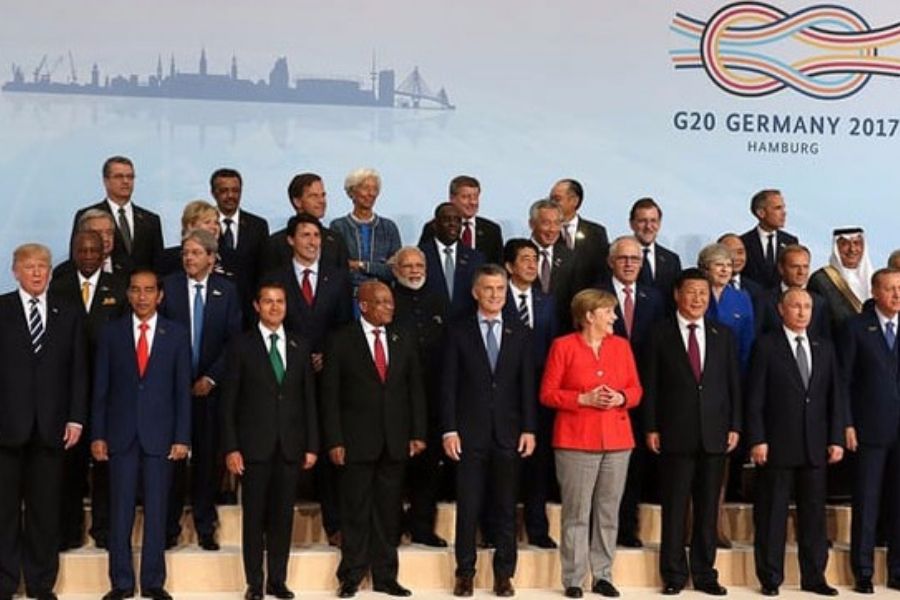
A revived thrust on climate conundrum along with a dominant strategy for agriculture should top the priority list of all the concerned countries in the G-20 meeting at Hamburg, Germany. Image Credit: WHO Twelfth G-20 Summit will be held on 7th and 8th July, 2017 in Hamburg, Germany. It’s a premier forum for economic cooperation and to discuss the challenges faced by its member countries. There are many pressing issues which the member countries including India would want to address at the Summit. But it is important to prioritize the issues. Agriculture is one such issue which cannot wait. India’s agricultural economy is in a deep crisis, if not addressed urgently can have dire environmental, societal and economic implications. State of Indian agriculture Food Sustainability Index (FSI), which ranks 25 countries according to the sustainability of their food systems, is a quantitative and qualitative measure. It measures the sustainability across three pillars- food loss and waste, sustainable agriculture and nutritional challenges. India was ranked 25th in 2016 with a score of 43.17 (out of 100). The most notable defects faced by India’s food system are- unsustainable use of groundwater, low quality agricultural subsidies and poor nutritional status. India is the biggest consumer of groundwater in the world. Agriculture has started to threaten the water supplies. Though the record of water irrigation is not very impressive and there has been a decline in surface irrigation, the increasing use of tube well irrigation has led to depletion of ground water. Groundwater Development Index, which measures ratio of groundwater consumed to groundwater recharged is just 60% in India. It was claimed that the use of Genetically Modified (GM) varieties can help India overcome the agricultural crisis. In reality, it has worsened the agricultural scenario. Use of GM varieties has eventually led to an increase in the use of pesticides, herbicides and insecticides which has in turn polluted the already depleting groundwater and soil. As per the Agreement on Agriculture (AOA), all the countries especially the developed ones need to limit the extent of support given to agriculture by reducing their subsidies (which can distort trade and production). To think that developed countries are not giving subsidies to their farmers is a myth. Their current stance can be termed as box shifting, that is, subsidies have moved from being direct to indirect. These subsidies do have trade distorting effects and hit the poor farmers in our country. Food security is one of the most severe challenges faced by us today. Deep linkages of agriculture and environment The correlation between agriculture and environment is robust. The resources of the country are under great strain due to the negative environmental impact of agriculture. India also received the lowest scores under FSI for overall greenhouse gas emission with sources including machinery, fertilizers, pesticides, soil erosion etc. India contributed 6.3% of global C02 in 2015 and its carbon emission from burning fossil fuel increased by 5.2 % in the same year. Paris Climate Agreement, which aims at cooperating towards the common aim of developing climate friendly, efficient and sustainable solution for expanding energy needs and other areas of sustainable development, is a crucial agreement for India in many ways. In order to revive agriculture and make it sustainable, it is essential to adopt agricultural practices that curb climate change; and agriculture has a huge unrealized potential to mitigate climate change. To realize that potential and increase the resilience of this sector, India needs to push for the agreement at the Summit. India is not the only country trying to solve this complex puzzle of dealing with agricultural and environmental issues. Least developed countries (LDCs) and developing countries like Argentina, China, Brazil, Indonesia and most of the African countries are in the same fix. A revived thrust on climate conundrum along with a dominant strategy for agriculture should top the priority list of all the concerned countries in Hamburg. A united effort at negotiations is the need of the hour.

India’s Outlook on the Pursuit of E-commerce.
A formal negotiation on-e-commerce implies talks on homogeneity of ‘Market Access’ which is certainly a risky territory for India’s domestic policies. Removal of physical barriers in trade and integration of markets are two prime advantages of e-commerce, but there is no reason to believe that these can be achieved only in a multilateral course. Image Credit: Pexels E-commerce has been a focal area for WTO this year, as was witnessed during WTO Director General Roberto Azevêdo’s visit to India in February, 2017. Also, many developed countries are wanting to take up this issue in the WTO’s eleventh ministerial meeting in Buenos Aires, Argentina in December 2017. In addition, the Aid-for-Trade initiative which was launched at the 2005 Hong Kong WTO Ministerial Conference, and aims to support developing countries’ access to markets is also pursuing the matter.Its sixth global review is to be held at the WTO, Geneva from July 11 to 13, 2017, and as is evident from the theme “Promoting Connectivity”, focus is on digital connectivity, in the form of e-commerce and digital trade. The intent behind this aspiration is “market access”. Developing countries like India which have strong domestic demand and segmented domestic retail brands, are perfect destinations for e-commerce giants to reap economic gains. Why are developing nations wary of this agenda? In 2016, India ranked 90 (out of 137 nations) on the UNCTAD B2C E-commerce Index which measures the readiness of countries to engage in online commerce. Most African countries rank even lower. This low ranking points towards a need to integrate the user base within, before making the issue multilateral. With the persistent problem of disparity in user base, any negotiation on e-commerce can be detrimental from the welfare perspective. “Digital Divide” in developing economies is being cited as the primary reason for not pursuing the agenda of e-commerce at current juncture in WTO negotiations. A formal negotiation implies talks on homogeneity of ‘Market Access’ which is certainly a risky territory for India’s domestic policies. Small retailers, who are incapacitated in competing with multinational retail chains have resisted the e-commerce drive since its inception. And a multilateral agreement with standardized policies is likely to further limit the scope of domestic policies in curbing any suppression by big retail chains. It is being believed that bringing the e-commerce agenda to the table is like kicking away the ladder for developing nations, to use Ha- Joon Chang’s words, because they are not prepared for a multilateral policy on this aspect. The Positive side It is often argued that market access will improve for domestic retailers and micro & small enterprises also, with such internationalization. Removal of physical barriers in trade and integration of markets are two prime advantages of e-commerce, but there is no reason to believe that these can be achieved only in a multilateral course. Keeping the trade-off in mind, it is for the best of interest of India to keep this a matter of domestic policy. Any discussion around this agenda must consider if developing world ready to take the leap and jump into e-commerce with no domestic player to compete. Also, one needs to understand if the e-commerce agenda really meets the development goals convened by the WTO. Trade expansion with skewed benefits or following fundamental development goals- the choice of developing countries seems obvious.