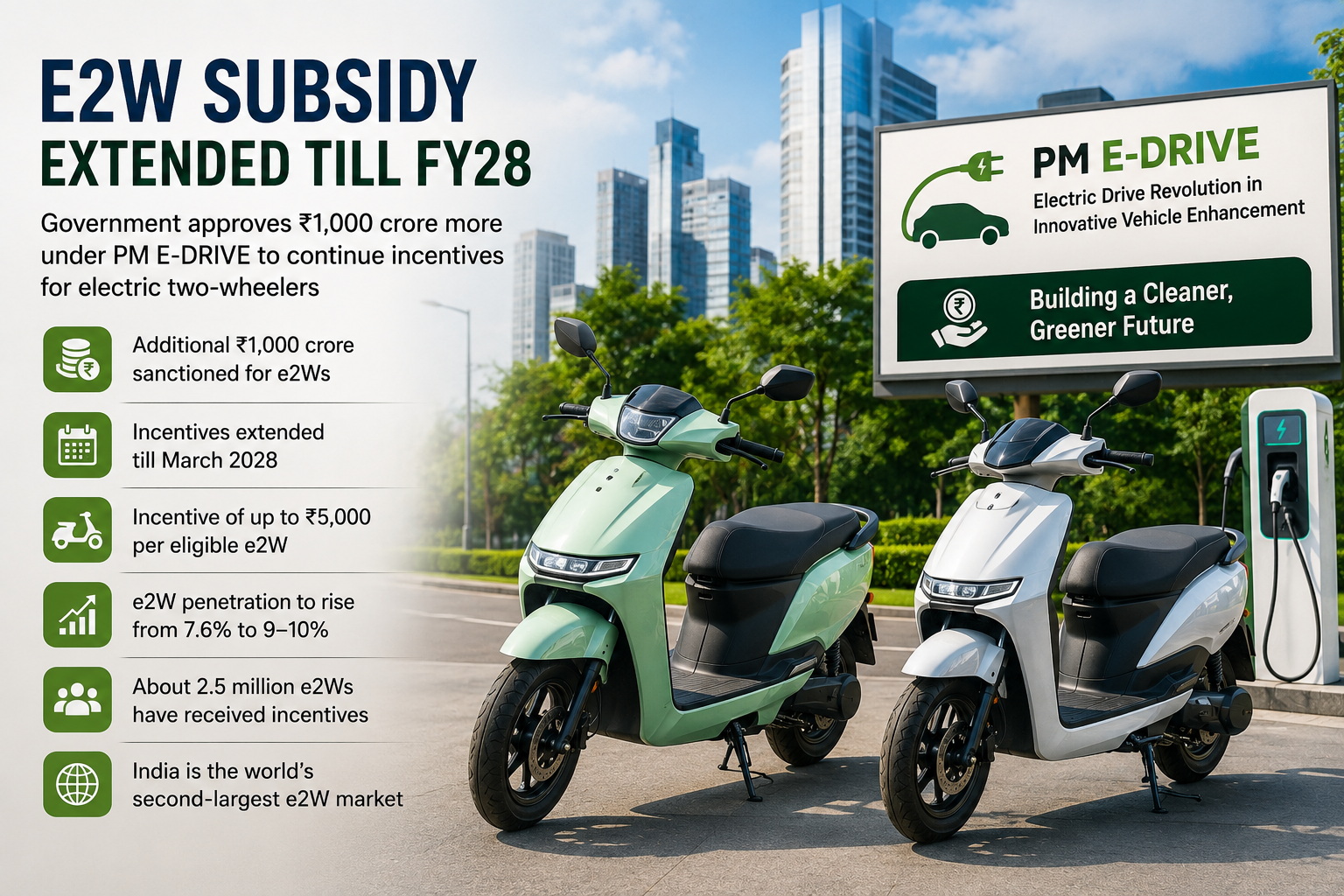
Government approves an additional ₹1,000 crore under PM E-DRIVE to continue incentives for electric two-wheelers, aiming to increase their market penetration from 7.6% to 9–10%
Key Highlights:
- Government allocates additional ₹1,000 crore for e2Ws.
- PM E-DRIVE incentives extended until March 2028.
- Current electric two-wheeler penetration stands at 7.6%.
- Government aims to raise e2W penetration to 9–10%.
- Eligible e2Ws can receive incentives of up to ₹5,000.
- Around 2.5 million electric two-wheelers have received incentives so far.
- India is currently the world’s second-largest e2W market by volume.
New Delhi, August 11: The central government has sanctioned an additional ₹1,000 crore for electric two-wheelers under the PM Electric Drive Revolution in Innovative Vehicle Enhancement (PM E-DRIVE) scheme, extending incentives for the segment until March 2028.
A Ministry of Heavy Industries (MHI) official said the additional funding was approved after the ministry requested an extension of incentives beyond July 2026, when the earlier deadline for electric two-wheelers was scheduled to end.
The additional allocation has been provided specifically for electric two-wheelers. According to the official, the Ministry of Finance agreed to the request and sanctioned ₹1,000 crore to ensure that the incentive programme continues.
Electric two-wheeler penetration in India currently stands at around 7.6%. The government aims to increase this figure to at least 9–10%, citing the widespread use of two-wheelers and their importance in addressing last-mile mobility needs.
Under the PM E-DRIVE scheme, each approved electric two-wheeler is eligible for an incentive of up to ₹5,000.
The PM E-DRIVE scheme was originally notified in September 2024 with a total outlay of ₹10,900 crore. It was initially scheduled to operate from October 1, 2024, to March 31, 2026. The government subsequently extended the overall scheme.
The government has taken a different approach for segments where electric vehicle adoption has already reached higher levels. For instance, subsidies for L5 electric three-wheelers were stopped in December 2025 after penetration in the segment reached around 41%, significantly higher than initially expected.
The MHI official said subsidies are expected to gradually reduce and eventually end as EV adoption increases. However, electric two-wheelers have not yet reached the level of penetration at which the government believes incentives can be withdrawn.
India is currently the world’s second-largest market for electric two-wheelers by volume, behind China. The government also believes that the domestic industry has developed significant research and development capabilities over the past five to six years.
According to the ministry, the PM E-DRIVE scheme has provided incentives to around 2.5 million electric two-wheelers so far. The government expects the sector to make further progress towards its adoption targets over the next two years.