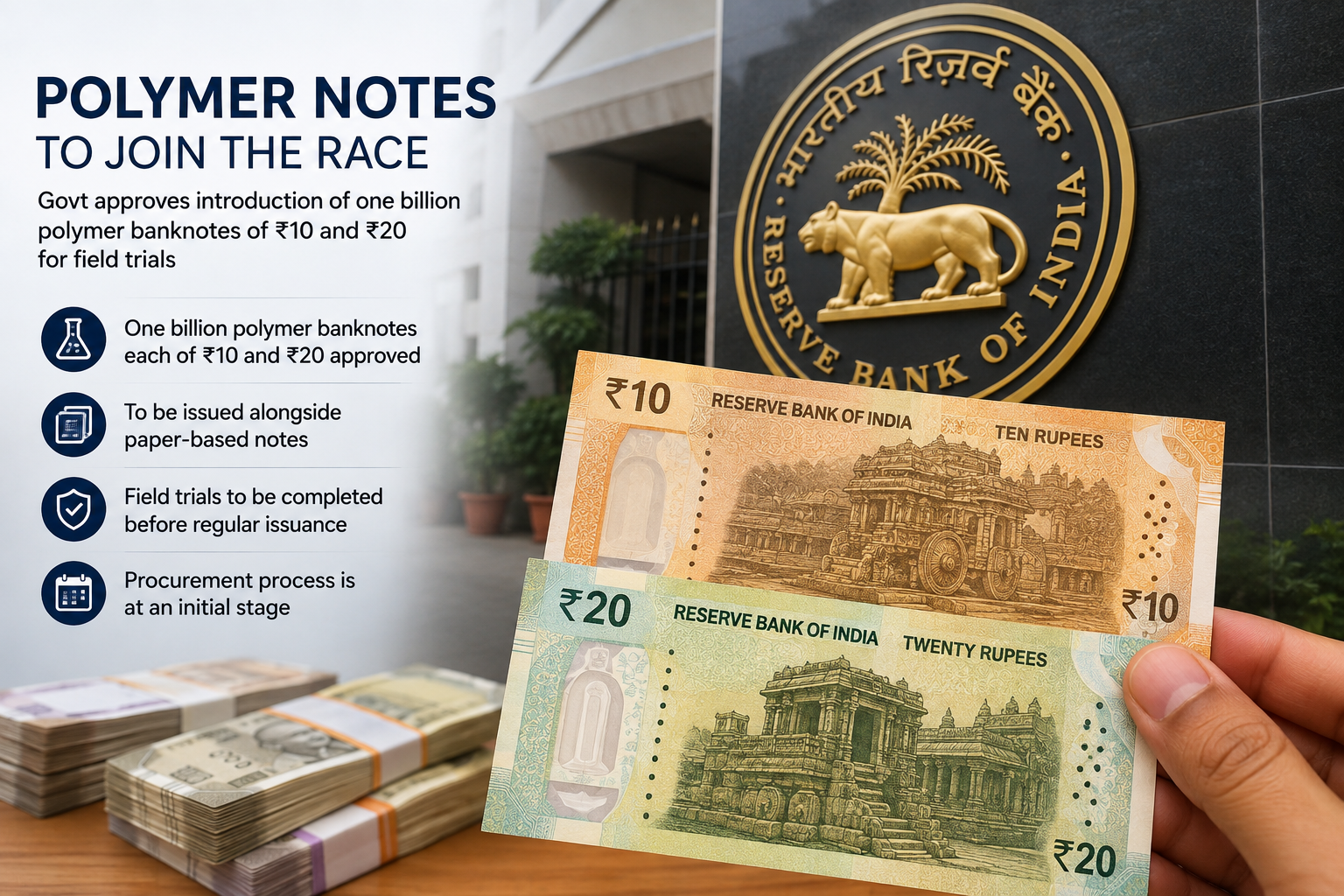
The government has approved one billion polymer banknotes each of ₹10 and ₹20 for field trials, with the new notes expected to be issued alongside existing paper-based currency after successful testing.
Key Highlights:
- Government approves polymer banknote field trials.
- One billion ₹10 polymer notes proposed.
- One billion ₹20 polymer notes also approved.
- Polymer notes will circulate alongside paper notes.
- Procurement is currently at an initial stage.
- Exact launch timeline is not yet decided.
- Field trials must be successful before regular issuance.
New Delhi, August 11: The government has approved the introduction of one billion polymer banknotes each in the ₹10 and ₹20 denominations for field trials, Parliament was informed on Tuesday.
The proposal was submitted by the Reserve Bank of India (RBI), based on the recommendation of its central board, under Section 25 of the Reserve Bank of India Act, 1934.
According to Finance Minister Nirmala Sitharaman, the proposal covers one billion pieces each of ₹10 and ₹20 polymer banknotes for field trials. Regular issuance of the polymer notes in these denominations will follow if the trials are completed successfully.
The new polymer currency will not immediately replace existing paper-based notes. The RBI has proposed issuing the polymer banknotes alongside paper substrate-based banknotes.
The procurement process is currently at an initial stage, meaning the exact timeframe for the introduction of the new notes has not yet been determined. The government has also said that it is currently not possible to provide an exact estimate of the expenditure involved.
The move comes as India continues to explore changes in its currency and financial systems. Polymer banknotes are designed to offer an alternative to traditional paper-based currency and can potentially provide greater durability.
The Finance Minister also informed Parliament about the country’s recent inflation trends. Average retail inflation, measured through the Consumer Price Index (CPI), declined from 5.4% in 2023-24 to 4.6% in 2024-25 and further to 2.1% in 2025-26.
However, retail inflation increased to 3.9% in the first quarter of 2026-27 due to factors including commodity price shocks, elevated global energy prices linked to the West Asia crisis, seasonal increases in vegetable prices and expectations of unfavourable El Nino conditions.
Despite the increase, inflation remained below the RBI’s target of 4%, according to the Finance Minister.
Sitharaman also highlighted various government measures aimed at controlling price pressures and supporting household consumption, including GST rate rationalisation, customs duty changes and tax relief for individuals.
The government has also exempted annual incomes up to ₹12 lakh from income tax, with the limit reaching ₹12.75 lakh for salaried individuals after the standard deduction.
According to the latest GDP estimates, per capita private final consumption expenditure grew 6.8% in 2025-26, compared with 4.8% in 2023-24. The government said it would continue monitoring price conditions and take fiscal, administrative and supply-side measures as required.