
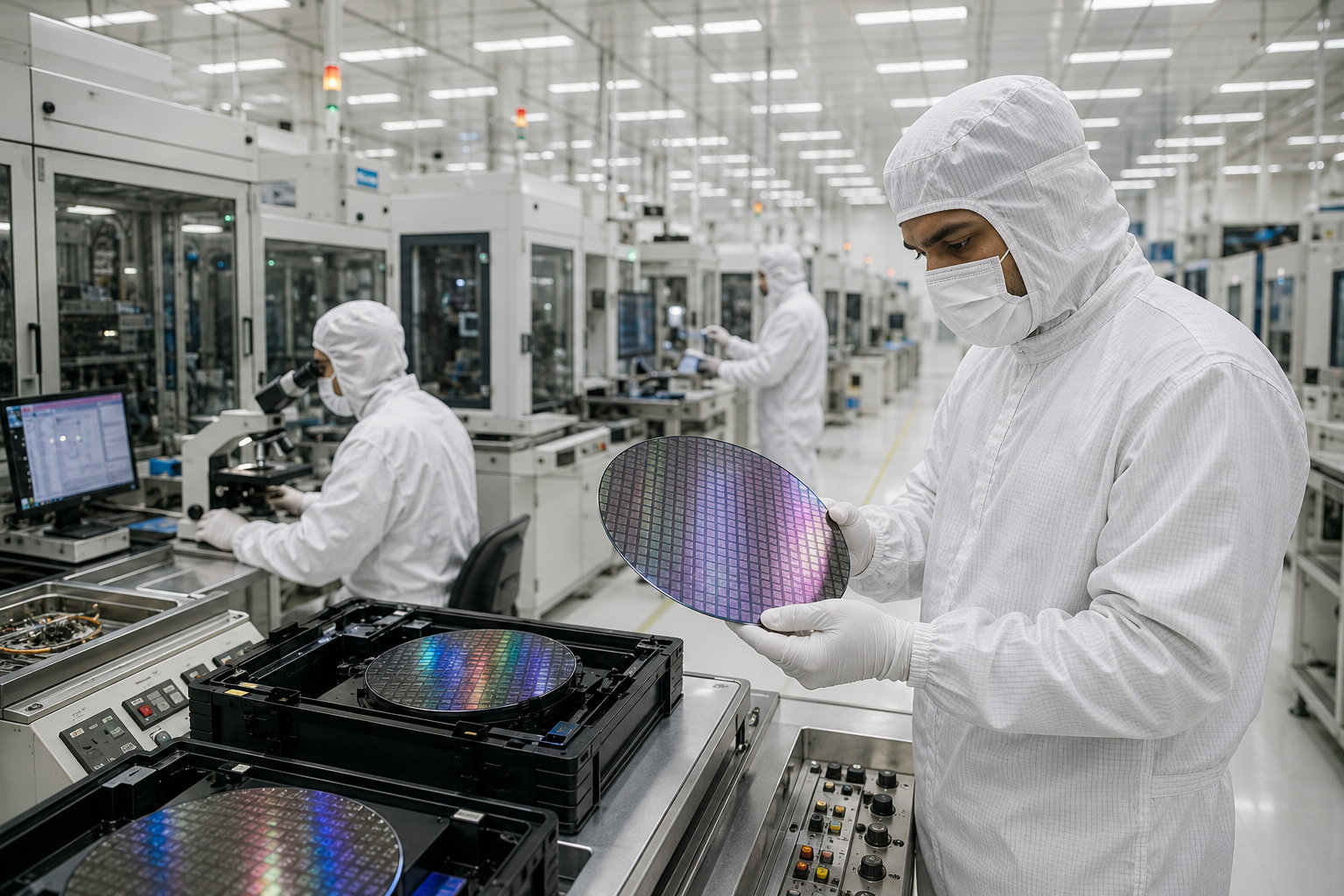
Secure Chip Ecosystem Focus
Key Highlights
- Government may expand trusted hardware restrictions.
- CCTV security model could cover more sectors.
- Focus on end-to-end trusted chip supply chains.
- Indian chip designers to receive greater support.
- Domestic semiconductor ecosystem gains momentum.
- Trusted electronics manufacturing to boost security.
- Policy aims to reduce dependence on non-trusted sources.
The Government of India is preparing to widen its trusted hardware strategy beyond CCTV cameras to other security-sensitive sectors as part of a broader effort to strengthen the country’s semiconductor ecosystem and reduce dependence on non-trusted technology sources.
Speaking at a Confederation of Indian Industry (CII) event on semiconductors, Electronics and Information Technology Secretary S. Krishnan said the government is evaluating how the security-driven approach adopted for CCTV cameras can be replicated across additional sectors where trusted hardware and secure supply chains are essential.
The government had earlier restricted the sale and deployment of CCTV cameras imported from non-trusted countries over concerns that certain electronic components and chips could contain vulnerabilities capable of transmitting sensitive information through unauthorized channels. Although the move initially faced resistance from industry, domestic manufacturers adapted by increasing local production and sourcing trusted components.
Krishnan said the experience gained through the CCTV policy has demonstrated that security-focused regulations can simultaneously strengthen domestic manufacturing while protecting critical infrastructure. According to him, similar measures may now be extended to other sectors involving sensitive electronic equipment and strategic technologies.
He noted that while India continues to expand semiconductor manufacturing capabilities, creating sufficient domestic demand for locally designed chips remains equally important. A secure and trusted supply chain, he said, is essential not only for economic growth but also for national security, particularly as advanced electronics become increasingly integrated into public infrastructure, defence systems, telecommunications and critical digital networks.
The official highlighted that companies supported under the government’s Design Linked Incentive (DLI) Scheme have already started developing semiconductor chips specifically for CCTV cameras in collaboration with Indian manufacturers. These initiatives are helping create indigenous technology solutions while reducing dependence on imported electronic components.
Going forward, the government plans to encourage Indian semiconductor designers to develop advanced chips that can support secure, end-to-end domestic manufacturing ecosystems. Such efforts are expected to complement the Semicon India Programme, Production Linked Incentive (PLI) schemes and other initiatives aimed at making India a global electronics manufacturing hub.
India has significantly expanded investments in semiconductor fabrication, chip design and electronics manufacturing over the past few years. Several global and domestic companies have announced new investments in semiconductor fabrication units, packaging facilities and component manufacturing under government incentive programmes.
Industry experts believe trusted hardware policies could become increasingly important as cybersecurity threats, data privacy concerns and geopolitical risks reshape global technology supply chains. Countries worldwide are now prioritising secure sourcing of electronic components used in telecommunications, surveillance systems, financial infrastructure and government networks.
The government also sees trusted semiconductor manufacturing as a key pillar of India’s long-term digital economy strategy. By promoting indigenous chip design and expanding secure manufacturing capabilities, policymakers aim to improve technological self-reliance while creating high-value employment opportunities across the semiconductor value chain.
As India accelerates its ambitions of becoming a global semiconductor hub, the proposed expansion of trusted hardware regulations is expected to encourage greater investment in domestic chip development, strengthen national cybersecurity, and enhance confidence in India’s electronics manufacturing ecosystem.