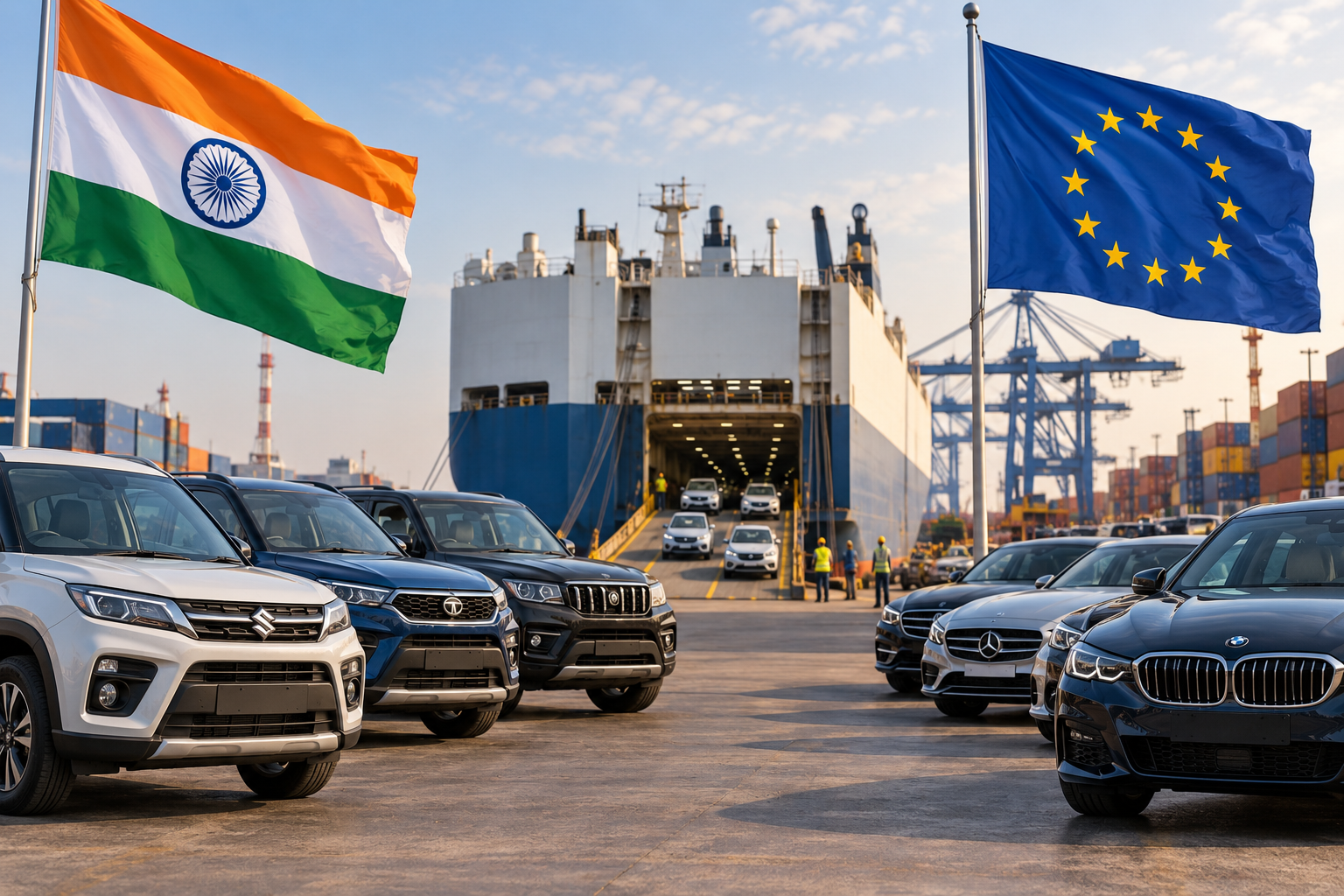
The India-EU Free Trade Agreement gives Indian-origin cars a substantially larger quota in Europe while allowing European automakers greater concessional access to India.
- European carmakers get a first-year quota of 1 lakh ICE and hybrid cars in India.
- The quota will increase to 1.6 lakh vehicles by the tenth year.
- Indian-origin ICE and hybrid cars priced up to €50,000 get a 2.5 lakh-unit EU quota in Year 1.
The India-European Union Free Trade Agreement is set to reshape automobile trade between the two markets, giving Indian manufacturers a significantly larger export opportunity in Europe while providing European carmakers greater access to India’s premium vehicle market.
Under the detailed tariff schedules, European manufacturers will receive a first-year quota of 100,000 internal combustion engine and non-plug-in hybrid cars for exports to India at concessional tariff rates.
This quota will gradually increase to 160,000 vehicles by Year 10, while the in-quota import duty will decline to 10% by the fifth year.
The opening is significant considering India imported only 17,191 cars from the European Union in 2025.
Bigger Export Opportunity for Indian Automakers
Indian manufacturers receive a considerably larger export window under the agreement.
Indian-origin ICE and hybrid cars priced at up to €50,000 will initially receive access to an EU quota of 250,000 vehicles annually.
That quota will expand to 400,000 units by Year 10, while the applicable EU tariff within the quota is scheduled to fall to zero by the fifth year.
The provisions could create new export opportunities for Indian manufacturers including Maruti Suzuki, Tata Motors and Mahindra & Mahindra as they look to expand their presence in overseas markets.
Mass-Market Cars Protected
India has structured the agreement to limit immediate pressure on its large domestic mass-market segment.
ICE and hybrid cars valued below €15,000 will not receive tariff concessions for entry into India.
For European cars priced between €15,000 and €35,000, the in-quota duty is set to fall from the current base rate of 110% to 35% in the first year before gradually declining to 10% by Year 5.
The structure means European premium and luxury manufacturers could gain greater access without immediately exposing India’s lower-priced passenger-car market to the same level of competition.
European EVs Get Delayed Access
Electric vehicles have received additional protection.
European EVs will not receive concessional market access in India during the first four years of the agreement.
EV concessions will begin from Year 5, while electric vehicles priced below €20,000 will remain outside the concession framework at that stage.
The transition period gives domestic manufacturers more time to expand their electric vehicle portfolios and manufacturing capabilities.
India-EU Trade Deal Moves Ahead
The latest details come as the trade agreement moves closer to implementation. The European Commission has moved towards obtaining formal approval for signing and concluding the agreement after India and the EU concluded negotiations earlier in 2026.
The wider FTA provides market access covering more than 99% of India’s exports by trade value, according to the Indian government.
For India’s automobile sector, the deal therefore represents a two-way opening: European manufacturers gain greater access to India’s premium vehicle market, while Indian manufacturers receive a substantially larger quota to pursue customers across the EU.
The eventual impact will depend on how quickly Indian manufacturers develop vehicles that meet European safety, emission, technology and consumer requirements and use the new tariff advantages to scale exports.