India is looking to scale up indigenous steel slag road technology that converts a by-product of steel manufacturing into construction material.
- Steel slag technology can cut road construction costs by around 40%, according to Union Minister Jitendra Singh.
- Such roads can deliver four times the strength of conventional roads, the minister said.
- Major maintenance could be required only after around 15 years in suitable applications.
India is looking to scale up steel slag road technology across the country as the government seeks to lower infrastructure costs, improve road durability and convert industrial waste into a valuable construction resource.
Steel Slag Road Technology can reduce road construction costs by around 40% while delivering four times the strength of conventional roads, Union Minister Jitendra Singh said on Saturday.
In suitable applications, roads constructed using the technology could also require major maintenance only after nearly 15 years, according to the minister.
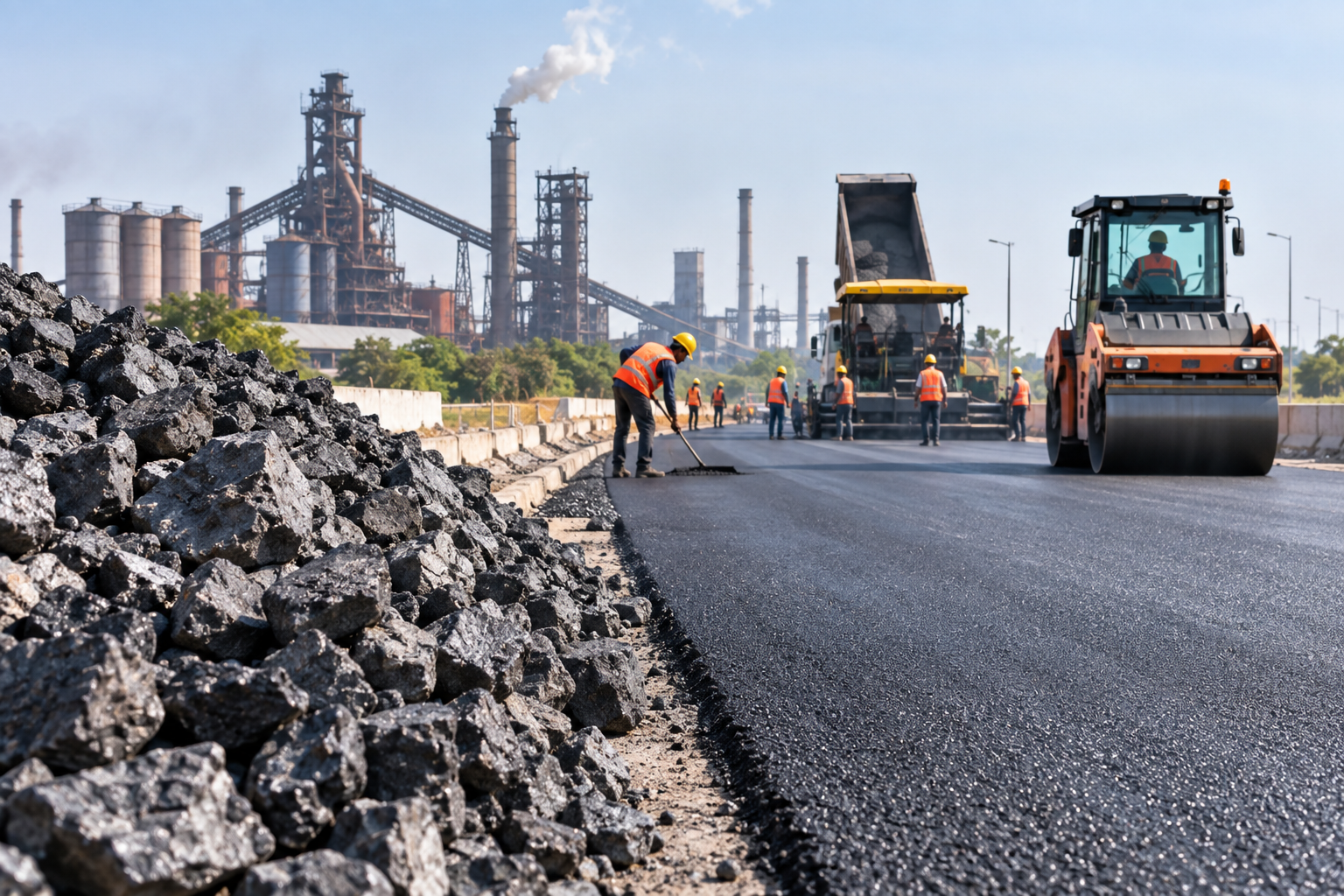
The technology, developed by CSIR-Central Road Research Institute (CSIR-CRRI), converts processed steel slag — a by-product generated during steel manufacturing — into aggregates that can be used for road construction.
India Sets Guinness World Record
The latest milestone is a 1.85-km road constructed using processed steel slag aggregates at Raigarh in Chhattisgarh.
The project, undertaken by CSIR-CRRI and Jindal Steel, has been recognised by Guinness World Records as the world’s longest road built with processed steel slag aggregates.
The government now wants the technology to move beyond individual demonstration projects.
Jitendra Singh called for its adoption to expand “from one project to many projects” and “from one State to many States”, including potential use by State governments, Railways, other government departments and private infrastructure developers.
40-Km Odisha Project Next
A significantly larger project is already in the pipeline.
CSIR-CRRI has received a work order for a 40-km steel slag road in Odisha using material from Jindal Steel’s Angul plant, according to CSIR Director General N. Kalaiselvi.
The project would represent a major jump from the current 1.85-km record and could demonstrate whether the technology can be deployed at a much larger scale.
From Industrial Waste to Infrastructure
Steel slag roads also fit into India’s broader circular-economy and “Waste to Wealth” strategy.
Using processed steel slag as road aggregate can reduce the need for natural materials obtained through mining and quarrying while finding a productive use for a major industrial by-product.
This could become increasingly important as India expands highways, expressways, industrial corridors, ports and urban infrastructure.
The technology could also have potential in areas exposed to heavy traffic or challenging weather conditions, although its suitability would depend on pavement design, processing standards and quality control.
Technology Already Used Across India
Steel slag technology has already been tested across different infrastructure environments.
One of its early major applications was a six-lane road connecting the Hazira industrial area with Hazira Port in Gujarat.
Around 80,000 tonnes of steel slag were also converted into processed aggregates for a one-kilometre, four-lane section of the NH-66 Mumbai-Goa Highway.
The technology has additionally been deployed in Arunachal Pradesh, including strategic border areas, and for a 1.1-km heavy-duty road inside Hazira Port.
The government’s next challenge will be moving the technology from successful individual projects to mainstream infrastructure construction while maintaining technical and quality standards.