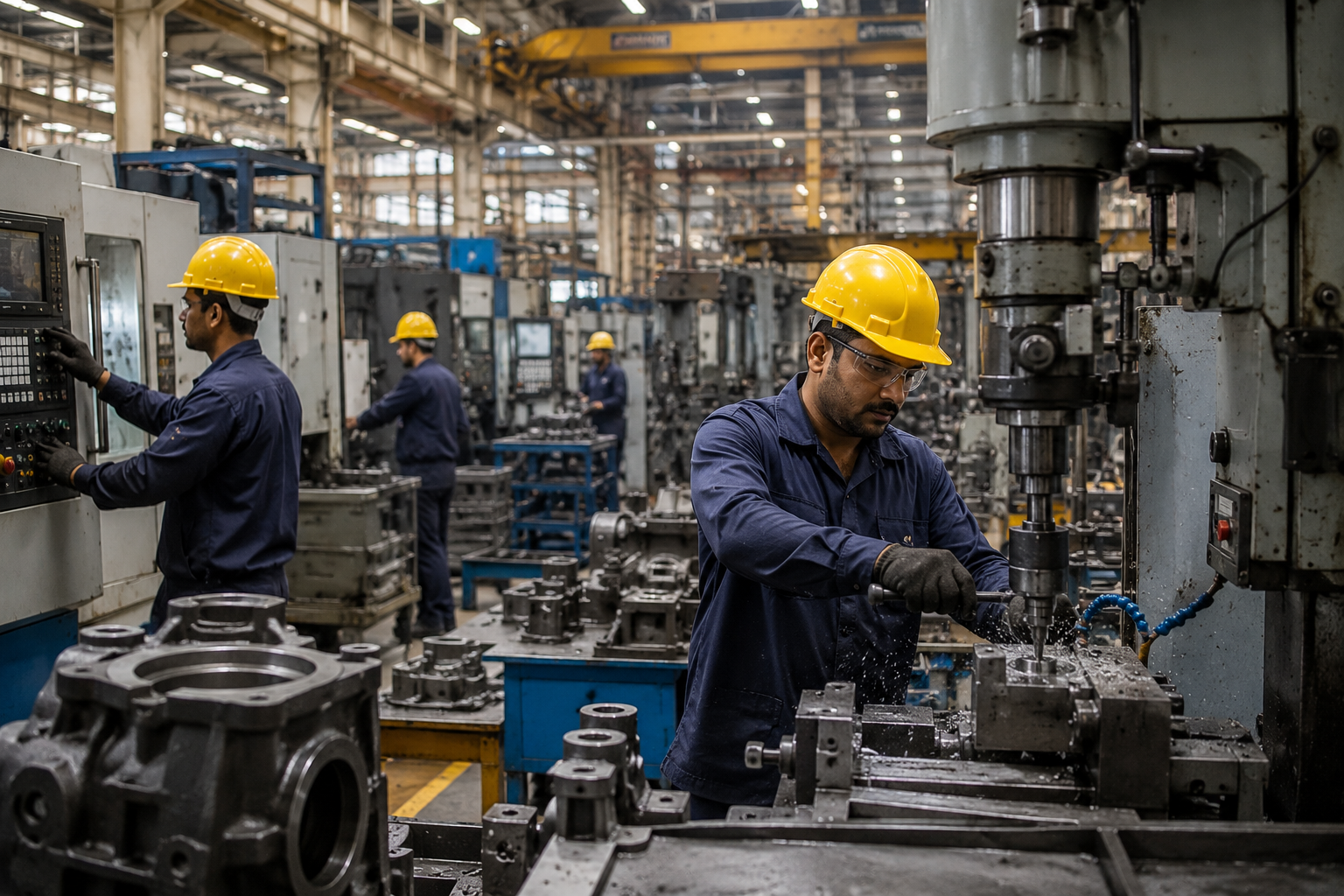
Capital spending leads industrial recovery
Key Highlights
- IIP growth averaged 6.3% in April-July FY27.
- Growth was significantly higher than the 4% recorded a year earlier.
- Capital goods output grew 15.4% during April-July.
- Intermediate goods expanded 9.4%.
- Consumer durables recorded 8.7% growth.
- Manufacturing growth stood at 7.3% in July.
- Weak household consumption remains a concern for the broader recovery.
India’s industrial sector is gaining momentum in the current financial year, with investment-led activity emerging as a key driver even as household consumption continues to lag. According to data highlighted in the newspaper report, the Index of Industrial Production (IIP) grew at an average rate of 6.3% during the first four months of FY27, from April to July, compared with 4% during the corresponding period a year earlier.
The acceleration comes despite global economic uncertainties and geopolitical challenges. At the current pace, industrial production growth is on course to record its strongest performance since FY24.
Investment emerges as the main growth engine
The composition of industrial growth indicates that businesses are increasing investment in capacity, machinery and infrastructure rather than relying primarily on household consumption.
Capital goods output recorded the strongest performance among the major categories, growing 15.4% during April-July FY27, compared with 8.1% in the same period a year earlier.
The newspaper report noted that the rebound is increasingly investment-led, with capital-goods output jumping 16.1% in July and 15.4% during April-July.
The improvement in capital goods reflects stronger spending on machinery, electrical equipment, transport equipment and other investment-intensive products. This suggests that businesses are continuing to expand or upgrade production capacity despite uncertainty surrounding global demand.
Manufacturing maintains healthy momentum
Manufacturing remains at the centre of the industrial recovery. Manufacturing growth stood at 7.3% in July, supported by electrical equipment, machinery and other capital-intensive segments.
The improvement has also extended to intermediate goods, which grew 9.4% during April-July, compared with 4.6% a year earlier.
Infrastructure and construction goods, however, recorded more moderate growth of 7.1%, slightly below the 7.4% expansion recorded during the corresponding period last year.
Primary goods growth improved to 3.3%, compared with 2.2% a year earlier.
Consumer demand remains the weak link
While investment-related categories have performed strongly, household consumption has not kept pace with the broader industrial recovery.
Consumer durables grew 8.7% during April-July, compared with 3.1% a year earlier. However, consumer non-durables growth slowed to 1.1%, compared with 2.6% in the corresponding period.
The divergence indicates that consumers continue to exercise caution when purchasing everyday goods, even though demand for larger-ticket products such as vehicles and appliances has shown signs of improvement.
Economists quoted in the report suggested that the investment cycle is currently running ahead of the consumption cycle. A sustained recovery in household demand will therefore be important for making industrial growth more broad-based.
Rural demand remains a concern
One of the major challenges for consumption is relatively weak rural income growth.
Although the broader economy has benefited from government spending, investment and improving industrial production, household purchasing power in some segments remains constrained.
Analysts have pointed to factors including rural wages and subdued demand for everyday consumer products. A sustained improvement in rural incomes could therefore become important in determining whether consumption catches up with the investment cycle.
Capital spending supports the outlook
Government and private-sector capital expenditure are providing important support to industrial activity.
The stronger performance of capital goods suggests that businesses are increasing purchases of machinery, electrical equipment and other productive assets. This type of spending can create a multiplier effect by increasing manufacturing activity, generating employment and eventually supporting consumption.
Infrastructure-related investment is also contributing to demand for construction materials, machinery and other industrial products.
What the numbers mean for India’s economy
The latest industrial production trends point to a changing composition of economic growth. Rather than being driven exclusively by household consumption, the recovery is increasingly supported by investment and production-related activity.
However, analysts remain cautious about the sustainability of this trend. A prolonged gap between investment growth and consumer demand could limit the breadth of the recovery.
The July IIP data also showed that industrial growth slowed to 6.7%, compared with 8.8% in June, highlighting some month-to-month volatility. Manufacturing and electricity production remained relatively resilient, but the moderation reinforces the need for stronger demand conditions.
For policymakers, the key challenge will be to maintain the investment momentum while encouraging a wider recovery in household consumption. Stronger rural incomes, employment growth and improving purchasing power could help bridge this gap.
Overall, the April-July numbers indicate that India’s industrial economy has entered FY27 with considerable momentum. Capital spending, machinery demand and manufacturing activity are leading the recovery, while consumer demand remains the area that needs closer attention.