Prime Minister Narendra Modi has called for Indian companies
Key Highlights
- PM Modi called for at least one Indian bank to enter the world’s top five.
- Indian pharmaceutical companies have been urged to become among the world’s five largest.
- The Prime Minister set a target of 50 Indian companies in the Fortune 500.
- The targets are part of a broader five-to-seven-year economic vision.
- Manufacturing, technology, defence, agriculture and green economy remain key focus areas.
- Modi highlighted India’s growing manufacturing and technology capabilities.
- India is being encouraged to combine domestic strength with stronger global competitiveness.
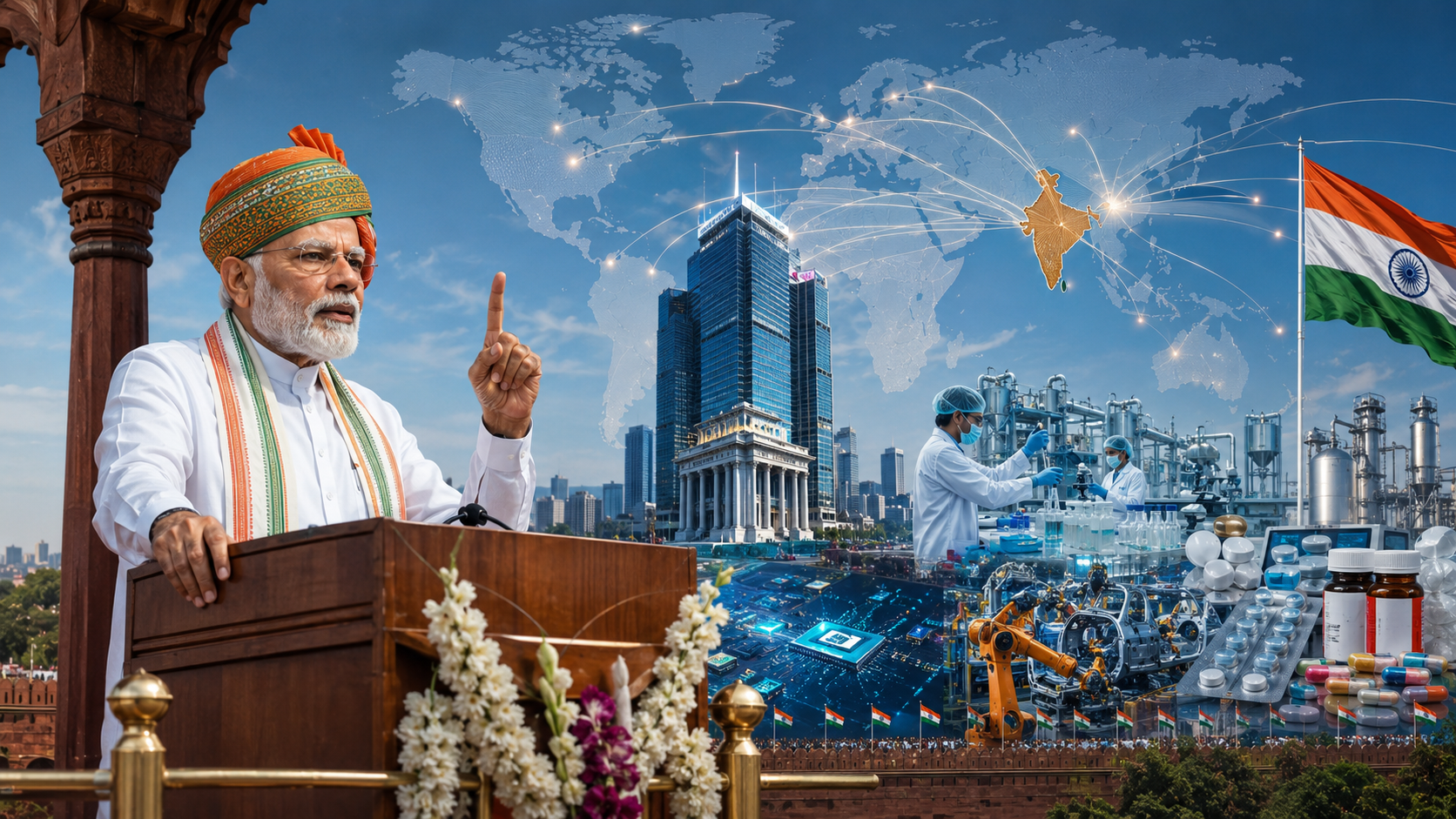
New Delhi, August 15: Prime Minister Narendra Modi on Saturday set ambitious global growth targets for Indian businesses, calling for at least one Indian bank to rank among the world’s top five and Indian pharmaceutical companies to become part of the global top five.
Addressing the nation from the Red Fort on Independence Day, Modi said India’s economic progress should increasingly translate into globally recognised companies across major sectors.
“The banking sector in India is flourishing; one Indian bank should be among the top five globally,” Modi said.
He also urged Indian pharmaceutical companies to compete for a position among the world’s five largest players, highlighting the need for Indian businesses to achieve greater scale and international competitiveness.
Target of 50 Indian Companies in Fortune 500
Modi’s banking and pharma targets form part of a wider ambition to increase India’s presence among the world’s largest corporations.
The Prime Minister set a target of having 50 Indian companies feature in the Fortune 500, reflecting the government’s broader focus on building globally competitive businesses.
He said the world has increasingly recognised India’s capabilities and pointed to the country’s free trade agreements with 40 countries as an indication of its expanding economic engagement.
The approach combines greater self-reliance with stronger participation in international markets, with Indian companies expected to compete on quality, scale and innovation.
Banking and Pharma in Focus
India’s banking sector has expanded significantly, but Modi said the next phase should focus on creating institutions capable of competing with the world’s largest banks.
The pharmaceutical industry has also been identified as a major area where Indian companies can strengthen their global position.
The targets are part of the Prime Minister’s broader “Shakti ki Sapt Dhara” framework, which identifies seven areas India needs to strengthen over the next five to seven years.
These include manufacturing, agriculture and food processing, technology and innovation, Gati-Shakti, defence, the green and blue economy, and India’s soft power.
Push for Global Competitiveness
Modi said India cannot simply shut its market to the world and instead needs to produce high-quality goods capable of competing internationally.
He extended the same ambition to India’s technology and digital capabilities, calling for digital public technologies developed in India to reach countries around the world.
The Prime Minister also said India should aim to take Made-in-India 6G technology globally.
He highlighted the expansion of India’s manufacturing capabilities over the past 12 years. According to figures cited in his address, electronic manufacturing has grown nearly sevenfold, mobile phone production has increased 33-fold and defence production has nearly quadrupled.
Five-to-Seven-Year Economic Challenge
The Prime Minister said India should achieve during the next five to seven years what could not be achieved over the previous five to seven decades.
The ambition goes beyond headline economic growth and focuses on creating Indian companies with significant global influence.
The targets for Fortune 500 representation, global banking and pharmaceuticals signal a push to transform India’s growing domestic economic strength into globally competitive corporate power.
For Indian businesses, the challenge will be to expand international operations, improve productivity, invest in innovation and build brands capable of competing with established global leaders.