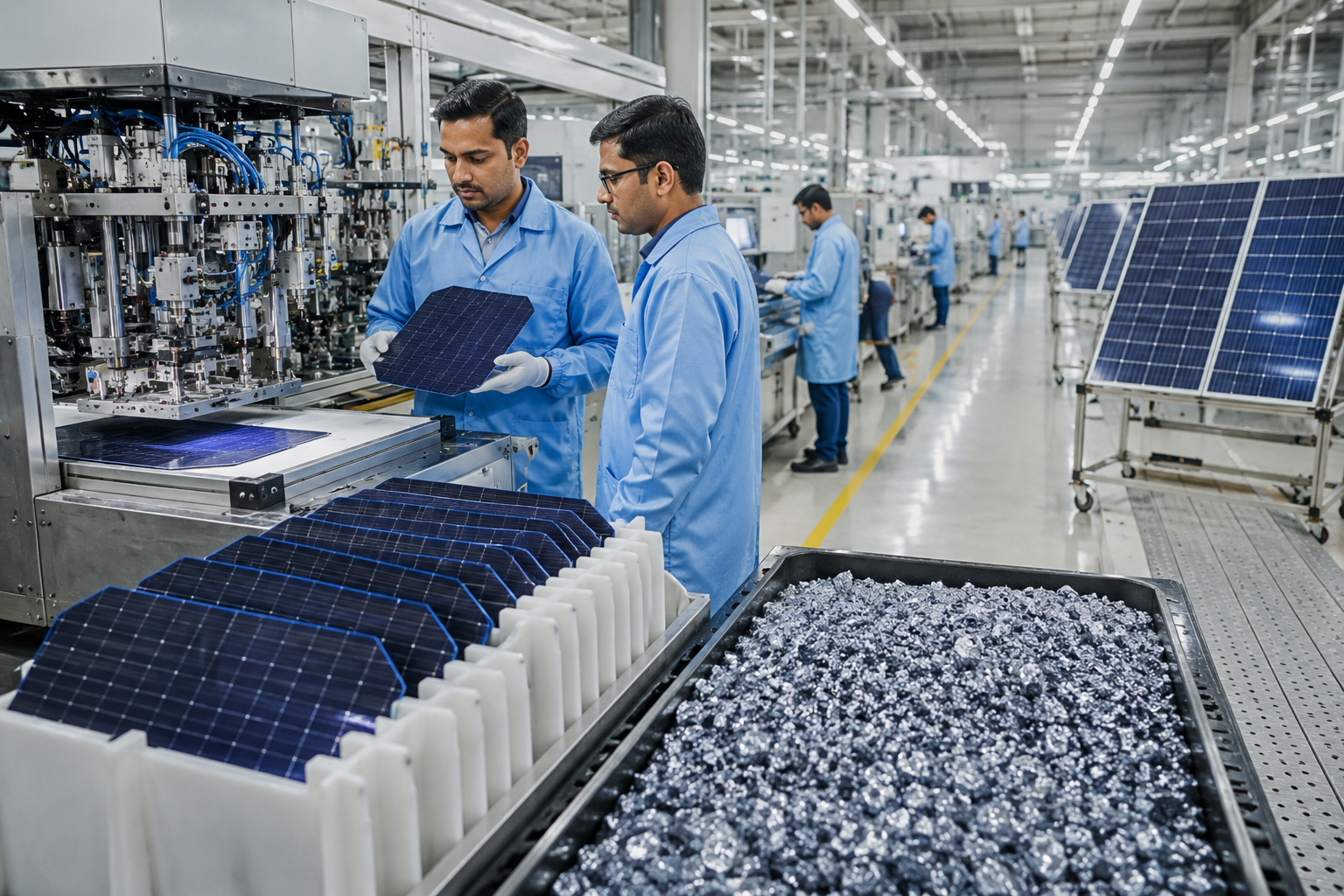
Domestic Solar Manufacturing Boost
Key Highlights
- Government plans incentives for domestic polysilicon production.
- Scheme aims to reduce dependence on Chinese imports.
- India targets 100 GW solar cell manufacturing capacity.
- Renewable energy capacity crosses 300 GW milestone.
- RTC renewable tariff discovered at ₹5.25 per unit.
The Ministry of New and Renewable Energy (MNRE) is preparing a new incentive scheme to promote polysilicon manufacturing in India. The initiative aims to strengthen the domestic solar manufacturing ecosystem and reduce reliance on imported raw materials, particularly from China, which currently dominates global polysilicon production.
Speaking at the 7th CII International Energy Conference & Exhibition, Renewable Energy Secretary Santosh Kumar Sarangi said the proposed support scheme will encourage manufacturers to expand into polysilicon production, an essential component used in solar cells and modules. The initiative is expected to deepen India’s renewable energy supply chain.
India has already emerged as the world’s second-largest solar module manufacturer, with over 213 GW of installed manufacturing capacity. The government expects solar cell manufacturing capacity to reach 100 GW within a year, while ingot and wafer manufacturing capacity is projected to touch 80 GW by June 2028.
Sarangi also highlighted India’s renewable energy achievements, noting that non-fossil fuel power capacity has crossed 300 GW, keeping the country on track to achieve its 500 GW renewable energy target by 2030. The government continues to expand investments in solar, wind and energy storage infrastructure.
The ministry also emphasized the growing competitiveness of renewable energy after SECI discovered a tariff of ₹5.25 per unit in its latest round-the-clock renewable energy auction. Officials believe integrated solar, wind and storage projects will lower power procurement costs while supporting India’s long-term clean energy goals.