Electric Two-Wheelers Break Annual Record
Key Highlights
- India’s E2W registrations reached 13,47,018 units in the first eight months of 2026.
- The figure has already surpassed the 13,42,327 units registered during full-year 2025.
- E2W registrations have more than doubled from 6.61 lakh units in 2022.
- TVS Motor leads the OEM chart with 3,53,637 registrations so far in 2026.
- Bajaj Auto recorded 3,02,181 units, while Ather Energy registered 2,27,184 units.
- Hero MotoCorp and Ola Electric recorded 1,46,097 and 93,025 units, respectively.
- Average monthly registrations have risen to around 1.68 lakh units, putting the industry on course for another annual record.
Updated News Article
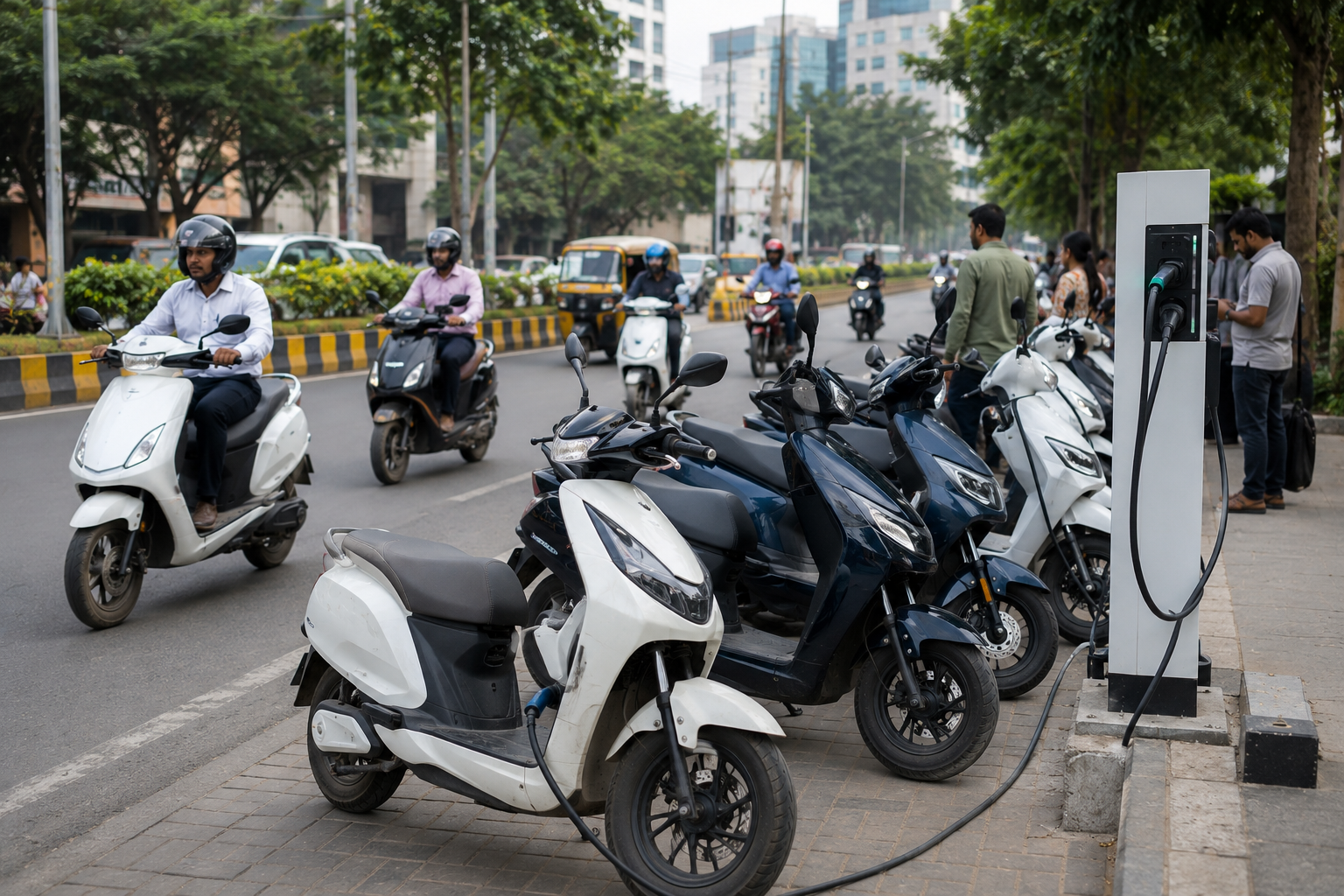
India’s electric two-wheeler market has achieved a significant milestone, with registrations in the first eight months of 2026 already surpassing the total number recorded during the entire calendar year 2025. The development highlights the accelerating shift towards electric mobility as consumers increasingly consider electric scooters and motorcycles as mainstream alternatives to petrol-powered vehicles.
According to Vahan registration data cited in the newspaper report, electric two-wheeler registrations between January and August 2026 reached approximately 13.47 lakh units. This is slightly higher than the 13.42 lakh units registered during the whole of 2025, meaning the industry has broken its previous annual record before the year has even entered its final four months.
The growth marks a dramatic expansion in India’s electric two-wheeler market over the past few years. E2W registrations stood at around 6.62 lakh units in 2022, before rising to approximately 9.01 lakh units in 2023 and 12.15 lakh units in 2024. The market crossed 13.42 lakh units in 2025, setting the stage for another strong year in 2026.
Monthly sales momentum remains strong
The pace of registrations has also strengthened considerably. The report notes that E2W registrations have averaged around 1,68,377 units per month so far in 2026, compared with roughly 1,11,861 units in 2025.
If this momentum continues through the remainder of the year, the industry could comfortably establish a new annual sales record. The upcoming festive season could provide another boost, as manufacturers and dealers typically see stronger consumer demand during this period.
Industry observers attribute the expansion to a combination of lower battery costs, improved vehicle technology, broader product availability and better financing options. As electric scooters become increasingly competitive with petrol models on upfront and running costs, more consumers are considering them for everyday urban transportation.
TVS Motor leads the OEM race
The OEM-wise registration data shows strong competition among India’s leading electric two-wheeler manufacturers.
TVS Motor emerged as the largest contributor among the manufacturers shown in the report, recording around 3,53,637 E2W registrations in 2026 up to August. Bajaj Auto followed with approximately 3,02,181 units, while Ather Energy recorded around 2,27,184 units.
Hero MotoCorp registered approximately 1,46,097 electric two-wheelers, while Ola Electric recorded around 93,025 units during the period.
The numbers indicate that competition in the electric two-wheeler market is broadening beyond a small group of early EV specialists. Traditional automobile manufacturers are expanding their electric portfolios and using their existing dealer networks, manufacturing capabilities and brand presence to compete in the segment.
Lower costs helping narrow petrol-EV gap
One of the important factors supporting electric two-wheeler adoption is the gradual reduction in battery costs. Battery packs remain one of the most expensive components of an electric vehicle, and lower costs can improve both vehicle affordability and manufacturers’ ability to offer competitive products.
The report also points to the expansion of product portfolios, service networks and financing options as factors improving consumer confidence. Manufacturers are increasingly offering electric scooters across multiple price points and use cases, making EVs accessible to a broader section of buyers.
The growing availability of charging infrastructure is another factor that could influence future demand. While charging availability remains uneven across cities, improvements in urban charging networks and greater familiarity with home charging are gradually reducing one of the traditional barriers to EV adoption.
Government policies add further support
State-level electric vehicle policies are also playing an important role in the market. Delhi’s recently approved EV policy, for example, provides incentives that can improve the affordability of electric vehicles. Similar policies across other states could influence adoption rates depending on the level and structure of incentives offered.
At the same time, manufacturers are stepping up investments in new models and technology. The growing competition is expected to encourage improvements in vehicle range, performance, connected features, battery technology and after-sales support.
The shift is also being supported by changing consumer preferences. For many urban commuters, electric scooters offer the advantage of lower operating costs compared with conventional petrol scooters, particularly for regular daily travel.
Festive season could push sales higher
With the industry already crossing its 2025 annual registration record, the final months of 2026 could prove particularly important. The festive season traditionally brings higher vehicle purchases, while manufacturers are expected to continue launching new models and promotional schemes.
If the current monthly run rate is sustained, E2W registrations could cross the 2-million-unit mark in 2026, creating another landmark for India’s electric mobility industry.
The latest registration data therefore suggests that electric two-wheelers are moving beyond the early-adopter phase. With established manufacturers increasing their presence, new products entering the market and consumers becoming more comfortable with EV technology, electric two-wheelers are increasingly becoming an important part of India’s broader automobile market.
The record achieved in just eight months could consequently prove to be more than a one-year sales milestone. It may signal a deeper structural shift in India’s two-wheeler market, with electric mobility gaining a larger role in the country’s future transportation landscape.