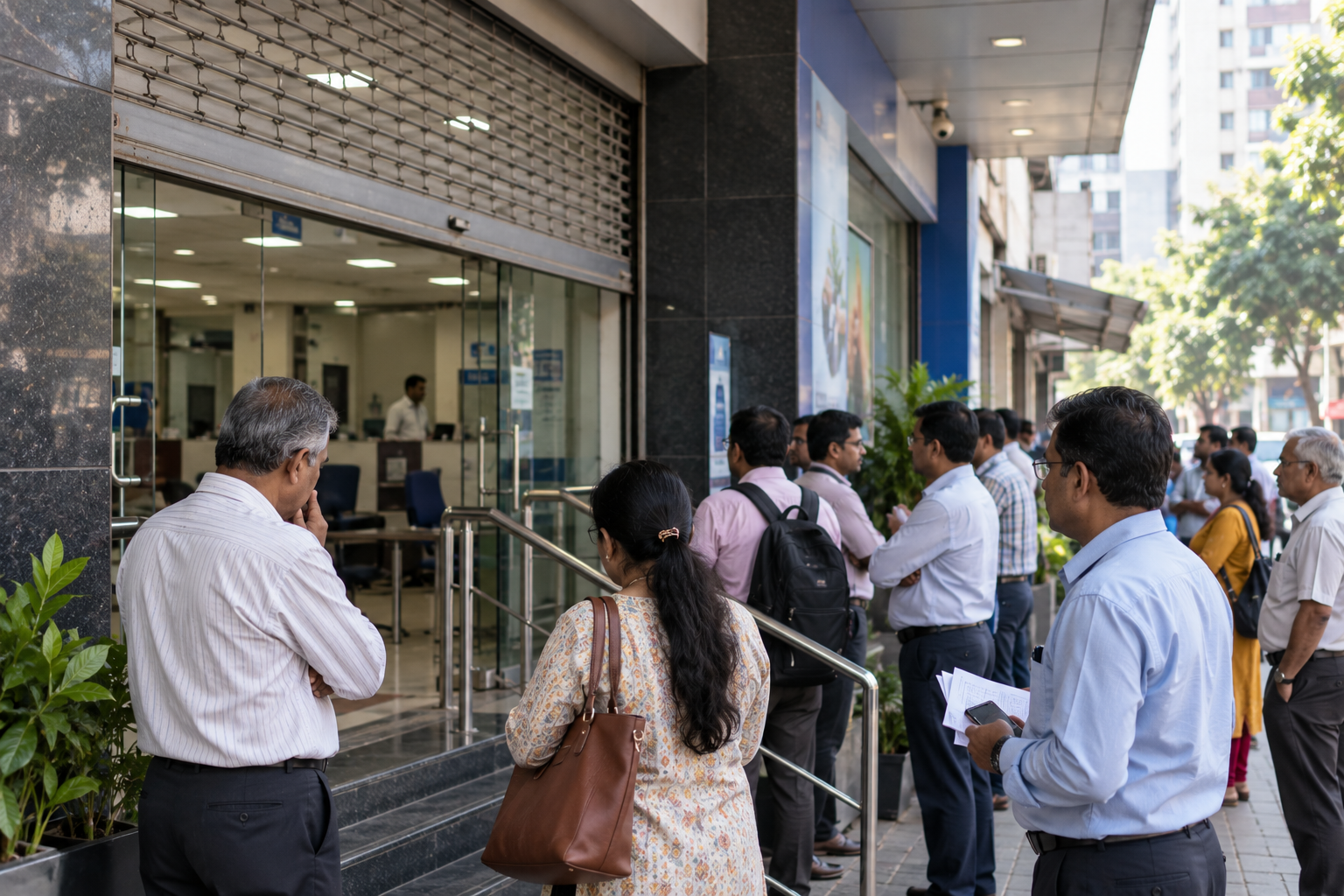
Public Sector Branches Face Disruptions
Banking services, particularly at public sector banks, were disrupted across India on Friday after the United Forum of Bank Unions called a nationwide strike over demands including the immediate implementation of a five-day workweek.
The UFBU, an umbrella organisation representing seven bank unions, called the strike after negotiations failed to produce an agreement on the unions’ outstanding demands.
The organisation represents around 90% of bank officers and employees, making the action significant for the country’s branch banking network.
Most branches of public sector banks were either completely or partially closed as employees and officers participated in the strike. Services including cash deposits, withdrawals, cheque clearing and administrative work were consequently affected at numerous branches.
Some old-generation private-sector banks were also affected, while private-sector banks generally continued normal operations.
Digital banking services, however, remained functional. Customers continued to have access to services such as UPI and internet banking, limiting the impact on customers who could shift routine transactions to digital channels.
Five-Day Week At Centre
The unions’ main demand is the declaration of all Saturdays as holidays, effectively creating a five-day banking week.
The demand follows an agreement reportedly reached during the 12th Bipartite Settlement between bank unions and the Indian Banks’ Association in March 2024. The implementation, however, continues to await government notification.
Under the existing arrangement, bank branches generally remain open on the first, third and fifth Saturdays of the month, while the second and fourth Saturdays are holidays.
Union representatives argue that bank employees continue to be treated differently despite the earlier agreement on a five-day working week.
All India Bank Employees Association General Secretary C H Venkatachalam said employees were dissatisfied because the government had not agreed to their demands.
Pension Issues Also Pending
The strike also reflects a wider set of unresolved employee demands.
These include updating and improving pension benefits, introducing a uniform dearness allowance formula for pensioners and providing employees covered under the National Pension System with an option to shift to the Old Pension Scheme.
The unions have maintained pressure on the government and banking authorities to address these issues alongside the five-day workweek demand.
Public sector banks had warned customers in advance about potential disruption. State Bank of India, for instance, advised customers that although arrangements had been made to maintain normal operations, branch and office work could be affected by the strike.
The nationwide action highlights the continuing tension between bank employee unions and authorities over working conditions and benefits.
At the same time, the availability of digital banking services has reduced the potential impact of branch closures compared with earlier periods when customers depended much more heavily on physical branches for routine transactions.
With UPI, internet banking and other digital services continuing to operate, customers were able to conduct many payments and banking activities despite disruptions at physical branches.
However, transactions requiring direct branch intervention, including certain cash and administrative services, faced delays.