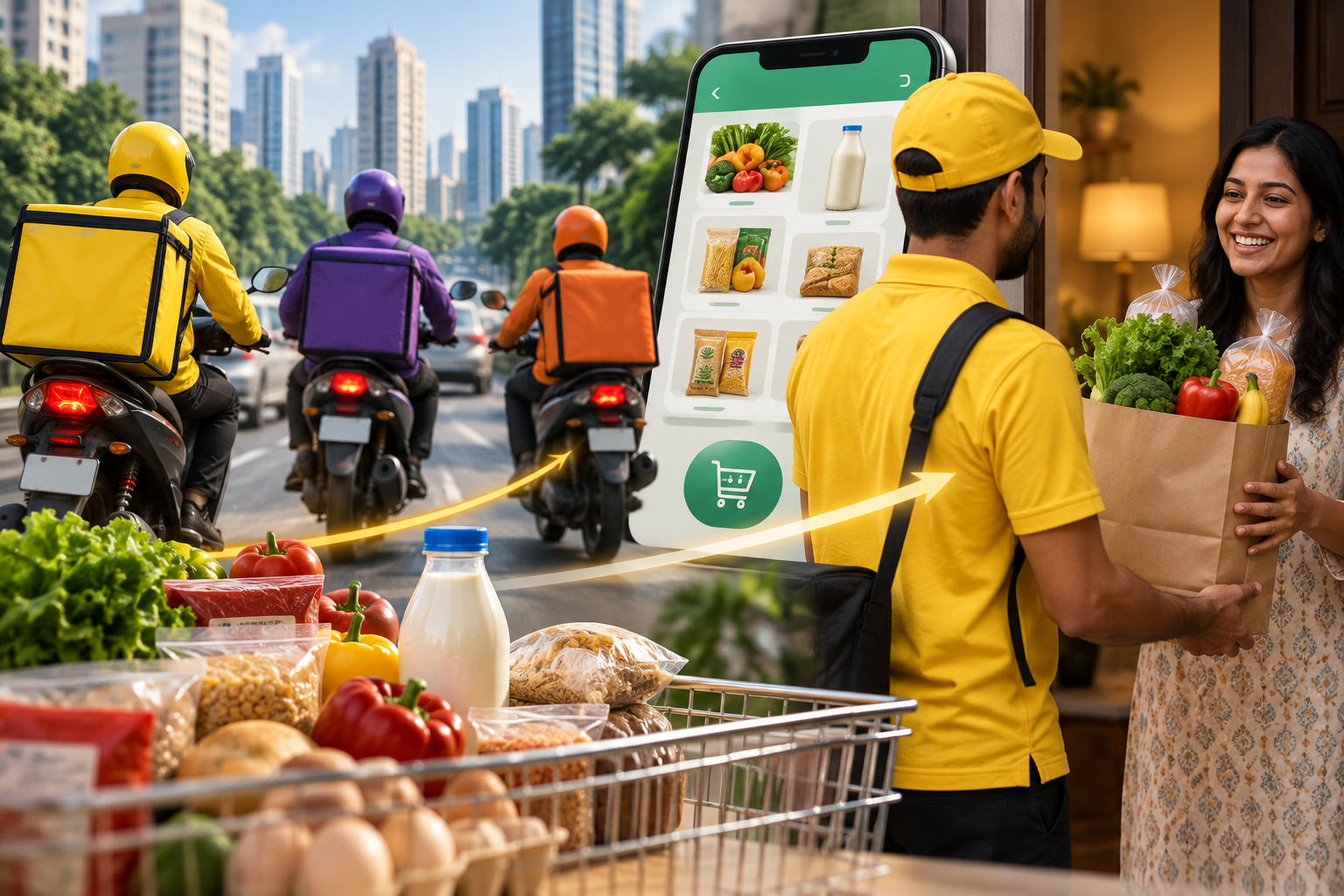
Instant delivery platforms such as Blinkit, Zepto and Swiggy Instamart have emerged as the dominant channel in India’s online grocery market, accounting for an estimated 70–75% of e-grocery orders.
Highlights
- Quick commerce accounts for around 70–75% of India’s e-grocery orders.
- The share has increased sharply compared with earlier years.
- Blinkit, Zepto and Swiggy Instamart are among the major platforms driving the shift.
- Faster deliveries and convenience are changing urban grocery shopping habits.
India’s online grocery market is increasingly being shaped by quick commerce, with instant delivery platforms now estimated to account for 70–75% of the country’s e-grocery orders, according to a report by Storyboard18.
Platforms such as Blinkit, Zepto and Swiggy Instamart have changed how consumers purchase groceries and everyday essentials online. What began primarily as a convenience-led service for urgent purchases has evolved into an important distribution and sales channel for consumer brands.
The rapid growth of quick commerce has come as consumers, particularly in major urban markets, increasingly seek shorter delivery times and easy access to products ranging from packaged foods and beverages to personal care and household essentials.
The 70–75% share represents a sharp increase from earlier years and highlights how quickly consumer preferences have shifted within the online grocery segment. Traditional scheduled e-grocery delivery is now facing a market where speed and convenience have become major competitive factors.
FMCG Companies Gain a New Growth Channel
The expansion of quick commerce is also having a significant impact on fast-moving consumer goods (FMCG) companies. For many brands, these platforms are emerging as an increasingly important route to reach consumers and generate incremental sales.
Quick-commerce apps can provide brands with greater digital visibility while making products immediately available to consumers. The model is particularly relevant for frequently purchased categories, where customers may value rapid delivery rather than planning purchases several days in advance.
The growth of the channel is also encouraging FMCG companies to rethink product assortment, inventory management and digital marketing strategies specifically for instant-delivery platforms.
At the same time, competition among quick-commerce companies remains intense as platforms expand their dark-store networks, product selections and delivery coverage.
The increasing dominance of instant delivery suggests that quick commerce is moving beyond being an alternative shopping option and becoming a core part of India’s digital retail ecosystem.
For FMCG companies, its rapid expansion could make quick commerce an increasingly important component of their distribution strategy as India’s online grocery market continues to grow.