Highlights:
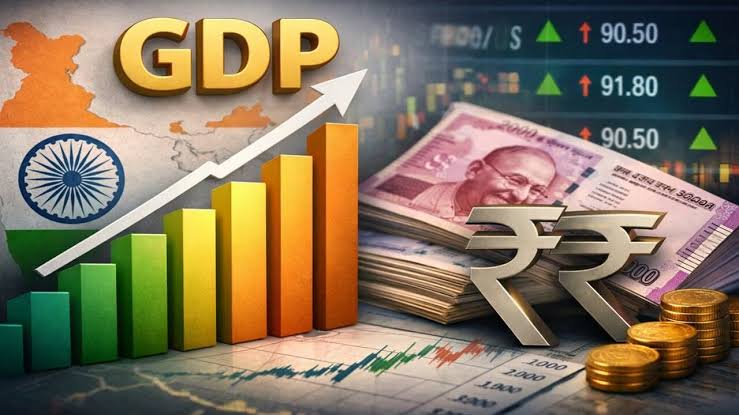
• India’s GDP grew 7.7% in FY26, higher than FY25’s 7.1%.
• March quarter GDP growth stood at 7.8%.
• Real GDP reached Rs 323.12 lakh crore.
• Real GVA expanded 7.9% during FY26.
• Growth was supported by services, manufacturing, and construction sectors.
New Delhi, June 5: India’s economy expanded by a stronger-than-expected 7.7% during the financial year 2025-26, according to provisional estimates released by the Ministry of Statistics and Programme Implementation (MoSPI), highlighting the resilience of domestic demand and sustained momentum across key sectors.
The latest data marks an improvement over the 7.1% growth recorded in FY25 and exceeds earlier government projections. The upward revision reflects the incorporation of actual economic data for all four quarters of the fiscal year, replacing earlier estimates that relied on information available only through December 2025.
Real Gross Domestic Product (GDP), measured at constant 2022-23 prices, rose to Rs 323.12 lakh crore in FY26 from Rs 299.89 lakh crore in the previous year. Nominal GDP, which factors in inflation, increased by 8.9% to Rs 346.36 lakh crore.
The economy also maintained strong momentum in the final quarter of the fiscal year. Real GDP grew 7.8% in the January-March period, up from Rs 81.40 lakh crore to Rs 87.77 lakh crore. Nominal GDP during the quarter climbed 9.1% to Rs 94.65 lakh crore.
Gross Value Added (GVA), a key measure of economic output excluding taxes and subsidies, expanded 7.9% in real terms during FY26, compared with 7.3% growth in the previous year. At current prices, nominal GVA increased 9.1% to Rs 314.87 lakh crore.
The broad-based expansion was supported by continued strength in the services sector, alongside healthy contributions from manufacturing, construction, and other industrial activities. Economic indicators such as GST collections, industrial production, corporate earnings, vehicle sales, freight traffic, telecom activity, banking transactions, and trade data pointed to sustained economic momentum throughout the year.
The FY26 estimates are based on India’s revised GDP series, which uses 2022-23 as the new base year. According to MoSPI, the updated methodology incorporates revised data from multiple sectors and provides a more comprehensive picture of economic performance.
The stronger growth figures reinforce India’s position among the fastest-growing major economies globally. Policymakers and investors will now closely watch the first-quarter FY27 GDP data, scheduled for release on August 31, 2026, for indications of whether the growth momentum can be sustained amid evolving global economic conditions.
Impact:
• Economic Growth: India remains among the world’s fastest-growing major economies.
• Investment Climate: Strong GDP growth may boost investor confidence and capital inflows.
• Employment: Expansion in manufacturing and services could support job creation.
• Fiscal Position: Higher economic activity may strengthen government tax revenues.
• Policy Outlook: Strong growth gives policymakers greater flexibility in managing inflation and interest rates.