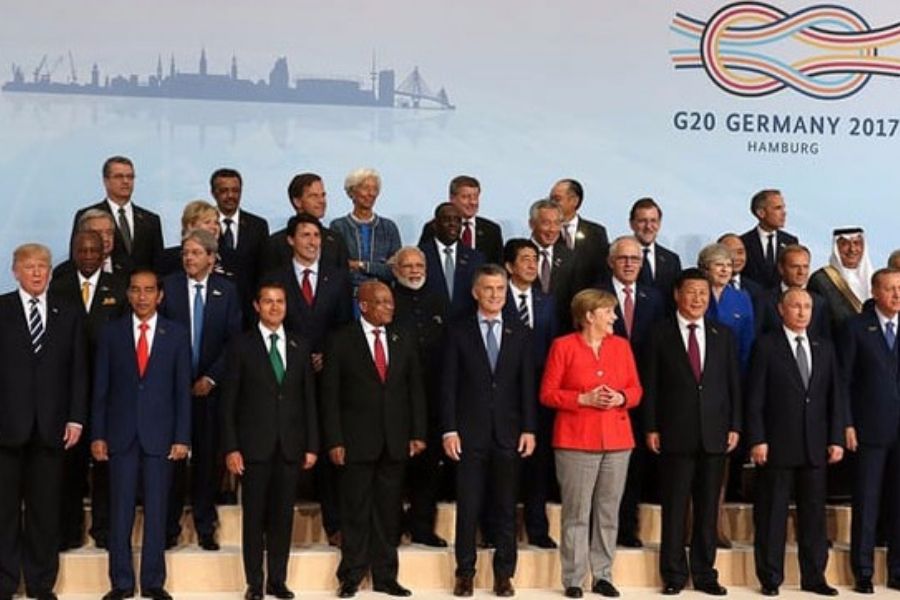
A revived thrust on climate conundrum along with a dominant strategy for agriculture should top the priority list of all the concerned countries in the G-20 meeting at Hamburg, Germany. Image Credit: WHO Twelfth G-20 Summit will be held on 7th and 8th July, 2017 in Hamburg, Germany. It’s a premier forum for economic cooperation and to discuss the challenges faced by its member countries. There are many pressing issues which the member countries including India would want to address at the Summit. But it is important to prioritize the issues. Agriculture is one such issue which cannot wait. India’s agricultural economy is in a deep crisis, if not addressed urgently can have dire environmental, societal and economic implications. State of Indian agriculture Food Sustainability Index (FSI), which ranks 25 countries according to the sustainability of their food systems, is a quantitative and qualitative measure. It measures the sustainability across three pillars- food loss and waste, sustainable agriculture and nutritional challenges. India was ranked 25th in 2016 with a score of 43.17 (out of 100). The most notable defects faced by India’s food system are- unsustainable use of groundwater, low quality agricultural subsidies and poor nutritional status. India is the biggest consumer of groundwater in the world. Agriculture has started to threaten the water supplies. Though the record of water irrigation is not very impressive and there has been a decline in surface irrigation, the increasing use of tube well irrigation has led to depletion of ground water. Groundwater Development Index, which measures ratio of groundwater consumed to groundwater recharged is just 60% in India. It was claimed that the use of Genetically Modified (GM) varieties can help India overcome the agricultural crisis. In reality, it has worsened the agricultural scenario. Use of GM varieties has eventually led to an increase in the use of pesticides, herbicides and insecticides which has in turn polluted the already depleting groundwater and soil. As per the Agreement on Agriculture (AOA), all the countries especially the developed ones need to limit the extent of support given to agriculture by reducing their subsidies (which can distort trade and production). To think that developed countries are not giving subsidies to their farmers is a myth. Their current stance can be termed as box shifting, that is, subsidies have moved from being direct to indirect. These subsidies do have trade distorting effects and hit the poor farmers in our country. Food security is one of the most severe challenges faced by us today. Deep linkages of agriculture and environment The correlation between agriculture and environment is robust. The resources of the country are under great strain due to the negative environmental impact of agriculture. India also received the lowest scores under FSI for overall greenhouse gas emission with sources including machinery, fertilizers, pesticides, soil erosion etc. India contributed 6.3% of global C02 in 2015 and its carbon emission from burning fossil fuel increased by 5.2 % in the same year. Paris Climate Agreement, which aims at cooperating towards the common aim of developing climate friendly, efficient and sustainable solution for expanding energy needs and other areas of sustainable development, is a crucial agreement for India in many ways. In order to revive agriculture and make it sustainable, it is essential to adopt agricultural practices that curb climate change; and agriculture has a huge unrealized potential to mitigate climate change. To realize that potential and increase the resilience of this sector, India needs to push for the agreement at the Summit. India is not the only country trying to solve this complex puzzle of dealing with agricultural and environmental issues. Least developed countries (LDCs) and developing countries like Argentina, China, Brazil, Indonesia and most of the African countries are in the same fix. A revived thrust on climate conundrum along with a dominant strategy for agriculture should top the priority list of all the concerned countries in Hamburg. A united effort at negotiations is the need of the hour.

India’s Outlook on the Pursuit of E-commerce.
A formal negotiation on-e-commerce implies talks on homogeneity of ‘Market Access’ which is certainly a risky territory for India’s domestic policies. Removal of physical barriers in trade and integration of markets are two prime advantages of e-commerce, but there is no reason to believe that these can be achieved only in a multilateral course. Image Credit: Pexels E-commerce has been a focal area for WTO this year, as was witnessed during WTO Director General Roberto Azevêdo’s visit to India in February, 2017. Also, many developed countries are wanting to take up this issue in the WTO’s eleventh ministerial meeting in Buenos Aires, Argentina in December 2017. In addition, the Aid-for-Trade initiative which was launched at the 2005 Hong Kong WTO Ministerial Conference, and aims to support developing countries’ access to markets is also pursuing the matter.Its sixth global review is to be held at the WTO, Geneva from July 11 to 13, 2017, and as is evident from the theme “Promoting Connectivity”, focus is on digital connectivity, in the form of e-commerce and digital trade. The intent behind this aspiration is “market access”. Developing countries like India which have strong domestic demand and segmented domestic retail brands, are perfect destinations for e-commerce giants to reap economic gains. Why are developing nations wary of this agenda? In 2016, India ranked 90 (out of 137 nations) on the UNCTAD B2C E-commerce Index which measures the readiness of countries to engage in online commerce. Most African countries rank even lower. This low ranking points towards a need to integrate the user base within, before making the issue multilateral. With the persistent problem of disparity in user base, any negotiation on e-commerce can be detrimental from the welfare perspective. “Digital Divide” in developing economies is being cited as the primary reason for not pursuing the agenda of e-commerce at current juncture in WTO negotiations. A formal negotiation implies talks on homogeneity of ‘Market Access’ which is certainly a risky territory for India’s domestic policies. Small retailers, who are incapacitated in competing with multinational retail chains have resisted the e-commerce drive since its inception. And a multilateral agreement with standardized policies is likely to further limit the scope of domestic policies in curbing any suppression by big retail chains. It is being believed that bringing the e-commerce agenda to the table is like kicking away the ladder for developing nations, to use Ha- Joon Chang’s words, because they are not prepared for a multilateral policy on this aspect. The Positive side It is often argued that market access will improve for domestic retailers and micro & small enterprises also, with such internationalization. Removal of physical barriers in trade and integration of markets are two prime advantages of e-commerce, but there is no reason to believe that these can be achieved only in a multilateral course. Keeping the trade-off in mind, it is for the best of interest of India to keep this a matter of domestic policy. Any discussion around this agenda must consider if developing world ready to take the leap and jump into e-commerce with no domestic player to compete. Also, one needs to understand if the e-commerce agenda really meets the development goals convened by the WTO. Trade expansion with skewed benefits or following fundamental development goals- the choice of developing countries seems obvious.