COVID-19 has left an indelible mark on all sectors of the global economy, with travel and tourism industry being no exception. Languished by this insipid experience, & ensuing travel and entry restrictions at international borders, the travel and tourism industry is said to see 50 million jobs losses worldwide. It would also severely undermine the revenues of a significant number of developing countries across the world. To counter the COVID-19 impact, countries are exploring possible course corrections like promoting local travel, drawing bilateral travel bubbles and touchless travel.

COVID-19 has proved to be grim, or rather in some cases catastrophic, for the international travel and tourism industry. An unsettling fear about the loss of lives has not only left travellers jittery, but has also sent governments across the globe into a tizzy. This reduction in international travel is likely to have domino effects for other allied sectors due to its linkages to industries like aviation, hospitality, food & beverage.
The World Travel and Tourism Council predicts that the pandemic could cut 50 million jobs worldwide in the travel and tourism industry: around 30 million jobs in Asia, 7 million in Europe, 5 million in the Americas and the rest in other continents. This is a significant cause of concern since it could have devastating economic consequences for a significant number of developing countries across the world, as per some UNCTAD estimates. Economies like Maldives (39.6% of GDP), British Virgin Islands (35.4% of GDP), Macau (29.3% of GDP), Aruba (28.1% of GDP), Seychelles (26.4% of GDP) and Curacao (23.4% of GDP) are heavily dependent on tourism.
Sizing up the impact
The virulence and the severity of the spread of the virus is so acute that it has created havoc and an unprecedented economic bearing on tourist arrivals. Lockdowns, quarantines and border restrictions have caused a major jolt to this sector leading to a universal contraction in tourist arrivals.
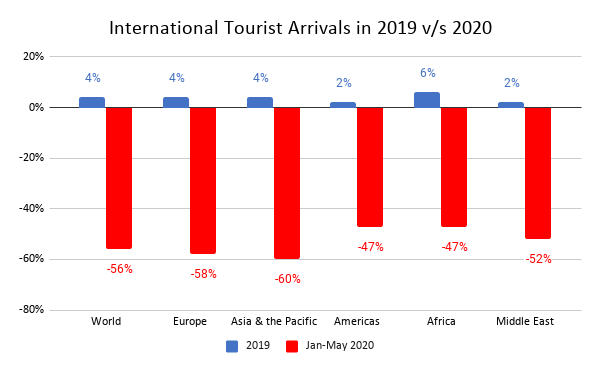
Findings from the World Tourism Barometer (July 2020 update) by the United Nations World Tourism Organization (UNWTO) state that there was a 56% year-on-year dip in international tourist arrivals in the first five months of 2020. In fact, in May 2020, international arrivals declined by 98%, indicating travel restrictions were in place in almost all parts of the world.
Source: UNWTO
To put this into numbers, it represents 300 million lesser international tourist arrivals & a loss of US$ 320 billion international tourism receipts in the first five months of 2020 as compared to the same period last year. The barometer notes that Asia Pacific region has been one of the most affected regions in terms of drop in international tourist arrivals. Deemed as the first region to come under the clutches of the deleterious pandemic, it saw a 60% dip in arrivals by 60% during the 5 months under study. This was followed by Europe (58%), the next major global epicenter for the virus; Middle East (-51%), the Americas & Africa (47% for both).
The ripple effects
Some UNCTAD estimates suggest that the world’s tourism sector could lose at least US$ 1.2 trillion, or 1.5% of the global GDP owing to the coronavirus pandemic. These losses could escalate to US$ 2.2 trillion or 2.8% of the world’s GDP if the break in international tourism lasts for upto eight months. Further, in the most pessimistic scenario, a 12-month break in international tourism is to cost the sector dearly at US$ 3.3 trillion or 4.2% of global GDP.
Source: UNCTAD
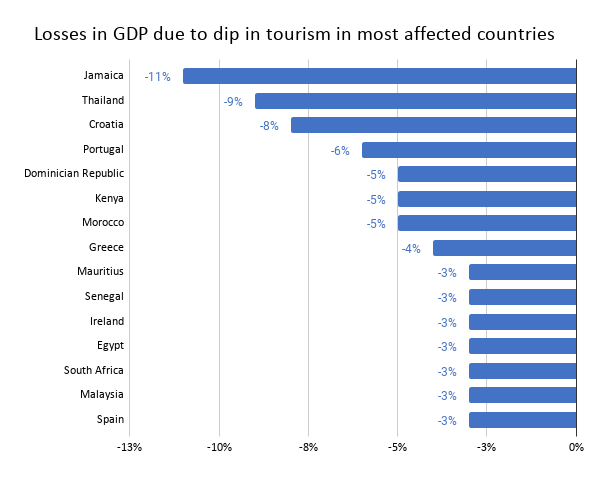
It attempts to map the GDP losses of some of the worst affected nations in this regard. In terms of percentage changes in GDP, Jamaica (where the tourism industry accounts for 20% of GDP) stands out with a loss of 11% in GDP in the moderate scenario. Thailand, followed by popular tourist destinations Croatia, Portugal and Dominican Republic which record losses of 9%, 8%, 6% and 5% respectively. In absolute terms, the world’s largest trading economies, USA (US$ 187 billion) and China (US$ 104 billion) face the largest declines in GDP. Other significantly affected nations include Thailand, France and Germany (approximately US$47 billion each).
| Sectoral Output Impact for most affected countries under the Moderate scenario (in % changes) | |||||||
| Country | Recreation & other services | Accommodation & food services | Dwellings | Trade | Construction | Air Transport | Communications |
| Jamaica | -28 | -31 | -10 | -6 | -11 | 0 | 1 |
| Thailand | -55 | -55 | -9 | -3 | -7 | -7 | -4 |
| Croatia | -55 | -55 | -5 | -3 | -5 | -8 | -1 |
| Portugal | -55 | -21 | -5 | -2 | -3 | -17 | -2 |
| Dominician Republic | -32 | -26 | -5 | -3 | -2 | -4 | -3 |
| Kenya | -19 | -55 | -4 | 0 | -1 | 1 | 0 |
| Morocco | -55 | -55 | -5 | -2 | -2 | -2 | -2 |
| Greece | -33 | -19 | -3 | -2 | -1 | 4 | -1 |
| Mauritius | -55 | -55 | -3 | -27 | -4 | -4 | -4 |
| Senegal | -12 | -13 | -4 | 0 | -4 | 3 | -1 |
| Ireland | -29 | -20 | -3 | -1 | -3 | 0 | -2 |
| Egypt | -18 | -23 | -3 | -2 | 0 | 1 | -2 |
| South Africa | -6 | -22 | -3 | -1 | -4 | 2 | -1 |
| Malaysia | -55 | -19 | -3 | 0 | -2 | 0 | -1 |
| Spain | -14 | -11 | -1 | -1 | -1 | 1 | -1 |
Source: UNCTAD
This is followed by an account of the sectoral impacts of the COVID-19 pandemic in the 15 most affected countries in percentage terms in a moderate scenario. A dip in tourist arrivals has a negative impact on the suppliers to hotels, food and recreational activities. The table highlights that the more connected the sector is, the stronger the impact of a negative shock in the tourism industry, with most losses ranging between -1% and -60%.
The UN’s trade and development body warns that indirect losses due intersectoral linkages in the tourism industry produce a multiplier effect throughout the economy. Thus, for every US$ 1 million lost in international tourism revenue, a country’s national income could drop by up to US$ 3 million. This is a particularly disturbing fact since in 42 out of 47 Least Developed Countries, tourism is considered a key sector comprising 9.5% of their GDP on average. Therefore, the virus can significantly jeopardize the prospects of their development. Further, it can also cause a dent in some more developed economies, which thrive on tourism. For a few larger high- or middle-income countries such as Croatia, Greece and Thailand, inbound tourism accounts for 8-18% of their GDP.
The Indian context
The Travel and Tourism Competitiveness Report (2019) ranked India as the 34th most attractive tourist destination in the world out of 140 economies. This is a significant improvement from the 40th rank that it secured in the preceding year. The sector has played a major role and acted as a strong pillar of the country’s growth. It provided 87.5 million jobs and accounted for 12.75% of the total jobs created in the country in 2019. According to industry estimates, India’s travel and tourism industry is growing at a rate higher than the global travel and tourism industry (3.5%) and contributed USD 194 billion to the Indian economy in 2019 which helped it gain 10th spot globally.
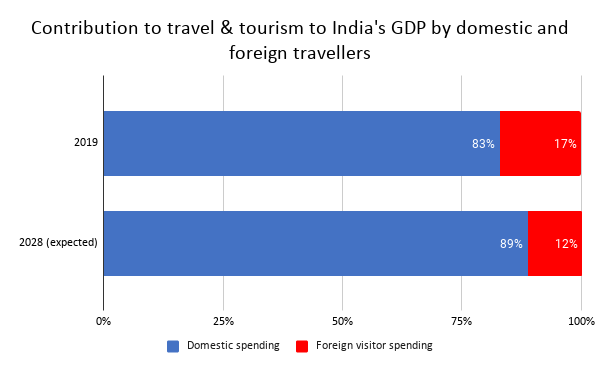
According to a report by Grant Thorton & FICCI, domestic travellers drove the travel and tourism sector in India in 2019; domestic spend in the sector stood at 83%. This share is expected to reach 89% by 2028, on account of an increase in disposable incomes and more leisure time at hand.
Source: Grant Thorton & FICCI
However, just like the rest of the world, COVID-19 has taken a toll on India’s travel and tourism industry too. According to a study by CARE Ratings, a fallout of the shutdown of hotels and suspension of flights and trains after the onset of the pandemic will lead to a revenue loss of INR 1.25 trillion (US$ 17.53 billion) in 2020. It also notes that during April-June 2020, the tourism industry is expected to see a revenue loss of INR 69.4 billion (US$ 973.46 million), denoting a year-on-year loss of 30%.
Towards a brighter future
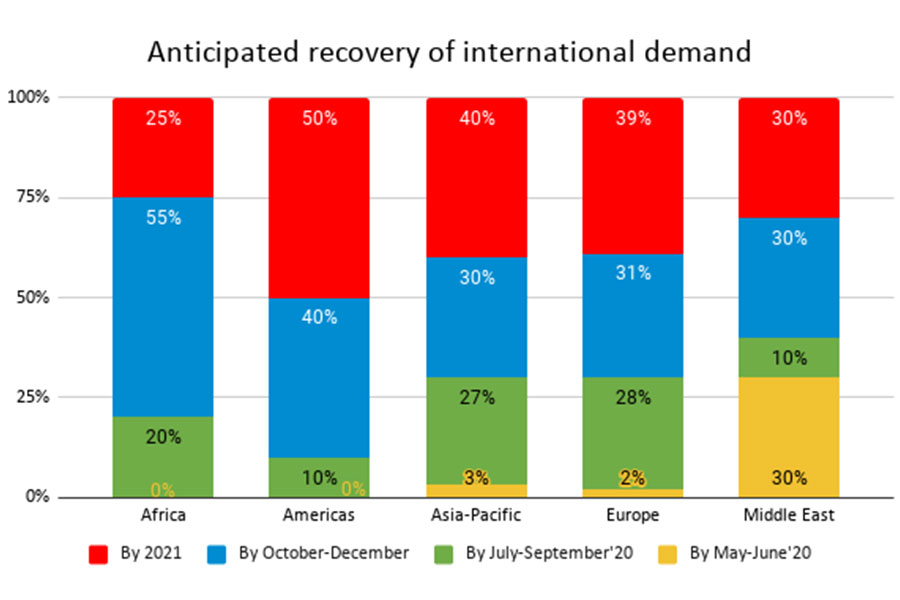
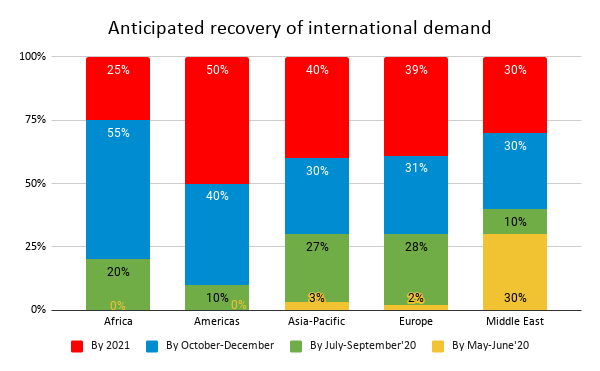
The next question which arises is that when is this industry likely to revive. There are eclectic estimates for different regions. The scenario presented by the UNWTO reflects very gradual paces of normalization in which monthly declines in arrivals start to. Asia and the Pacific, Europe & the Middle East see a change in this trend earlier.
Source: UNWTO
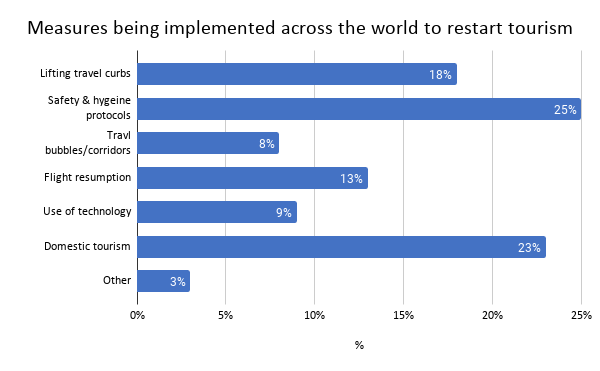
Findings from UNWTO indicate that as on 15th June 2020, around 48 destinations across the world had started easing travel curbs. Regions across the world have started showing encouraging signs. For example, the Carribean registered 4 consecutive weeks of positive net bookings while in the week of 13th July, the EU recorded more bookings than cancellations from Europe, Africa & the Middle East.
Research shows that as travel curbs are eased, restoring the confidence of consumers will be the key to the sector’s recovery. Strict enforcement of safety & hygiene protocols such as mandating thermal screenings & wearing of PPEs for all those who board a flight or enter an airport, can be some important ways to do this.
Source: UNWTO
Another move to establish confidence among travellers is offering COVID-19 travel insurance. Portugal’s national tourism authority Turismo de Portugal, for example, has introduced a travel insurance scheme for foreign tourists that covers COVID-19 related claims. Benefits include among others, medical, surgical, pharmaceutical and hospital expenses associated with COVID-19. It also encompasses cancellation, interruption or extension expenses due to the pandemic. Apart from this, the country has also adopted some other measures to instill confidence in travellers such as the renewal of the Portugal Health Passport, which now includes tests for COVID -19 available to all who visit the country.
Buoyed by the low revenue figures, regions like the Baltic States (Latvia, Lithuania and Estonia) are creating a “travel bubble”, allowing citizens to travel freely between them to lure tourists. Similarly, on May 5, the leaders of Australia and New Zealand, Prime Ministers Scott Morrison and Jacinda Ardern respectively, announced their commitment to introducing a trans-Tasman COVID-safe travel zone. This zone will be mutually beneficial and help their trade and economic recovery by kick-starting the tourism and transport sectors.
Meanwhile, since experts expect domestic tourism to recover faster, countries can also explore the idea of boosting internal travel. For instance, Japan has launched the ‘Go To’ campaign to spur domestic tourism, which bears a part of travelling expenditure. Similarly, Greece has decided to grant EUR 30 million to subsidize holidays for citizens through its ‘Tourism for All’ Initiative; while Italy has designed a holiday bonus for its citizens. Romania & Serbia have created tourist passes & vouchers for the same purpose.
Lastly, this crisis could prove to be the perfect opportunity to help the tourism sector evolve and to embrace the concept of touchless travel. The World Economic Forum states that such an endeavour will be supported by digital tools such as the ‘Known Traveller Digital Identity’ initiative. Contactless fingerprint, as well as iris and face recognition will emerge as solutions for identity verification, and their use will become more widespread as physical fingerprint and hand scanners are phased out. Digital health passports will be one example of this. Apple and Google are already close to finalizing a contact-tracing software scheme for developers to help automate the process of health scans & screenings.