India’s EV transition gains scale, but true acceleration is yet to come

India’s electric vehicle (EV) ecosystem is entering a defining phase—one marked not just by rapid growth, but by increasing structural depth. In FY26, EV retail sales crossed 24.5 lakh units, reflecting a robust 24.6% year-on-year rise. More importantly, this growth is no longer concentrated in a single category; it is broad-based across two-wheelers, passenger vehicles, three-wheelers, and commercial vehicles. This signals a shift from early-stage adoption to a more stable, demand-led expansion, underpinned by improving consumer confidence, expanding product offerings, and policy support.

However, India’s EV story is equally defined by its untapped potential. Despite strong momentum, EVs still account for a relatively small share of total vehicle sales, highlighting significant headroom for growth. As global electrification accelerates, India stands at a unique intersection—emerging as both a high-growth market and an underpenetrated one, setting the stage for its next phase of transformation.
Electric Vehicles_TPCI

India’s electric vehicle journey is entering a new phase—one where growth is no longer episodic but increasingly systemic. In FY26, EV retail sales crossed 24.5 lakh units, marking a strong 24.6% year-on-year increase, according to the Federation of Automobile Dealers Associations (FADA). What stands out is not just the scale, but the consistency—every major segment has expanded, signalling that electric mobility is moving beyond early adoption into a more stable, demand-driven trajectory. In absolute terms, India is now adding more EVs annually than it did in the first several years of its transition combined.

Yet, beneath these headline numbers lies a more nuanced shift. India’s EV adoption is accelerating at a time when the global market is also expanding rapidly, with over 18 million EVs sold worldwide in 2024. Against this backdrop, India’s share in global EV stock has steadily increased, even as its domestic penetration remains in single digits. This creates an interesting duality—India is both a fast-growing EV market and an underpenetrated one. It is precisely this combination of scale potential and structural headroom that is shaping the next phase of the country’s electric mobility transition.

How the numbers add up

Electric two-wheelers continued to dominate the EV landscape, crossing the 14 lakh mark during the fiscal. Sales in this segment rose 21.81% to 14,01,818 units in FY26, compared to 11,50,790 units in FY25. TVS Motor Company led the segment with 3,41,513 units, followed by Bajaj Auto with 2,89,349 units and Ather Energy with 2,39,178 units.

The electric passenger vehicle (PV) segment posted the sharpest growth among high-volume categories, surging 83.63% year-on-year. Retail sales reached 199,923 units in FY ’26, narrowly missing the 2 lakh milestone, compared to 108,873 units in the previous fiscal. Tata Motors Passenger Vehicles emerged as the segment leader with sales of 78,811 units, followed by JSW MG Motor India at 53,089 units and Mahindra & Mahindra Ltd at 42,721 units.

Electric three-wheelers also maintained a steady growth trajectory, registering an 18.97% increase to 830,819 units in FY26, up from 698,914 units in FY25. Meanwhile, electric commercial vehicles recorded the fastest growth, albeit on a smaller base, with sales jumping by 120.57% to 19,454 units from 8,820 units a year earlier.

FADA described FY ’26 as a watershed year for India’s EV ecosystem, highlighting the sector’s growing depth and diversity—from last-mile mobility solutions such as auto-rickshaws to personal passenger cars. The consistent growth across all segments underscores the strong structural momentum driving India’s transition towards sustainable and mass-market electric mobility.

India’s EV transition

India has embarked on an aggressive transition towards electric mobility with multiple strategic objectives. These include reducing dependence on imported fuels, increasing the share of renewable energy by utilising the storage capacity of EV batteries, and lowering greenhouse gas (GHG) emissions. The shift also aims to improve air quality and enhance the Plant Load Factor (PLF) of electricity generation systems. Additionally, India seeks to position itself as a leading player in the rapidly expanding global electric mobility market.

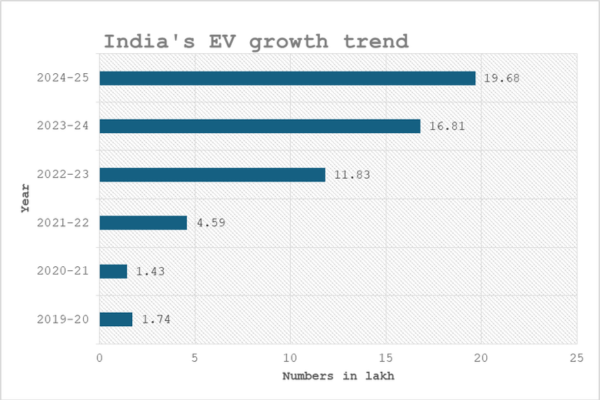
Although India’s electric mobility transition began at a relatively slow pace, it is now gaining steady momentum as the country works toward achieving a 30% share of EVs in total vehicle sales by 2030.
India's EV growth trend_TPCI

Source : Vahan Portal

According to the NITI Aayog report titled ‘Unlocking a $200 Billion Opportunity: Electric Vehicles in India 2025’, the electric vehicle (EV) sales in India grew from 50,000 units in 2016 to 2.1 million in 2024, bringing the country’s total EV stock to 5.45 million. This accounted for roughly 9% of the global EV stock, while India’s 2024 EV sales represented about 11% of global EV sales. Over the same period, global EV sales surged from 918,000 units in 2016 to 18.8 million in 2024, driving a rapid increase in the total global EV stock to approximately 61.21 million vehicles.

India’s EV penetration, which was about one-fifth of the global level in 2020, has improved to over two-fifths by 2024. Even with steady progress, adoption continues to advance at a measured pace despite strengthening growth momentum.

Key challenges in EV adoption

As per the NITI Aayog report, electric vehicle adoption in India is steadily increasing, though it lags behind leading markets like the US, EU, and China. The country has seen significant growth in electric two-wheelers and three-wheelers, while progress in electric buses has been moderate. Adoption of electric cars remains slow, and long-haul electric trucks have yet to take off.

The report highlights the following as the major challenges constraining progress.

  • Financing constraints, particularly for high-cost segments such as electric buses and trucks.
  • Insufficient charging infrastructure, along with underutilisation of available public charging stations.
  • Limited awareness of EV performance among public and private stakeholders.
  • Limited data availability and regulatory gaps constrain evidence-based decision-making.

Policy measures and way forward

Electric vehicles accounted for only about 7.6% of total vehicle sales in India in 2024, significantly below the 30% target for 2030. After nearly a decade to reach this level of penetration, the country now needs to accelerate adoption sharply, increasing the EV share by over 22% within the next five years. This necessitates stronger measures to accelerate the transition.

The NITI Aayog report proposes a set of measures aimed at expediting the transition:

  • As incentives have largely served their purpose, the focus needs to shift toward mandates and disincentives to provide stronger regulatory signals for accelerating the transition.
  • Prioritising select segments of the vehicle fleet based on the potential benefits of electrification and the relative ease of developing the necessary supporting ecosystem.
  • Emphasizing on concentrated adoption in select regions instead of spreading efforts uniformly across the country, as achieving saturation in limited geographies creates demonstrable impact and drives replication elsewhere.
  • Moving capital expenses to operating costs to overcome the challenge of high upfront investment being unaffordable.
  • Intensifying research and development in new battery technologies to achieve more affordable batteries, higher energy density, and reduced reliance on imported rare earth minerals.
  • Strategically expand charging infrastructure based on a thorough assessment of location viability.
  • Improve awareness and information systems to enable informed, evidence-based decisions.

Furthermore, it is essential to address several inter-agency coordination gaps. The key issues include delays in power connection approvals by DISCOMs and the high fixed charges they impose, both of which undermine the viability of charging stations. Additionally, inconsistencies in GST rates for batteries, vehicles, and charging services make it difficult to reduce EV capital costs and increase the cost of public charging. Issues related to fast versus slow charging also need to be addressed. Resolving these inter-agency coordination issues is critical to supporting the growth of electric mobility.

Conclusion

India’s electric mobility journey is gaining momentum, as reflected in strong growth across segments and supportive policy direction. However, the gap between current adoption levels and the 2030 target remains significant. Bridging this will require targeted interventions, including improved financing access, faster expansion of charging infrastructure, and clearer regulatory frameworks. Strengthening domestic manufacturing and battery innovation will also be crucial. With sustained policy push and coordinated efforts, India can accelerate adoption and position itself as a major player in the global EV ecosystem.


Read more

Unlocking a $200 Billion Opportunity: Electric Vehicles in India

ACC batteries to anchor India’s EV and storage boom


FAQ

  1. What was the growth rate of India’s EV retail sales in FY26?
    India’s EV retail sales grew by 24.6% in FY26, reaching 24.52 lakh units, as reported by the Federation of Automobile Dealers Associations (FADA).
  2. Which EV segment performed the best in FY26?
    Electric passenger vehicles recorded the highest growth at 83.63%, while electric two-wheelers remained the largest segment by volume.
  3. What is India’s current EV penetration and target?
    EVs accounted for about 7.6% of total vehicle sales in 2024, compared to the government’s target of 30% by 2030.
  4. What are the key challenges in EV adoption in India?
    Major challenges include financing constraints, inadequate charging infrastructure, low utilisation of charging stations, limited awareness, and regulatory gaps.
  5. What measures are suggested to accelerate EV adoption?
    Key measures include shifting from incentives to mandates, prioritising high-impact segments, expanding charging infrastructure strategically, boosting battery R&D, improving financing access, and strengthening policy coordination.


 

Previous Post
Next Post

Most Recent Posts

  • All Post
  • 8th Pay Commission
  • Aadhar
  • Aditya Birla Capital
  • Advertising Standards
  • Affordable Housing
  • Agriculture
  • Agriculture & Food
  • AI in Healthcare
  • AI Technology
  • Airlines
  • alcohol industry
  • Android
  • APEDA
  • Apple
  • Artificial Intelligence
  • Ashwini Vaishnaw
  • Asset Management
  • Atmanirbhar Bharat
  • Audio Devices
  • Audio Products
  • Auto Industry
  • Automobile
  • Automobiles
  • Automotive
  • Automotive Industry
  • Aviation
  • Bain Healthcare Report 2026
  • Bank
  • Banking
  • Banking Technology
  • Battery Industry
  • Beverage Industry
  • Beverages
  • Bihar
  • biotechnology
  • Bitcoin
  • BMW Group India
  • Brand Insight
  • BRICS
  • Bullion Market
  • Business
  • Business & Economy
  • Business & Trade
  • Business Leadership Post COVID-19
  • Business News
  • Business Terminology
  • Business Utilities
  • Buyback
  • Capital Goods
  • Capital Markets
  • CarsBusiness
  • CBIC
  • CCI
  • Child Investment
  • China
  • China technology news
  • Citizen Services
  • Clean Energy
  • Clean Technology
  • Cloud Computing
  • coal
  • Commerce
  • Commerce and Industry
  • Commercial Real Estate
  • Commercial Vehicles
  • Commodities
  • Communications
  • Companies
  • Competition Law
  • Compliance
  • Computer Accessories
  • connected cars
  • Consumer Affairs
  • Consumer Electronics
  • Consumer Finance
  • Consumer Goods
  • Consumer Health
  • Consumer Markets
  • Consumer News
  • Consumer Protection,
  • Consumer Rights
  • Consumer Spending
  • Consumer Trends
  • Content Creation
  • Copper
  • Corporate
  • corporate affairs
  • Corporate Earnings
  • Corporate Governance
  • Corporate News
  • Corporate Social Responsibility
  • Cost of Living
  • Country
  • CRED
  • Credit Cards
  • CREDIT RATING
  • Crude Oil
  • Cryptocurrency
  • CSR
  • Culture
  • Currency
  • Customs Duty
  • Cyber Security
  • Cybersecurity
  • Dairy Industry
  • Data & Analytics
  • Defence
  • Delhi Government
  • Delhi-NCR
  • Demographics
  • Derivatives
  • DGCA
  • DGFT
  • DigiLocker
  • Digital Assets
  • Digital Economy
  • Digital Health India
  • Digital Identity
  • Digital India
  • Digital Infrastructure
  • Digital passport for robots
  • Digital Payments
  • Digital Platforms
  • digital services
  • Diplomacy
  • Dixon Technologies
  • DPIIT
  • E Commerce
  • E-commerce
  • E-Governance
  • Ease of Doing Business
  • Economic Growth
  • Economy
  • Edible Oil Industry
  • Editor Choice
  • EdTech
  • Education
  • Electric Mobility
  • Electric Vehicles
  • Electronics
  • Employment
  • ENERGY
  • Engineering
  • Entertainment
  • Environment
  • EPFO
  • Ethanol Economy
  • EV Industry
  • EV Technology
  • Exports
  • EXTER
  • Farmers
  • Fashion
  • FINANCE
  • Finance Ministry,
  • Financial Marketing
  • Financial Markets
  • Financial News
  • Financial Planning
  • Financial Results
  • Financial Services
  • Fintech
  • FnTech
  • Food & Beverage
  • Food & Beverages
  • Food Exports
  • Food Industry
  • Food Manufacturing
  • Food Processing
  • Food Regulations
  • food safety
  • Foreign Exchange
  • Foreign Investment
  • Foreign Policy
  • Foreign Trade
  • Forex Reserves
  • fssai
  • FTA
  • Fuel
  • Fuel Prices
  • Future Energy
  • Gadgets
  • Gadgets & Apps
  • Gaming
  • GDP
  • Generative AI Healthcare
  • Geopolitics
  • GI Products
  • Global Brand Alliance
  • Global Economy
  • Global Markets
  • Global Politics
  • Global Tech
  • Global Trade Policy
  • Global Trends\
  • Gold
  • Gold Market
  • Gold Prices
  • Gols & Silver
  • Government
  • Government & Policy
  • Government Affairs
  • Government Bonds
  • Government Data
  • Government Initiatives
  • Government Policy
  • Government Policy & Regulation
  • Government Scheme
  • Government Schemes
  • Government Services
  • Green Energy
  • Green Mobility
  • GroupGlobal
  • GST
  • GST Council
  • GST Counsil
  • Hair Care
  • Hardware
  • Hatchback Segment
  • Health Supplements,
  • Horticulture
  • Housing
  • HSBC
  • Human Resources
  • humanoid robot market
  • Hyundai
  • IBT Infographics
  • iinvestment
  • Imports & Exports
  • Income Tax
  • India
  • India Auto Market
  • India Business News
  • India Inc
  • India News
  • India Retail
  • India-Canada Relations
  • India-China
  • India-Japan Relations
  • India-Russia Relations
  • India-South Korea Relations
  • India-US Relations
  • Indian Economy
  • Indian Navy
  • Industrial Pollution
  • Inflation
  • Infra
  • Infrastructure
  • Innovation
  • Instagram
  • Insurance
  • international
  • International Affairs
  • International Cooperation
  • International Relations
  • International Trade
  • Internet & Connectivity
  • Internet Policy
  • Internet Regulation
  • Interview
  • Investing
  • Investment News
  • Investments
  • iPhone News
  • IPO
  • IT Industry
  • Jewellery
  • Jio Platforms
  • JioBlackRock
  • Jobs & Careers
  • Joint Ventures
  • Kim Kardashian
  • Labour
  • Latest
  • Launches
  • Leadership
  • Leaderspeak
  • Lending
  • Lifestyle
  • Lifestyle Tech
  • List
  • Loans & Credit
  • Local News
  • Logistics
  • LPG
  • Luxury Cars
  • Machinery
  • Macroeconomics
  • Macroeconomy
  • maharashtra
  • Maharashtra News
  • Make in India
  • Makhana
  • Managed Workspaces
  • Manufacturing
  • Market Outlook
  • Markets
  • Maruti Suzuki
  • Mergers & Acquisitions
  • Meta
  • Microsoft
  • Middle East
  • Mobile Apps
  • Mobile Industry
  • Mobile Launch
  • Mobility
  • Monetary Policy
  • Monsoon
  • MoSPI
  • MSME
  • Mutual Funds
  • Nano Tech
  • National
  • National news
  • NEET 2026
  • NewsElectric
  • NewsTata
  • NPCI
  • NPS Vatsalya
  • Office Market
  • Oil & Gas
  • Oil and Gas
  • Others
  • OTT
  • Packaged Drinking Water
  • Packaged Foods
  • Packaging Industry
  • Packaging Innovation
  • Passenger Vehicles
  • Paytm
  • Pension & Retirement
  • Pensions
  • Personal Care
  • Personal Finance
  • Perspectives
  • Petroleum
  • PFRDA
  • Pharmaceuticals
  • PM Modi
  • PMAY-G
  • PMAY-U
  • PMAY,
  • PMI
  • policy
  • Population
  • PORTS
  • Positive News
  • PPF
  • Precious Metals
  • Pricing
  • Product Labeling
  • Product Labelling
  • Product Launch
  • Property Market
  • PSU
  • PSU Banks
  • Public Health
  • Public Policy
  • Public Safety
  • Public Sector
  • Public Services
  • Public Welfare
  • Quarterly Results
  • Railways
  • Rajasthan
  • Raksha Bandhan
  • Raksha Bandhan Gifts
  • Rare Earths
  • Ratings Agencies
  • RBI
  • Real Estate & Realty Sector
  • Recycling
  • Regulation
  • Regulatory Action
  • Regulatory Affairs
  • Regulatory Updates
  • REIT
  • Reliance Industries
  • Renewable Energy
  • RERA
  • Research
  • Retail
  • Retirement Planning
  • Road Infrastructure
  • Robotics & Automation
  • robotics standards
  • Rupee
  • Rural Development
  • Rural Housing
  • SAIL
  • Salaries
  • Samsung
  • Savings
  • Science & Technology
  • Sebi
  • Security
  • Semiconductor
  • Semiconductors
  • Services Sector,
  • SHIPPING
  • Silver Prices
  • Skill Development
  • Skills Development
  • Small Business
  • Smart Devices
  • Smart Home
  • Smart Mobility
  • Smartphones
  • Social Impact
  • Social Media
  • Society
  • Software Development
  • Solar Energy
  • Space Technology
  • Startups
  • Statistics
  • Steel Industry
  • Stock Market
  • stocks
  • streaming
  • Sugar Industry
  • Sukanya Samriddhi Yojana
  • Sustainability
  • SUV
  • Tamil Nadu Pollution Board
  • Tariffs
  • Tariffs & Duties
  • Tata Group
  • Tata Motors
  • Tata Sons
  • Tax Planning
  • Taxation
  • Tech
  • Tech Branding
  • Technology
  • Telecom & Technology
  • Telecom Industry
  • Top Story
  • Tourism
  • Trade
  • Trade Agreement
  • Trade Basket
  • Trade Partner
  • Trade Policy,
  • Transportation
  • Travel
  • Trending
  • Two-Wheelers
  • UIDAI
  • UPI
  • Urban Development
  • US-Iran Conflict Economic Impact
  • US–India Relations
  • Uttar Pradesh
  • Vaccines
  • VehiclesLuxury
  • vivo
  • Wastewater Management
  • Water Quality,
  • Wealth Management
  • Wearables
  • Wellness
  • WhatsApp
  • Wheat
  • Workplace
  • World
  • World News
  • Worldview
  • Yamaha
  • zLead Slider
    •   Back
    • Healthcare
    • Auto
    • Fmcg
    • Hospitality
    •   Back
    • Cash Crop
    • Organic
    • New Era Agri
    • Processed Food
    •   Back
    • Construction
    • Power
    • Mining
    • Telecom
    •   Back
    • ENERGY
    •   Back
    • Export/Import
    • Trade Deal
    • Trade Fair
    •   Back
    • Policies
    • Industry
    • Finance
    •   Back
    • Others technology
    • Mobile phone
    • Gadgets
    •   Back
    • Manufacturing
    • Services
    • Startup

India Business & Trade is a national media platform decoding the ideas, decisions and shifts shaping India’s growth story—across plicy, business, global commerce and a rapidly evolving marketplace.

Reach Us

India Business & Trade
M-62, Saket, New Delhi-110064, India

Subscribe To Newsletter

Stay ahead in the dynamic world of trade and commerce with India Business & Trade’s weekly newsletter.

Copyright © 2026 India Business & Trade. All Rights Reserved


Fatal error: Uncaught TypeError: Unsupported operand types: string * int in /var/www/sites/indiabusinesstrade.in/wp-content/plugins/royal-elementor-addons/admin/includes/wpr-templates-modal-popups.php:192 Stack trace: #0 /var/www/sites/indiabusinesstrade.in/wp-content/plugins/royal-elementor-addons/admin/includes/wpr-templates-modal-popups.php(128): WprAddons\Admin\Includes\WPR_Templates_Modal_Popups::get_template_settings() #1 /var/www/sites/indiabusinesstrade.in/wp-content/plugins/royal-elementor-addons/admin/includes/wpr-templates-modal-popups.php(106): WprAddons\Admin\Includes\WPR_Templates_Modal_Popups::render_popup_content() #2 /var/www/sites/indiabusinesstrade.in/wp-content/plugins/royal-elementor-addons/admin/includes/wpr-templates-modal-popups.php(64): WprAddons\Admin\Includes\WPR_Templates_Modal_Popups::display_popups_by_location() #3 /var/www/sites/indiabusinesstrade.in/wp-includes/class-wp-hook.php(341): WprAddons\Admin\Includes\WPR_Templates_Modal_Popups->render_popups() #4 /var/www/sites/indiabusinesstrade.in/wp-includes/class-wp-hook.php(365): WP_Hook->apply_filters() #5 /var/www/sites/indiabusinesstrade.in/wp-includes/plugin.php(522): WP_Hook->do_action() #6 /var/www/sites/indiabusinesstrade.in/wp-includes/general-template.php(3224): do_action() #7 /var/www/sites/indiabusinesstrade.in/wp-content/plugins/royal-elementor-addons/admin/templates/wpr-canvas.php(64): wp_footer() #8 /var/www/sites/indiabusinesstrade.in/wp-includes/template-loader.php(132): include('...') #9 /var/www/sites/indiabusinesstrade.in/wp-blog-header.php(19): require_once('...') #10 /var/www/sites/indiabusinesstrade.in/index.php(17): require('...') #11 {main} thrown in /var/www/sites/indiabusinesstrade.in/wp-content/plugins/royal-elementor-addons/admin/includes/wpr-templates-modal-popups.php on line 192