India’s trade in FY 2025–26: Resilient growth amid structural pressures

India’s external trade in FY 2025–26 delivered a headline that looked steady but concealed significant stress beneath. Total exports reached approximately US$ 860 billion, growing 4.22% — a respectable number in isolation, until imports growing at 6.47% pushed the overall trade deficit past US$ 119 billion. The year unfolded against a punishing global backdrop: geopolitical realignments, supply chain fragmentation, and a late-year West Asia conflict that sent March export figures sharply lower.

Yet India’s trade response was neither passive nor uniform. Services exports expanded nearly 8%, the merchandise basket held its diversity, and several high-growth categories signalled genuine structural shifts underway. The full picture, as ever, demands reading beyond the aggregates.
India trade growth_TPCI

India’s external trade performance in FY 2025–26 reflects a story of resilience under stress—steady expansion in aggregate exports, but with clear signs of strain from an increasingly fragmented global order. Total exports reached about US$ 860 billion, growing 4.22%, even as imports rose faster at 6.47%, pushing the overall trade deficit wider to over US$ 119 billion. This divergence is not accidental; it mirrors the global macro backdrop of the year—marked by geopolitical tensions, supply chain realignments, and commodity price volatility. The late-year disruption in West Asia, for instance, sharply curtailed trade flows with the region, underscoring how quickly geopolitical shocks now transmit into trade balances.

What stands out, however, is the structural composition of India’s trade response. While merchandise exports showed only modest growth, services exports expanded nearly 8%, reinforcing India’s emerging role as a services-led stabiliser in global trade. At the same time, the export basket remained diversified—ranging from engineering goods and electronics to agriculture and marine products—allowing India to partially offset regional and sectoral shocks. Yet, the faster growth in imports, particularly in non-oil, non-gold categories, signals strong domestic demand but also a deeper integration into global value chains where import dependence remains significant. In essence, FY 2025–26 captures India at an inflection point: a trading economy navigating geopolitical fragmentation with diversified exports and strong services competitiveness, but still contending with structural trade imbalances in a rapidly shifting global landscape.

Commerce Secretary Rajesh Agrawal stated that India’s exports are performing well despite prevailing challenges. He, however, noted that amid the conflict involving the US, Israel, and Iran that began on February 28 this year, India’s exports to West Asia declined by 57.95% in March. He added that imports from the region also dropped by 51.64% during the month. Meanwhile, imports of crude oil and related products fell by nearly 36% year-on-year to US$ 12.18 billion, while gold imports decreased by 31.6% to US$ 3.06 billion.

Merchandise trade shows widening deficit

India’s export growth was underpinned by a diversified basket including engineering goods, petroleum products, electronics, pharmaceuticals, chemicals, textiles, gems & jewellery, rice, and marine products, reinforcing its role in global value chains. Key export markets continued to include the US, UAE, China, the Netherlands, and the UK.

In FY 2025-26, merchandise exports saw a slight uptick, rising to US$ 441.78 billion from US$ 437.70 billion in the previous year (FY 2024-25). In contrast, merchandise imports grew at a faster pace, increasing to US$ 774.98 billion from US$ 721.20 billion, indicating stronger inbound trade.

Consequently, the merchandise trade deficit expanded to US$ 333.19 billion in FY 2025–26, compared to US$ 283.50 billion in the previous fiscal year.

Non-petroleum and non-gems & jewellery exports in FY 2025–26 increased to US$ 359.67 billion from US$ 344.50 billion in FY 2024–25. Meanwhile, imports of non-petroleum, non-gems & jewellery items—including gold, silver, and other precious metals—rose to US$ 498.56 billion from US$ 454.59 billion during the same period.

Key export destinations (in terms of change in value, exhibiting positive growth) included China (36.66%), Spain (46.33%), Hong Kong (33.22%), Vietnam (22.78%), and Sri Lanka (21.14%). On the import side, major source countries (in terms of change in value, exhibiting growth) were China (16.03%), the USA (15.95%), Hong Kong (23.32%), Peru (78.08%), and the UK (36.09%).

Trade patterns in March 2026

In March 2026, merchandise exports declined to US$ 38.92 billion from US$ 42.05 billion in March 2025, while imports also eased to US$ 59.59 billion from US$ 63.74 billion, suggesting a moderation in trade activity on a year-on-year basis for the month.

Table: India’s trade performance in March 2026

Category Mar-26

Mar-25

Merchandise Exports 38.92 42.05
Imports 59.59 63.74
Services Exports 35.20 35.63
Imports 16.96 17.48
Total trade (Merchandise +Services) Exports 74.11 77.67
Imports 76.55 81.22
Trade Balance -2.44 -3.55

Source: DGCIS; figures in US$ billion

The data shows that India’s trade deficit improved in March 2026, narrowing to US$ 2.44 billion compared to US$ 3.55 billion in March 2025.

Non-petroleum and non-gems & jewellery exports declined to US$ 31.69 billion in March 2026 from US$ 34.25 billion in March 2025. In contrast, imports of non-petroleum, non-gems & jewellery items—including gold, silver, and other precious metals—rose to US$ 41.87 billion from US$ 37.99 billion during the same period.
Top growth categories for 2025-26_TPCI

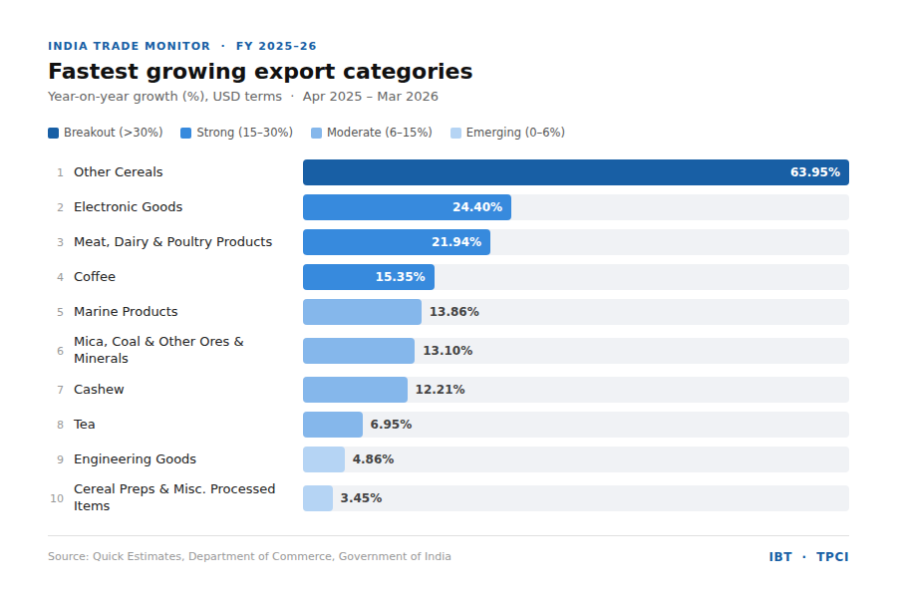
India’s fastest-growing export categories in FY 2025–26 reveal a clear dual-engine pattern—agriculture-led commodities at the top, followed by technology and value-added manufacturing segments. The standout performer, other cereals (+63.95%), reflects a combination of policy easing, global supply gaps, and India’s price competitiveness in staple foods, similar to the rebound seen in rice exports after restrictions were lifted. Alongside this, strong growth in coffee, marine products, and cashew underscores how agri-exports continue to benefit from resilient global demand. This suggests that despite global volatility, India retains a structural advantage in primary commodities driven by scale, cost, and supply stability.

At the same time, the second tier of growth—electronic goods (+24.4%) and meat, dairy & poultry (+21.9%)—points to a deeper structural shift in India’s export basket. Electronics, in particular, has rapidly moved up the value chain, supported by production-linked incentives and a surge in mobile manufacturing exports, positioning it among India’s largest and fastest-growing export sectors. More broadly, recent trade trends show that high-value and technology-driven sectors like electronics and engineering goods are increasingly offsetting weakness in traditional labour-intensive exports, which have struggled amid global demand shocks & tariff barriers.

Taken together, the composition of top growth categories signals that India’s export expansion reflects a hybrid model—anchored in agricultural strength while steadily pivoting toward electronics and industrial exports. This diversification is enabling India to absorb geopolitical disruptions and uneven global demand, making its export trajectory more resilient, even as underlying imbalances like import dependence persist.

Services exports continue to power India’s trade balance

Services trade showed a slight moderation in March but remained robust over the full fiscal year. In March 2026, services exports were estimated at US$ 35.20 billion, down marginally from US$ 35.63 billion in March 2025, while imports also eased to US$ 16.96 billion from US$ 17.48 billion.

For FY 2025–26 (April–March), services exports rose to an estimated US$ 418.31 billion from US$ 387.55 billion in FY 2024–25. Services exports are estimated to have grown by 7.94% in FY 2025–26 (April–March) compared to FY 2024–25. Services imports increased modestly to US$ 204.42 billion from US$ 198.72 billion.

Consequently, the services trade surplus widened to US$ 213.89 billion in FY 2025–26, compared to US$ 188.84 billion in the previous year, reinforcing the sector’s role as a key contributor to India’s external stability.

Conclusion

India’s trade account in FY 2025–26 closed on a familiar note — resilient on the surface, unresolved underneath. Merchandise exports inched up to US$ 441.78 billion, but imports outpaced them decisively, stretching the goods deficit to US$ 333 billion. The West Asia shock in March was a reminder of how quickly geopolitical fractures translate into trade disruptions. What kept the headline numbers respectable was services — a US$ 213.89 billion surplus that continues to do the heavy lifting on India’s external balance.

The faster-growing export categories tell a more optimistic story: electronics climbing the value chain, agri-commodities capitalising on global supply gaps, marine and coffee exports finding new markets. But structural import dependence — particularly in non-oil, non-gold categories — signals an economy still deeply tethered to global supply chains it does not yet control. India is diversifying its export base intelligently; the harder task is reducing the import intensity of its own growth.

Read more

Quick estimates for March 2026

Why long-haul freight holds the key to India’s net zero future

India’s pulse imports fall sharply as domestic supply strengthens

West Asia crisis: India’s Gulf F&B exports face persistent disruptions


FAQs

How did India’s total exports perform in FY 2025–26?

India’s total exports rose to US$ 860.09 billion in FY 2025–26, registering a growth of 4.22% compared to the previous fiscal year.

How did imports perform during FY 2025–26?
Imports increased at a faster pace than exports, rising by 6.47% to US$ 979.40 billion, which contributed to a widening trade deficit.

Which countries were key export destinations for India in FY 2025–26?
Major export destinations included the US, UAE, China, the Netherlands, and the UK, along with strong growth in markets like Spain, Vietnam, and Sri Lanka.

Which import sources recorded the highest growth?
Significant growth in imports was seen from countries such as China, the USA, Hong Kong, Peru, and the UK during FY 2025–26.

Which sectors drove India’s export growth in March 2026?
Key performing sectors included other cereals, mica and minerals, handicrafts, petroleum products, engineering goods, and marine products, all showing positive growth in March 2026.

Previous Post
Next Post

Most Recent Posts

  • All Post
  • 8th Pay Commission
  • Aadhar
  • Aditya Birla Capital
  • Advertising Standards
  • Affordable Housing
  • Agriculture
  • Agriculture & Food
  • AI in Healthcare
  • AI Technology
  • Airlines
  • alcohol industry
  • Android
  • APEDA
  • Apple
  • Artificial Intelligence
  • Ashwini Vaishnaw
  • Asset Management
  • Atmanirbhar Bharat
  • Audio Devices
  • Audio Products
  • Auto Industry
  • Automobile
  • Automobiles
  • Automotive
  • Automotive Industry
  • Aviation
  • Bain Healthcare Report 2026
  • Bank
  • Banking
  • Banking Technology
  • Battery Industry
  • Beverage Industry
  • Beverages
  • Bihar
  • biotechnology
  • Bitcoin
  • BMW Group India
  • Brand Insight
  • BRICS
  • Bullion Market
  • Business
  • Business & Economy
  • Business & Trade
  • Business Leadership Post COVID-19
  • Business News
  • Business Terminology
  • Business Utilities
  • Buyback
  • Capital Goods
  • Capital Markets
  • CarsBusiness
  • CBIC
  • CCI
  • Child Investment
  • China
  • China technology news
  • Citizen Services
  • Clean Energy
  • Clean Technology
  • Cloud Computing
  • coal
  • Commerce
  • Commerce and Industry
  • Commercial Real Estate
  • Commercial Vehicles
  • Commodities
  • Communications
  • Companies
  • Competition Law
  • Compliance
  • Computer Accessories
  • connected cars
  • Consumer Affairs
  • Consumer Electronics
  • Consumer Finance
  • Consumer Goods
  • Consumer Health
  • Consumer Markets
  • Consumer News
  • Consumer Protection,
  • Consumer Rights
  • Consumer Spending
  • Consumer Trends
  • Content Creation
  • Copper
  • Corporate
  • corporate affairs
  • Corporate Earnings
  • Corporate Governance
  • Corporate News
  • Corporate Social Responsibility
  • Cost of Living
  • Country
  • CRED
  • Credit Cards
  • CREDIT RATING
  • Crude Oil
  • Cryptocurrency
  • CSR
  • Culture
  • Currency
  • Customs Duty
  • Cyber Security
  • Cybersecurity
  • Dairy Industry
  • Data & Analytics
  • Defence
  • Delhi Government
  • Delhi-NCR
  • Demographics
  • Derivatives
  • DGCA
  • DGFT
  • DigiLocker
  • Digital Assets
  • Digital Economy
  • Digital Health India
  • Digital Identity
  • Digital India
  • Digital Infrastructure
  • Digital passport for robots
  • Digital Payments
  • Digital Platforms
  • digital services
  • Diplomacy
  • Dixon Technologies
  • DPIIT
  • E Commerce
  • E-commerce
  • E-Governance
  • Ease of Doing Business
  • Economic Growth
  • Economy
  • Edible Oil Industry
  • Editor Choice
  • EdTech
  • Education
  • Electric Mobility
  • Electric Vehicles
  • Electronics
  • Employment
  • ENERGY
  • Engineering
  • Entertainment
  • Environment
  • EPFO
  • Ethanol Economy
  • EV Industry
  • EV Technology
  • Exports
  • EXTER
  • Farmers
  • Fashion
  • FINANCE
  • Finance Ministry,
  • Financial Marketing
  • Financial Markets
  • Financial News
  • Financial Planning
  • Financial Results
  • Financial Services
  • Fintech
  • FnTech
  • Food & Beverage
  • Food & Beverages
  • Food Exports
  • Food Industry
  • Food Manufacturing
  • Food Processing
  • Food Regulations
  • food safety
  • Foreign Exchange
  • Foreign Investment
  • Foreign Policy
  • Foreign Trade
  • Forex Reserves
  • fssai
  • FTA
  • Fuel
  • Fuel Prices
  • Future Energy
  • Gadgets
  • Gadgets & Apps
  • Gaming
  • GDP
  • Generative AI Healthcare
  • Geopolitics
  • GI Products
  • Global Brand Alliance
  • Global Economy
  • Global Markets
  • Global Politics
  • Global Tech
  • Global Trade Policy
  • Global Trends\
  • Gold
  • Gold Market
  • Gold Prices
  • Gols & Silver
  • Government
  • Government & Policy
  • Government Affairs
  • Government Bonds
  • Government Data
  • Government Initiatives
  • Government Policy
  • Government Policy & Regulation
  • Government Scheme
  • Government Schemes
  • Government Services
  • Green Energy
  • Green Mobility
  • GroupGlobal
  • GST
  • GST Council
  • GST Counsil
  • Hair Care
  • Hardware
  • Hatchback Segment
  • Health Supplements,
  • Horticulture
  • Housing
  • HSBC
  • Human Resources
  • humanoid robot market
  • Hyundai
  • IBT Infographics
  • iinvestment
  • Imports & Exports
  • Income Tax
  • India
  • India Auto Market
  • India Business News
  • India Inc
  • India News
  • India Retail
  • India-Canada Relations
  • India-China
  • India-Japan Relations
  • India-Russia Relations
  • India-South Korea Relations
  • India-US Relations
  • Indian Economy
  • Indian Navy
  • Industrial Pollution
  • Inflation
  • Infra
  • Infrastructure
  • Innovation
  • Instagram
  • Insurance
  • international
  • International Affairs
  • International Cooperation
  • International Relations
  • International Trade
  • Internet & Connectivity
  • Internet Policy
  • Internet Regulation
  • Interview
  • Investing
  • Investment News
  • Investments
  • iPhone News
  • IPO
  • IT Industry
  • Jewellery
  • Jio Platforms
  • JioBlackRock
  • Jobs & Careers
  • Joint Ventures
  • Kim Kardashian
  • Labour
  • Latest
  • Launches
  • Leadership
  • Leaderspeak
  • Lending
  • Lifestyle
  • Lifestyle Tech
  • List
  • Loans & Credit
  • Local News
  • Logistics
  • LPG
  • Luxury Cars
  • Machinery
  • Macroeconomics
  • Macroeconomy
  • maharashtra
  • Maharashtra News
  • Make in India
  • Makhana
  • Managed Workspaces
  • Manufacturing
  • Market Outlook
  • Markets
  • Maruti Suzuki
  • Mergers & Acquisitions
  • Meta
  • Microsoft
  • Middle East
  • Mobile Apps
  • Mobile Industry
  • Mobile Launch
  • Mobility
  • Monetary Policy
  • Monsoon
  • MoSPI
  • MSME
  • Mutual Funds
  • Nano Tech
  • National
  • National news
  • NEET 2026
  • NewsElectric
  • NewsTata
  • NPCI
  • NPS Vatsalya
  • Office Market
  • Oil & Gas
  • Oil and Gas
  • Others
  • OTT
  • Packaged Drinking Water
  • Packaged Foods
  • Packaging Industry
  • Packaging Innovation
  • Passenger Vehicles
  • Paytm
  • Pension & Retirement
  • Pensions
  • Personal Care
  • Personal Finance
  • Perspectives
  • Petroleum
  • PFRDA
  • Pharmaceuticals
  • PM Modi
  • PMAY-G
  • PMAY-U
  • PMAY,
  • PMI
  • policy
  • Population
  • PORTS
  • Positive News
  • PPF
  • Precious Metals
  • Pricing
  • Product Labeling
  • Product Labelling
  • Product Launch
  • Property Market
  • PSU
  • PSU Banks
  • Public Health
  • Public Policy
  • Public Safety
  • Public Sector
  • Public Services
  • Public Welfare
  • Quarterly Results
  • Railways
  • Rajasthan
  • Raksha Bandhan
  • Raksha Bandhan Gifts
  • Rare Earths
  • Ratings Agencies
  • RBI
  • Real Estate & Realty Sector
  • Recycling
  • Regulation
  • Regulatory Action
  • Regulatory Affairs
  • Regulatory Updates
  • REIT
  • Reliance Industries
  • Renewable Energy
  • RERA
  • Research
  • Retail
  • Retirement Planning
  • Road Infrastructure
  • Robotics & Automation
  • robotics standards
  • Rupee
  • Rural Development
  • Rural Housing
  • SAIL
  • Salaries
  • Samsung
  • Savings
  • Science & Technology
  • Sebi
  • Security
  • Semiconductor
  • Semiconductors
  • Services Sector,
  • SHIPPING
  • Silver Prices
  • Skill Development
  • Skills Development
  • Small Business
  • Smart Devices
  • Smart Home
  • Smart Mobility
  • Smartphones
  • Social Impact
  • Social Media
  • Society
  • Software Development
  • Solar Energy
  • Space Technology
  • Startups
  • Statistics
  • Steel Industry
  • Stock Market
  • stocks
  • streaming
  • Sugar Industry
  • Sukanya Samriddhi Yojana
  • Sustainability
  • SUV
  • Tamil Nadu Pollution Board
  • Tariffs
  • Tariffs & Duties
  • Tata Group
  • Tata Motors
  • Tata Sons
  • Tax Planning
  • Taxation
  • Tech
  • Tech Branding
  • Technology
  • Telecom & Technology
  • Telecom Industry
  • Top Story
  • Tourism
  • Trade
  • Trade Agreement
  • Trade Basket
  • Trade Partner
  • Trade Policy,
  • Transportation
  • Travel
  • Trending
  • Two-Wheelers
  • UIDAI
  • UPI
  • Urban Development
  • US-Iran Conflict Economic Impact
  • US–India Relations
  • Uttar Pradesh
  • Vaccines
  • VehiclesLuxury
  • vivo
  • Wastewater Management
  • Water Quality,
  • Wealth Management
  • Wearables
  • Wellness
  • WhatsApp
  • Wheat
  • Workplace
  • World
  • World News
  • Worldview
  • Yamaha
  • zLead Slider
    •   Back
    • Healthcare
    • Auto
    • Fmcg
    • Hospitality
    •   Back
    • Cash Crop
    • Organic
    • New Era Agri
    • Processed Food
    •   Back
    • Construction
    • Power
    • Mining
    • Telecom
    •   Back
    • ENERGY
    •   Back
    • Export/Import
    • Trade Deal
    • Trade Fair
    •   Back
    • Policies
    • Industry
    • Finance
    •   Back
    • Others technology
    • Mobile phone
    • Gadgets
    •   Back
    • Manufacturing
    • Services
    • Startup

India Business & Trade is a national media platform decoding the ideas, decisions and shifts shaping India’s growth story—across plicy, business, global commerce and a rapidly evolving marketplace.

Reach Us

India Business & Trade
M-62, Saket, New Delhi-110064, India

Subscribe To Newsletter

Stay ahead in the dynamic world of trade and commerce with India Business & Trade’s weekly newsletter.

Copyright © 2026 India Business & Trade. All Rights Reserved


Fatal error: Uncaught TypeError: Unsupported operand types: string * int in /var/www/sites/indiabusinesstrade.in/wp-content/plugins/royal-elementor-addons/admin/includes/wpr-templates-modal-popups.php:192 Stack trace: #0 /var/www/sites/indiabusinesstrade.in/wp-content/plugins/royal-elementor-addons/admin/includes/wpr-templates-modal-popups.php(128): WprAddons\Admin\Includes\WPR_Templates_Modal_Popups::get_template_settings() #1 /var/www/sites/indiabusinesstrade.in/wp-content/plugins/royal-elementor-addons/admin/includes/wpr-templates-modal-popups.php(106): WprAddons\Admin\Includes\WPR_Templates_Modal_Popups::render_popup_content() #2 /var/www/sites/indiabusinesstrade.in/wp-content/plugins/royal-elementor-addons/admin/includes/wpr-templates-modal-popups.php(64): WprAddons\Admin\Includes\WPR_Templates_Modal_Popups::display_popups_by_location() #3 /var/www/sites/indiabusinesstrade.in/wp-includes/class-wp-hook.php(341): WprAddons\Admin\Includes\WPR_Templates_Modal_Popups->render_popups() #4 /var/www/sites/indiabusinesstrade.in/wp-includes/class-wp-hook.php(365): WP_Hook->apply_filters() #5 /var/www/sites/indiabusinesstrade.in/wp-includes/plugin.php(522): WP_Hook->do_action() #6 /var/www/sites/indiabusinesstrade.in/wp-includes/general-template.php(3224): do_action() #7 /var/www/sites/indiabusinesstrade.in/wp-content/plugins/royal-elementor-addons/admin/templates/wpr-canvas.php(64): wp_footer() #8 /var/www/sites/indiabusinesstrade.in/wp-includes/template-loader.php(132): include('...') #9 /var/www/sites/indiabusinesstrade.in/wp-blog-header.php(19): require_once('...') #10 /var/www/sites/indiabusinesstrade.in/index.php(17): require('...') #11 {main} thrown in /var/www/sites/indiabusinesstrade.in/wp-content/plugins/royal-elementor-addons/admin/includes/wpr-templates-modal-popups.php on line 192