
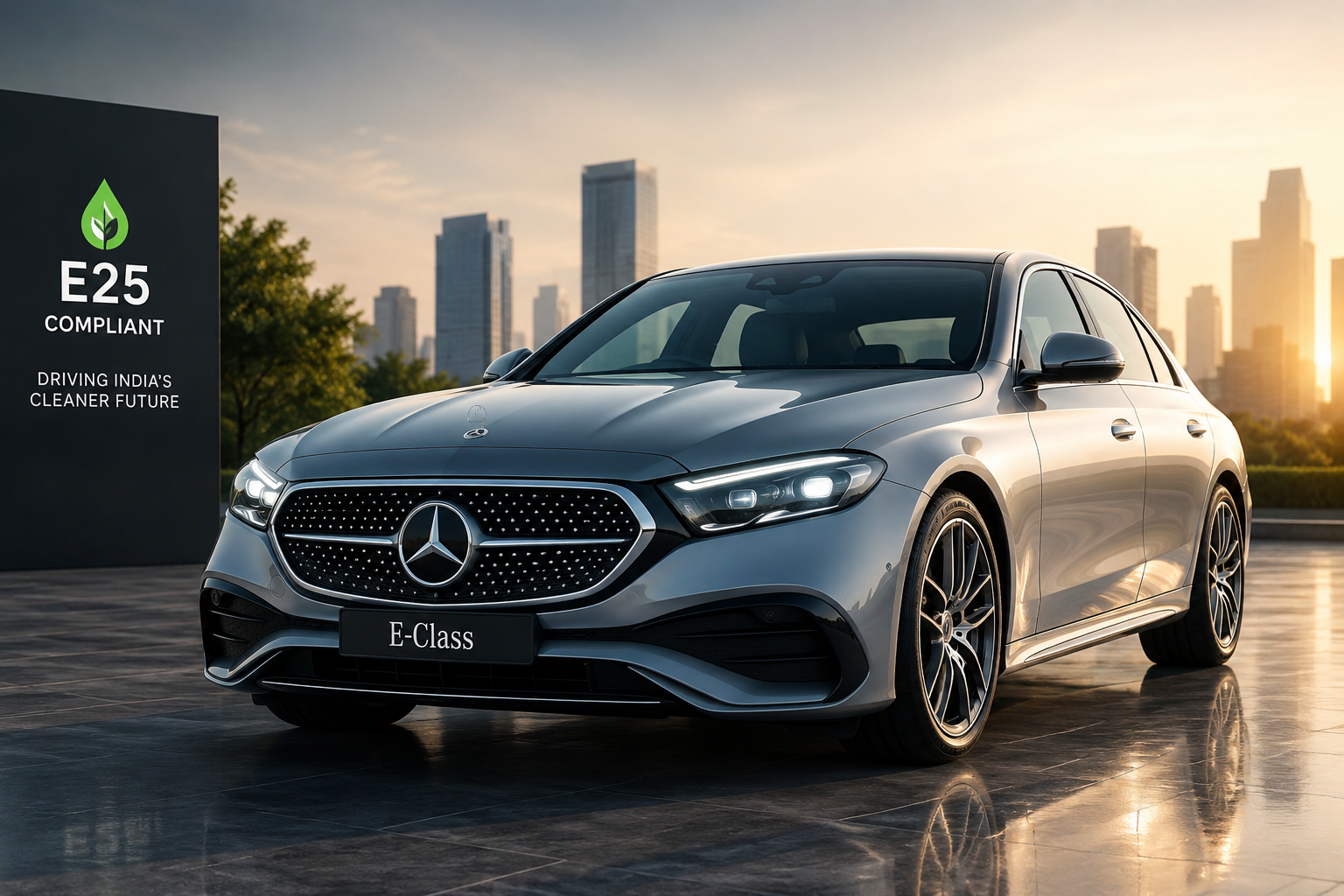
Mercedes-Benz India has begun rolling out E25-compatible vehicles ahead of future ethanol fuel regulations.
The move aligns with India’s biofuel push while the luxury carmaker continues offering both petrol and electric models.
Key Highlights
- Mercedes-Benz starts introducing E25-compliant vehicles in India.
- Move supports the government’s push towards higher ethanol blending.
- Company has upgraded its product portfolio in anticipation of future fuel regulations.
- Existing models sold this year are already E25 compliant.
- Mercedes says demand remains split between internal combustion engine (ICE) and electric vehicles (EVs).
- Premium EVs now account for 22–25% of Mercedes-Benz India’s sales.
Mercedes-Benz India has started rolling out E25-compliant vehicles in the country, becoming one of the early luxury carmakers to prepare for future ethanol-blended fuel regulations. The move comes as India continues to promote biofuels to reduce dependence on imported crude oil and improve energy security.
Mercedes-Benz India Managing Director and CEO Santosh Iyer said the company has already upgraded its product portfolio to meet anticipated fuel norms. According to him, all vehicles currently being sold in India are E25 compliant, ensuring they are ready if the government decides to introduce E25 (25% ethanol blend) petrol in the future.
At present, the Centre has made E20 petrol (20% ethanol blend) mandatory across the country. While trials on E25 fuel are underway, the government has not yet announced a timeline for its nationwide rollout. By making its vehicles E25-ready in advance, Mercedes-Benz aims to future-proof its products and offer customers greater peace of mind.
Iyer noted that the transition to E25 aligns with the German luxury carmaker’s broader strategy of preparing for changing fuel standards while maintaining a wide range of powertrain options for Indian buyers.
On the electric mobility front, Mercedes-Benz said customer demand continues to be divided between conventional petrol-powered vehicles and electric models. The company believes consumers increasingly prefer having multiple technology choices rather than shifting entirely to a single powertrain.
According to the company, 22–25% of its sales in segments where electric variants are available now come from EVs. However, Iyer added that a significant share of buyers still prefers internal combustion engine vehicles, prompting Mercedes-Benz to continue investing in both electric mobility and cleaner combustion technologies.
The rollout of E25-compatible vehicles reflects the company’s long-term strategy of staying ahead of evolving regulations while supporting India’s transition towards cleaner transportation.