
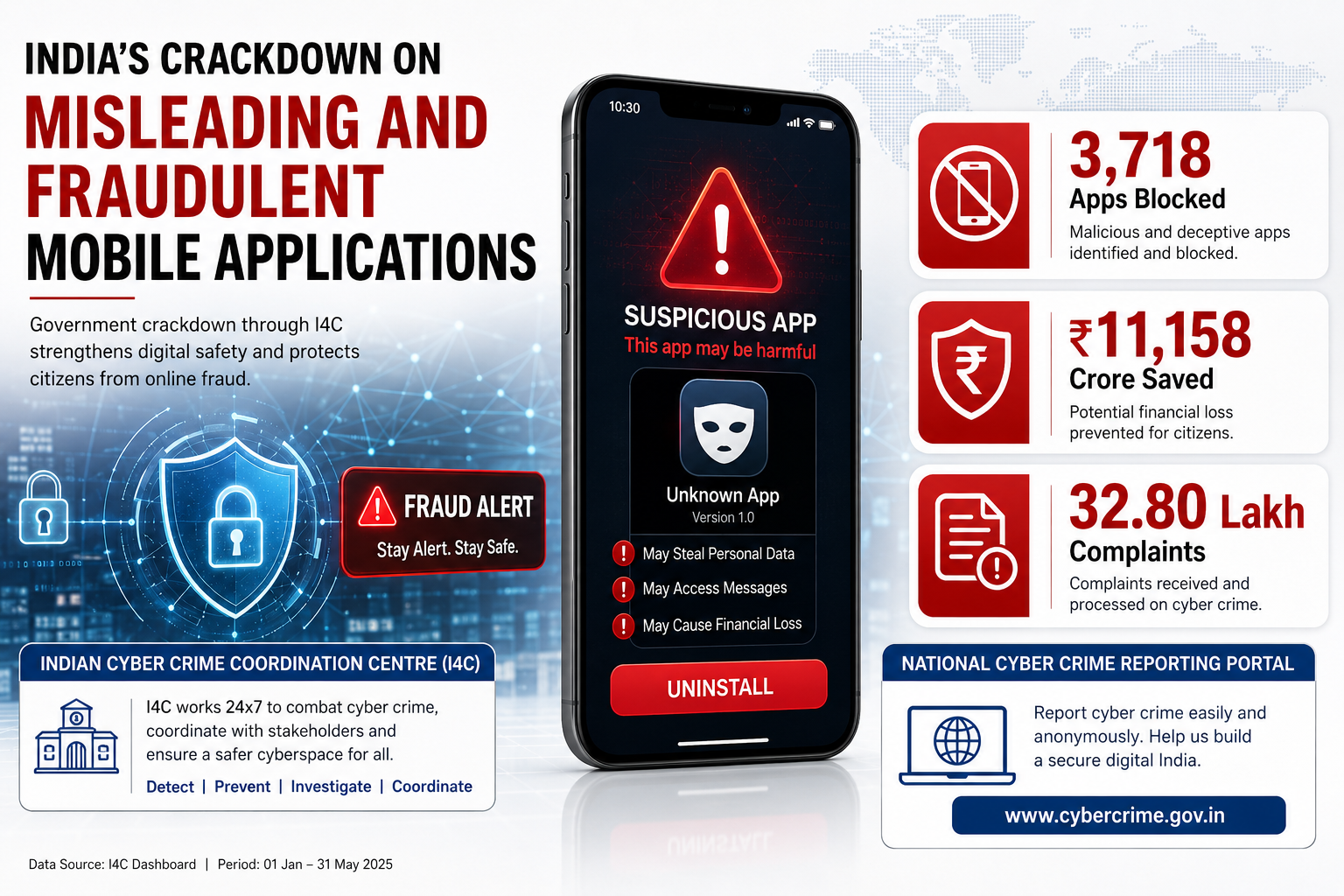
I4C has blocked 3,718 mobile applications, including fraudulent loan apps, while the government has saved over ₹11,158 crore through its cyber fraud reporting and prevention systems.
Key Highlights:
- I4C has blocked 3,718 mobile apps till June 30, 2026.
- The blocked apps include fraudulent loan applications.
- More than ₹11,158 crore has been saved through CFCFRMS.
- The system has handled over 32.80 lakh cyber fraud complaints.
- Over 30.48 lakh suspect identifiers have been received from banks.
- More than 32.08 lakh Layer 1 mule accounts have been shared with participating entities.
- Transactions worth ₹25,698 crore have been declined through the Suspect Registry.
- More than 15.75 lakh SIM cards and 5.77 lakh IMEIs have been blocked.
- Money Restoration and Grievance Redressal Modules became functional in April 2026.
New Delhi, August 11: The Ministry of Home Affairs has stepped up measures to tackle misleading and fraudulent mobile applications as part of its broader efforts to combat cybercrime in the country.
The Indian Cyber Crime Coordination Centre (I4C), an attached office of the Ministry of Home Affairs, has been established to deal with different forms of cybercrime through a coordinated approach.
As part of these efforts, the National Cyber Crime Reporting Portal (NCRP) has been launched to allow citizens to report incidents related to various types of cybercrime, with a special focus on crimes against women and children.
The government has also introduced the ‘Sahyog’ Portal to speed up the process of sending notices to internet intermediaries for removing or disabling access to information, data or communication links being used to commit unlawful acts.
According to the Ministry, I4C had blocked a total of 3,718 mobile applications, including fraudulent loan apps, under the relevant provisions of the Information Technology Act, 2000, as of June 30, 2026.
The Citizen Financial Cyber Fraud Reporting and Management System (CFCFRMS), launched in 2021, enables immediate reporting of financial fraud and helps prevent fraudsters from siphoning off funds.
Through the CFCFRMS, more than ₹11,158 crore has been saved across over 32.80 lakh complaints as of June 30, 2026.
The government has also established a Suspect Registry of identifiers linked to cyber criminals in collaboration with banks and financial institutions. More than 30.48 lakh suspect identifier records received from banks and 32.08 lakh Layer 1 mule accounts have been shared with participating entities.
The system has also helped decline transactions worth ₹25,698 crore. In addition, more than 15.75 lakh SIM cards and 5.77 lakh IMEIs reported by police authorities have been blocked by the government.
To improve the handling of cybercrime complaints, the Ministry has issued a comprehensive Standard Operating Procedure for NCRP-CFCFRMS. The SOP provides a standard framework covering complaint processing, coordination with banks, grievance redressal, removal of lien markings and restoration of defrauded funds to rightful claimants.
The Money Restoration Module and Grievance Redressal Module became functional in April 2026. These systems are intended to speed up the restoration of defrauded money and address complaints related to frozen bank accounts and lien marking.
The government is also conducting awareness campaigns to educate citizens about cybercrime and online safety. These include SMS, television, radio, social media, school and cinema campaigns, as well as awareness programmes at railway stations and airports.
The government has also used platforms such as CyberDost on social media, MyGov publicity campaigns and celebrity and IPL campaigns to spread awareness about cyber safety.
The measures were highlighted by Minister of State in the Ministry of Home Affairs Bandi Sanjay Kumar in a written reply to a question in the Lok Sabha.