Key Highlights
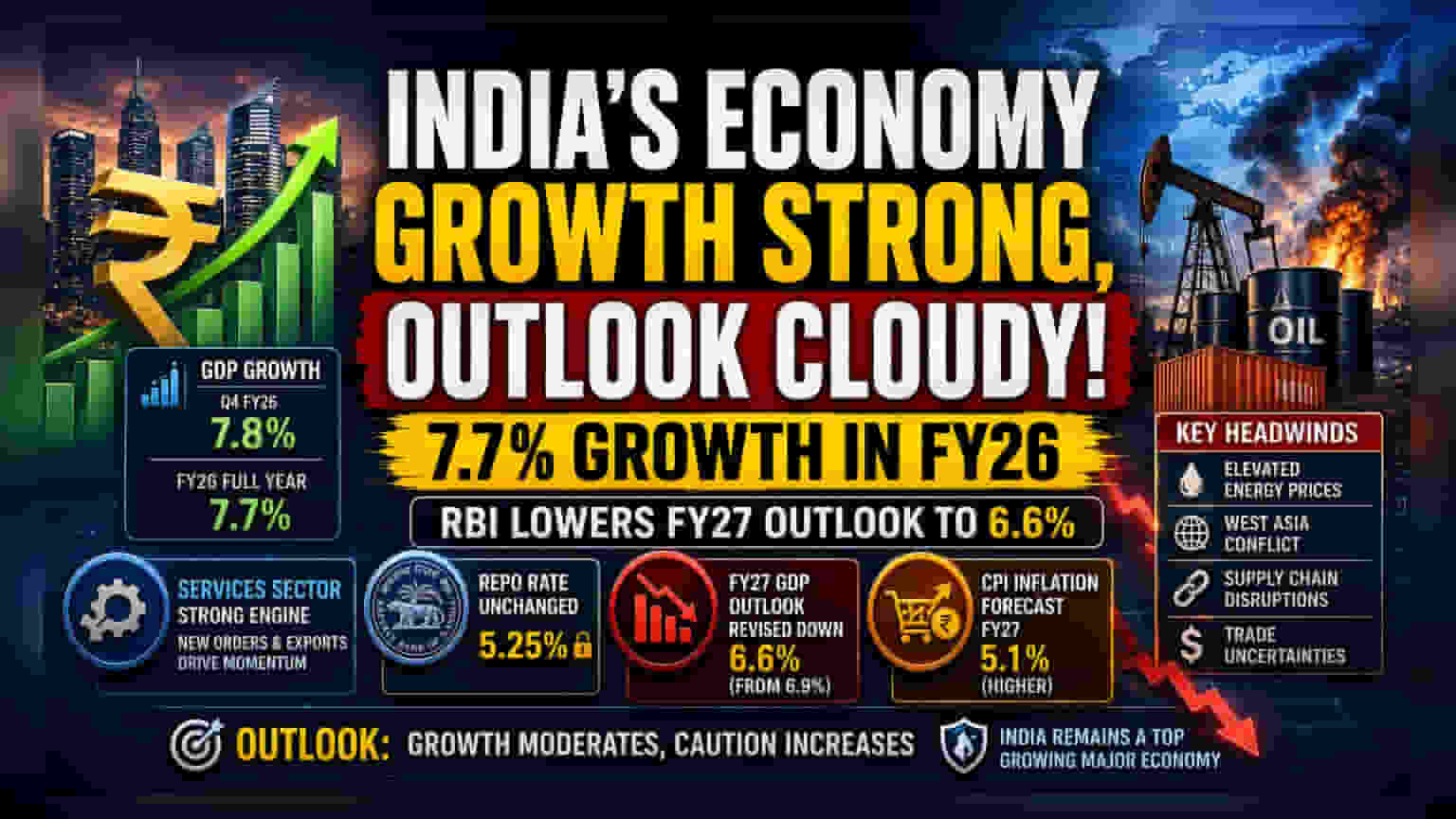
- India’s GDP grew by 7.7% in FY26, up from 7.1% in FY25.
- GDP expanded by 7.8% in the fourth quarter (January–March 2026).
- Real GDP at constant prices is estimated at ₹323.12 lakh crore.
- Nominal GDP rose 8.9% to ₹346.36 lakh crore in FY26.
- Agriculture and construction sectors were key contributors to economic growth.
- Strong domestic demand, infrastructure spending, and services activity supported expansion.
- India maintained its status as the world’s fastest-growing major economy despite global uncertainties.
India Registers Robust 7.7% GDP Growth in FY26, Q4 Expansion Reaches 7.8%
New Delhi, June 5 — India’s economy recorded a strong growth rate of 7.7 percent during the financial year 2025-26, improving from the 7.1 percent expansion achieved in the previous fiscal year, according to official data released by the Ministry of Statistics and Programme Implementation (MoSPI) on Friday.
The latest figures highlight the resilience of the Indian economy amid a challenging global environment marked by geopolitical tensions, supply-chain disruptions, volatile commodity prices, and slower growth in several major economies. The strong performance was driven by sustained domestic demand, government-led infrastructure spending, steady agricultural output, and continued expansion across key service industries.
Economic momentum remained particularly strong during the final quarter of FY26. Gross Domestic Product (GDP) grew by an estimated 7.8 percent between January and March 2026, supported by robust activity in agriculture, construction, manufacturing, and services. The quarterly performance reflects the broad-based nature of India’s growth story and underscores the strength of domestic economic fundamentals.
According to the government, India’s real GDP at constant prices is projected to reach ₹323.12 lakh crore during FY26, compared with the First Revised Estimate of ₹299.89 lakh crore recorded in FY25. The increase demonstrates a significant expansion in economic output and reflects sustained growth across multiple sectors of the economy.
Meanwhile, nominal GDP at current prices is estimated at ₹346.36 lakh crore for FY26, up from ₹318.07 lakh crore in the previous financial year. The 8.9 percent increase in nominal GDP highlights the continued rise in economic activity and the overall size of India’s economy.
A major contributor to growth during the year was the government’s ongoing investment in infrastructure development. Large-scale spending on highways, railways, airports, ports, urban infrastructure, and digital connectivity projects continued to stimulate economic activity and create demand across industries. Public capital expenditure remained one of the key pillars supporting growth throughout the fiscal year.
The construction sector emerged as one of the strongest-performing segments of the economy, benefiting from infrastructure projects as well as sustained demand in residential and commercial real estate markets. Increased investment in housing and urban development projects further boosted construction activity.
Agriculture also played a crucial role in supporting growth during FY26. Favorable weather conditions in many regions contributed to healthy crop production, while resilient rural demand helped sustain economic activity in the countryside. The sector’s steady performance provided support to both consumption and employment.
India’s services sector, which accounts for more than half of the country’s economic output, remained another major growth engine. Financial services, information technology, transportation, trade, hospitality, and digital businesses continued to expand, supported by rising consumer spending and increasing digital adoption across the economy.
The strong GDP performance comes as policymakers continue to balance economic growth with inflation management. Although inflationary pressures have eased compared with previous years, authorities remain vigilant regarding food prices, energy costs, and external risks that could affect economic stability.
Economists believe India’s growth outlook remains favorable due to strong domestic consumption, healthy corporate balance sheets, improving private-sector investment, and ongoing structural reforms. Government initiatives aimed at boosting manufacturing, strengthening supply chains, enhancing logistics, and attracting domestic and foreign investment have also contributed to economic momentum.
Despite the positive outlook, challenges remain. Global economic uncertainty, fluctuations in crude oil prices, climate-related risks affecting agriculture, and the need to create sufficient employment opportunities for India’s growing workforce continue to be important policy concerns. Experts emphasize that sustaining high growth rates over the long term will require continued reforms, productivity improvements, and greater participation from the private sector.
The FY26 growth figures reaffirm India’s position as the fastest-growing major economy in the world and highlight the importance of domestic demand, infrastructure investment, and sectoral diversification in driving economic expansion. As global growth remains uneven, India’s economic performance is expected to continue playing an increasingly important role in supporting worldwide economic activity.