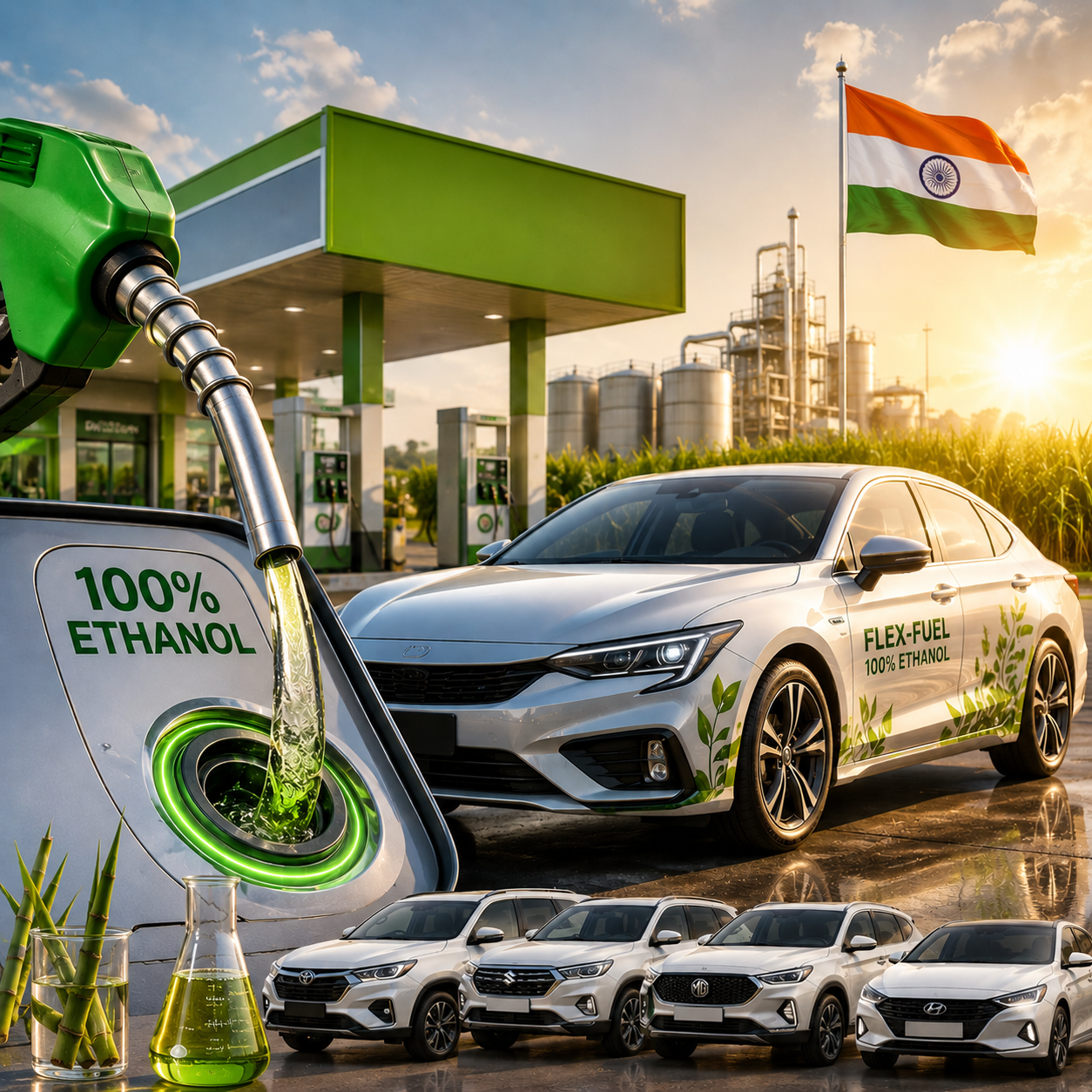
Government Clears Legal Framework for Pure Ethanol Fuel as India Pushes to Reduce Dependence on Imported Fossil Fuels
Highlights
- Transport Minister Nitin Gadkari has approved the use of 100% ethanol fuel.
- Move aims to reduce India’s dependence on imported fossil fuels.
- Several automakers are preparing to launch ethanol-compatible vehicles.
- Toyota, Suzuki, MG, and Hyundai are expected to introduce compatible models soon.
- India has already achieved its 20% ethanol blending target ahead of schedule.
Union Road Transport and Highways Minister Nitin Gadkari has announced that the government has finalized regulations permitting the legal use of 100% ethanol fuel in India, marking a significant step toward reducing the country’s reliance on imported fossil fuels and promoting cleaner alternative energy sources.
Speaking at a press conference in Nagpur marking 12 years of the NDA government, Gadkari revealed that he signed the final approval file on Saturday evening, clearing the regulatory framework required for the adoption of pure ethanol fuel.
The minister said the idea of using ethanol as a mainstream fuel alternative was initially met with skepticism and criticism. However, he maintained that ethanol could significantly reduce India’s fuel import bill while supporting domestic agriculture and renewable energy initiatives.
Gadkari further stated that several major automobile manufacturers are preparing to launch vehicles capable of running entirely on ethanol. Companies including Toyota, Suzuki, MG Motor, and Hyundai Motor Company are expected to introduce 100% ethanol-compatible vehicles within the next six weeks.
The development follows the recent introduction of E85 fuel, which is designed for flex-fuel vehicles capable of operating on high ethanol blends.
Meanwhile, Petroleum and Natural Gas Minister Hardeep Singh Puri highlighted India’s progress in ethanol blending, noting that the country achieved its target ahead of schedule. Ethanol blending in petrol increased from 1.5% in 2014 to 10% by November 2022, while the target of 20% blending, originally set for 2030, was achieved in 2024.
The government said consultations with industry stakeholders, automobile associations, and fuel companies are continuing to ensure a smooth transition toward greater ethanol adoption in the transportation sector.