Restrictive trade measures including tariffs and import duties rose sharply over the past one year. This could threaten global economic growth, trade and jobs, according to the World Trade Organization. In the recent past, WTO members applied 137 new trade-restrictive measures during the year that ended in October, up from 108 in the previous-“year corresponding period”, as reported by the Geneva-based organization. The coverage of these trade-restrictive measures accounts for trade to the extent of $588 billion, seven times larger than a year ago. This proliferation of trade restrictive measures and the uncertainty created by such actions could place economic recovery in jeopardy. The WTO defines trade-restrictive measures as new or increased tariffs, complicated customs procedures, quantitative restrictions and local / domestic content measures. The WTO has cut down on its outlook for global commerce through 2019 and has warned that tension between major trading partners increasingly threatens economic growth. During the same period, however, WTO members also implemented 162 measures aimed at facilitating trade, including eliminating or reducing tariffs and simplified customs procedures for imports and exports. Close to 14 trade-facilitating measures per month were notified by WTO members, an increase from an average of 11 measures in the previous annual overview. So, on the face of it, increasing both restrictive and facilitation measure is the new approach of practicing trade? Let us observe another case as well. According to the WTO’s report released last month, G20 economies applied a total of 40 trade-restrictive measures during the review period (May 16 to October 15, 2018) or say about eight such measures per month, on an average. These measures included tariff increases, import bans and export duties. According to the WTO, about 79% of the current import-restrictive coverage is associated with bilateral measures between U.S. and China. G20 countries also implemented a higher number of trade remedy investigations than they terminated, but the gap between initiations and terminations has narrowed. Initiations of anti-dumping investigations accounted for three-fourths of all initiations during the review period. The WTO noted that iron and steel and products of iron and steel, furniture, bedding, mattresses and electrical machinery and parts thereof were the main sectors affected by trade remedy initiations. On the flip side, G20 countries applied a total of 33 trade-facilitative measures, or seven trade-facilitative measures per month. These included eliminating or reducing import tariffs and export duties. The trade coverage of import-facilitating measures was US$ 216 billion. One silver lining is the WTO’s Information Technology Agreement which liberalized an additional US$541 billion of trade and has been an important trade liberalization measure.Again analogous situation can be observed here as well. Figure 1, Monthly trade restrictive measure applied by G20 Economies. Increase in trade restrictive steps is not be ameliorating for India as it would impact exports growth of the country. Process to promote outbound shipments, helps, not only in earning foreign exchange and boost economic activities, but also creates employment opportunities. Since 2011-12, India’s exports have been hovering at around USD 300 billion. During 2017-18, the shipments grew by about 10 per cent to USD 330 billion. Third world economies are now facing a reduced export demand for their goods and services for two distinct reasons. One is the world capitalist crisis, which entails a reduced aggregate demand in the world economy and hence reduced aggregate exports for all countries taken together; the other is the protectionism of the major developed economies like US, which, by garnering for that country a larger share than it would have otherwise had of this reduced world market, leaves correspondingly less for others. Since the imports of several of these third world countries are more sluggish to change, these countries face an enlarged trade deficit, and hence current account deficit, on their balance of payments, which is a combined result of the world capitalist crisis, and of US protectionism.
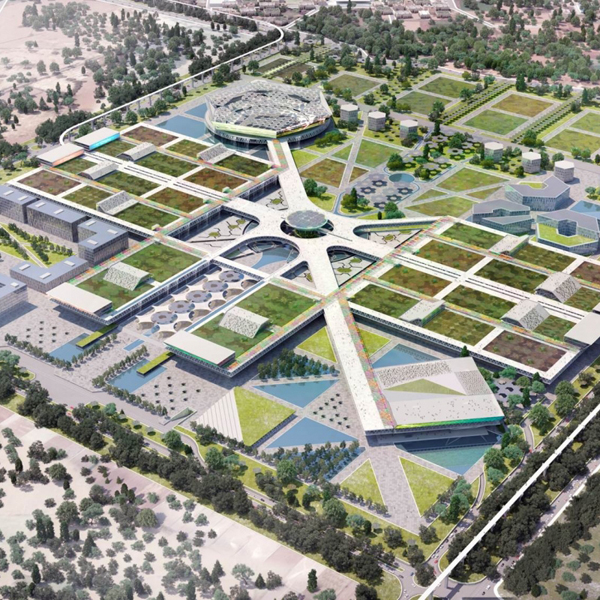
World’s 3rd largest convention centre coming up in Delhi
Delhi’s Dwarka region will soon have a massive Convention Centre, which is going to be Asia’s 2nd largest state-of-the-art Convention Centre and the 3rd largest in the world being designed with an objective to handle international conferences, exhibitions and trade shows so as to host summits of the level of G20 Summit and other such mega International events in the country. Informs CP Kukreja, the architect for the Convention Centre named India International Convention and Expo Centre (IICC), the project is coming up on 225 acres of land, and will have a built up area of 1.6 crore sq. feet. The Convention Centre will have capacity to host 10000 people. It will have a LED Video Wall which will be the largest LED Façade ever built. Informs Ishtiyaque Ahmed, Vice President at Delhi Mumbai Industrial Corridor Development Corporation Ltd. and the man currently responsible for the project: “India International Convention and Expo Centre (IICC) is being developed to achieve the vision of the Hon’ble Prime Minister to create a state-of-the-art and world class centre to promote MICE activities in India which will help in attracting and promoting business and industry in India.” The project has been planned at an estimated cost of Rs. 25,700 crores. Department of Industrial Policy and Promotion (DIPP) has set up a 100% Government owned company – India International Convention and Exhibition Centre Limited (IICC Ltd.) which is implementing the project. Ever since Prime Minister Narendra Modi laid the foundation for the project in September this year, the work has already commenced in full-swing. On the occasion of the foundation-laying ceremony, Prime Minister Modi said “IICC would reflect India’s economic progress, rich cultural heritage, and our consciousness towards environment protection.” “It is a part of the Government’s vision which gives importance to world class infrastructure, and ease of doing business,” the PM said. He further claimed that his Government has begun a series of unprecedented projects for the nation’s development and IICC was going to be one of such project. In this context, he mentioned the longest tunnel, the longest gas pipeline, the largest mobile manufacturing unit, and electricity to every household among many others. He said these are illustrations of the skill, scale and speed of New India. The Prime Minister said that several countries across the world have developed elaborate capacities to hold conferences. He said this had not been thought of in India for a quite a while. Now this is changing, he added. The facilities provided at the centre will be at par with the best in the world in terms of size and quality, offering setting for international and national events, meetings, conferences, exhibitions and trade shows. The project is envisioned to be on a scale of a Central Business District with supporting retail, commercial and hospitality sectors. It would rank among the top 5 in the World, top 3 in Asia and biggest in India in terms of indoor exhibition space when compared to the biggest facilities available at present. In addition to giving boost to business and industry it is also expected to generate over 5 lakh direct and indirect employment opportunities. IICC will be an integrated complex with a host of mutually beneficial facilities like Exhibition Halls, Convention Centre (comprising Plenary Hall, Ball Room and Meeting Rooms), a multi-purpose Arena, Open Exhibition spaces, mixed use commercial spaces like Star Hotels (5, 4 and 3 star), Retail services and high-end offices. The facilities will be designed with sustainable approaches in planning and design, transformation, alternative energy production, energy conservation, water resource management, solid waste management, efficient land use, eco-friendly building design to create cost-effective and measurable savings for the project. The construction will be in line with green building principles and Indian Green Building Council (IGBC) Platinum rating standards. Over 40% of the area is planned to be developed as open/green area with a total built up area of 10.70 lakh square metres comprising of Convention Centre (60000 sq metres to accommodate 10000 persons), Exhibition Halls (About 2.56 lakh sq metres), Foyer (61000 sq metres), multi-purpose Arena with retractable roof (50000 sq metres to accommodate 20000 persons), Hotels (about 2.82 lakh sq metres with 3500+ rooms), office space (about 2.30 lakh sq m) and retail space (About 1.30 lakh sq. m). The project will be developed in two phases. Phase-I will be completed by December, 2019 with a Convention Centre (60000 sq metres) and two Exhibition Halls (60000 sq. metres) with adjoining Foyer and related support facilities. Phase-II will be completed by December 2024 with construction of 3 Exhibition Complexes, Arena, Metro connectivity, Hotels, Retail and Office space. The project complex will have a dedicated underground Metro station which will be an extension of the Airport High Speed Metro Corridot and is being constructed by Direct Metro Rail Corporation (DMRC). Says Sandip Das, Director and the man responsible for the events organized by TPCI: “It is a moment of pride that such extensive facilities are being planned in India. It will now be possible to hold international level conferences in the heart of India.”
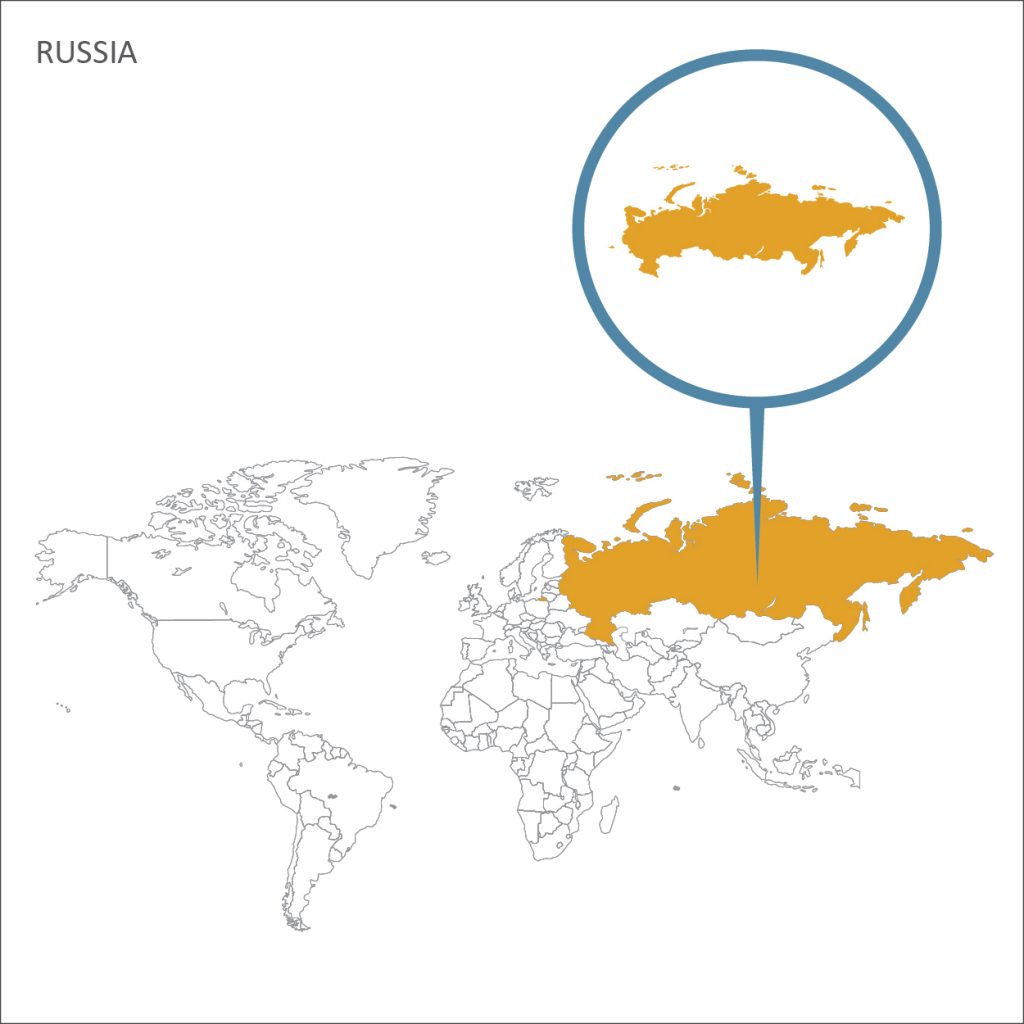
Country Profile- Russia
Russia is located in both Asia and Europe, it is a transcontinental country. Its major part lies in Asia. It is the world’s largest country in terms of area. The United Nations Development Programme ranks Russia 59th in terms of Human Development Index with the value of 0.816. It is ranked 31st in ‘Ease of Doing Business’ by World Bank released in 2018 with 9th rank in property registration and 12th rank in enforcing contracts. As per World Economic Outlook Database, 2018 estimate Russia is ranked 6th in world in GDP in PPP terms at a value of US$ 4.18 trillion while ranked 12th in GDP in nominal terms at a value of US$ 1.57 trillion. The per capita GDP of Russia in PPP terms is estimated to be US$ 29032 and in nominal terms it is estimated to be US$ 10950 in 2018 by World Economic Outlook Database. TRADE STATISTICS In 2017, Russia imported US $ 228.21 billion worth of goods. Its export was over US $ 359.15 billion in value in 2017 which accounted for 2 % of the total exports in the world. As per ITC trade map Russia ranks 15th among the top world exporters, list is led by China. The top trading partner of Russia is China, followed by Netherlands and Germany. India does not rank in the list of top 10 trading partners of Russia, but has a significant import from Russia of worth US$ 7.99 billion and an export value of US$ 2.14 billion from India to Russia, resulting into a trade deficit of US$ 5.85 billion for India. RUSSIA’S MERCHANDISE TRADE WITH WORLD Russia’s exports to the world have followed its path of imports throughout, as can be seen in the graph below. The country has maintained a trade surplus throughout the past decade. In 2017 it had a trade surplus of US $ 130.94 billion. In the last 10 years trade surplus was highest in the year 2013 at US$ 212.32 billion. RUSSIA’S EXPORT TO THE WORLD Russia’s total export in 2017 amounted to US $ 359.15 billion. Natural resources are the primary export products of Russia. Its top export product at HS-6 digit level last year was Crude petroleum oil, Light oil, Medium oil, Natural gas and Coal. These products constitute 58% of the total export basket of Russia, i.e. its export basket is skewed. RUSSIA’S IMPORTS FROM THE WORLD Russia’s import basket is primarily led by Medicaments, Telephones for cellular networks, Aeroplanes and other powered aircraft, Machinery for liquefying air or other gases and Motor cars and other motor vehicles which together make up the Top 5 imports of Russia. The import basket is diversified. INDIA- RUSSIA MERCHANDISE TRADE India consistently maintained a trade deficit with Russia. Deficit reached the highest i.e. turned worse in 2017 with a deficit of 5.84 billion. Barring a dip in 2014 and 2015 India’s export is following an increasing trend year on year after 2008. Barring the dip in 2014 and 2015. India’s import from Russia reached a new high in 2017 at US$ 7.9 billion. INDIA’S EXPORT TO RUSSIA India’s total exports to Russia amounted to US $ 2.14 billion in 2017. Its top five exports at HS-6 digit level were Medicaments, Tea, Coffee extracts, Parts of aeroplanes or helicopters and frozen shrimps and prawns. INDIA’S IMPORT FROM RUSSIA India’s total import from Russia in 2017 was US $ 7.89 billion. India’s import was dominated by Unworked diamond, Crude Petroleum oils, Unwrought silver, Coal, Newsprint in rolls of a width > 36 cm and Potassium chloride for use as fertiliser. The import basket of India for the products imported from Russia is highly skewed, such that the top 5 products amount to 71 % of total imports by India from Russia. India-Russia share a very special political and economic relationship. Apart from energy diplomacy, the economic relationship between the two nations is majorly dependent on two commodities diamond and Petroleum oil with two signing numerous pacts on the same. Besides the traditional source of energy the two nations are also collaborating on clean nuclear energy since Russia is endowed with large nuclear reserves and India is a large energy consumer. As per InvestIndia, Russia has invested US$ 1.2 billion from 2000 to 2018, with key investment areas being oil & gas, aerospace, defence and financial services. The bilateral trade between India and Russia is targeted to reach US$ 30 billion by the year 2025 and the level of mutual investments is expected to reach US$ 15 billion by 2025. Both nations have sought to establish extensive collaboration and commerce in field of infrastructure, information technology, space research and defence technology.
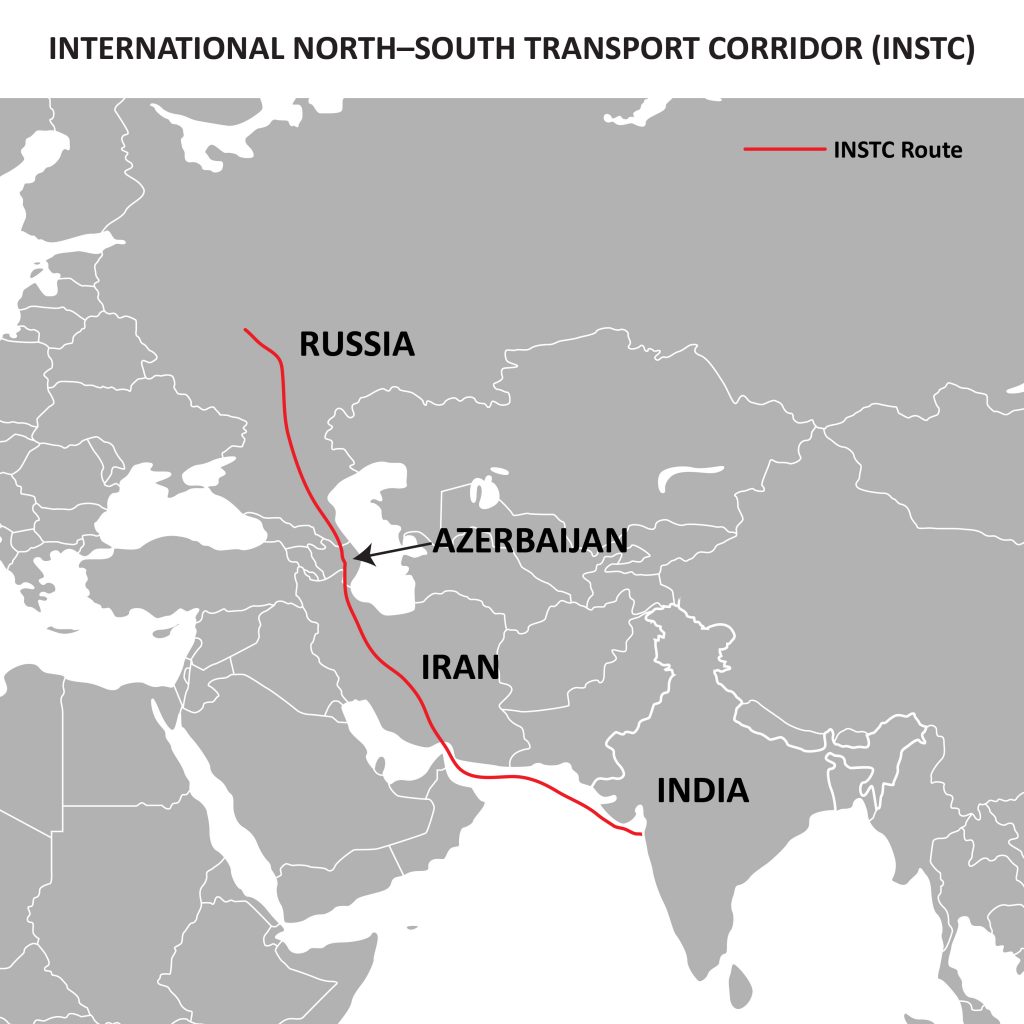
Central Asian and East European markets to get closer to India by new trade route via Iran and Russia
In order to enhance trade and connectivity, India, Russia and Iran are now planning to launch a new cargo transport corridor, which would be a cheaper and shorter alternative to the Suez Canal or the China route and is expected to reduce transport costs by $2500 per 15 tons of cargo, besides reducing the travel time by nearly half. The new International North-South Transport Corridor (INSTC), when it comes into effect, will bring Central Asian and East European markets much closer to India, thus enhancing bilateral trade opportunities between the two regions. INSTC is a 7,200 km long multi-mode network of ship, rail and road route for moving freight between India, Iran, Afghanistan, Armenia, Azerbaijan, Russia, Central Asia and Eastern European countries. The route primarily involves moving freight from India, Iran, Azerbaijan and Russia via ship, rail and road. Once it gets commenced, INSTC will enhance trade connectivity between major cities such as Mumbai, Moscow, Tehran, Baku, Bandar Abbas, Astrakhan, Bandar Anzali and many more. Cargoes from India will be delivered to the Iranian port of Bandar Abbas. The goods will subsequently be transported by land to Bandar Anzali on the Caspian Sea. The cargo will then be shipped to the Astrakhan Port of Russia and will then be moved to their destination in Russia, East Europe or Central Asian countries. This corridor is estimated to have a capacity of 20-30 million tons of goods per year and will be a cheaper and time-saving alternative to routes via China and Europe, which are not only long but also time-consuming and expensive, thus making this new corridor the most viable route to Central Asian and East European countries including Russia. The new shipment passage is an important initiative taken by India, Russia and Iran to enhance connectivity and promote transport cooperation among these nations. India is keen to move ahead with this project despite American sanctions against both Russia and Iran, as this route not only reduces India’s dependence on China but also is a suitable alternative to much bigger China’s Belt-and-Road project. China’s Belt-and-Road initiative is trying to connect Arabian Sea via Pakistan and is trying to reach closer to the Indian Ocean through passing through various countries in the East. The Indian Ambassador to Russia, DB Venkatesh Varma has recently visited the Astrakhan region to see the preparations of the Russian authorities to develop the port. Dry runs of the two routes forming part of the ambitious projects were conducted as far back as 2014; the first was Mumbai to Baku via Bandar Abbas and second was Mumbai to Astrakhan via Bandar Abbas, Tehran and Bandar Anzali. The objective of the study was to identify and address key bottlenecks. Apparently the Astrakhan route has found greater favour. The route, once gets into operation, will make it very lucrative for East Asia and South East Asia exporters. Exporters from India’s west coast would be able to send their goods through Iran’s Bandar Abbas and Chabahar ports, Central Asian states, Russia and onwards to Europe. It will bring the Eurasia region much closer and cost-effective. There is enormous potential and it is likely that the INSTC will be activated before 2020.
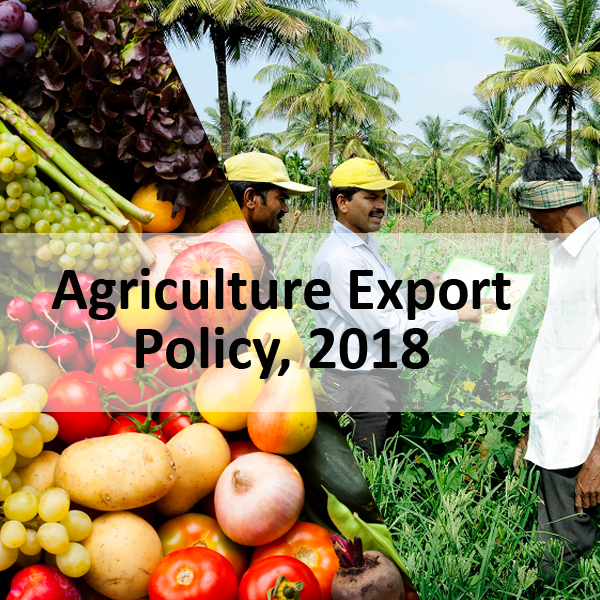
‘Agriculture Export Policy, 2018’ to harness export potential of Indian agriculture
Mr. Suresh Prabhu, Hon’ble Minister for Commerce and Industry has come out with the first ever policy for agriculture exports which removes export restrictions for organic, agro processed products and gives special preference to high value, value added, perishable products. “This is a forward-looking policy and we as the country’s only F&B focused trade promotion body welcomes it,” says Mohit Singla, adding that “TPCI is the only trade promotion body that has been working towards pushing organic exports since last two years to fetch the growing business across developed and developing economies and has been advocating the need for more spending on branding of products and commodities specific to India.” The Union cabinet on Thursday had announced the ‘Agriculture Export Policy, 2018’ in which it has approved an export policy for agriculture, lifting all restrictions on organic and processed food, with an aim to help the government’s efforts to double the farmers’ income by 2022. The policy also seeks to invest Rs. 1,400 crore to set up specialized clusters in different states for different produce to push exports. TPCI had been advocating the need for setting up specialized clusters during various suggestions given to ministry from time to time. A draft report on agricultural enclaves for boosting agricultural exports, prepared by TPCI, had talked in detail of the need to develop specific clusters. “One of these tools (for better promotion of exports) is the promotion of clusters. An agro-based cluster (AC) is simply a concentration of producers, agribusinesses and institutions that are engaged in the same agricultural or agro-industrial sub-sector, and interconnect and build value networks when addressing common challenges and pursuing common opportunities. This cluster is identified on crop basis which an economy can produce, but this is not matched with the global demand. Mapping of requisite food which are demanded by the net food importing economies is missing in the working mechanism of clusters,” said the report, further elaborating that “Agricultural Enclave is an analogous concept with some augmentations. To bolster economic specific agricultural exports, an economy needs to prepare itself to match all standards and quality.” Besides being the only organization pushing organic exports from India for more than two years now, TPCI had also been advocating of a need for branding of agri-products and commodities specific to India by increasing their visibility. Says Singla: “Various other countries have branded their agri-produce and other commodities and India is yet to embark on a mission to brand its products, on lines of several products from other countries. I am pleased to know that the Government has finally come up with a policy that mentions the need for branding of our products in the international market. This is sure to give a big boost to export of Indian agri-products.” Indusfood, which has been developed as the “World Food Supermarket” jointly with Ministry of Commerce & Industry, has been envisaged keeping in mind India’s great agri-export potential and together with the Source India events that TPCI holds in various markets of the world, TPCI is working aggressively to increase India’s export to the envisaged targets in the Report. TPCI had also been talking of a need to have a market intelligence digital data platform for sharing the global demand supply information incorporating alerts on changes in NTBs. Some other points that TPCI had been advocating and have been incorporated in the ‘Agriculture Export Policy, 2018’ include need for product specific clusters to match destination specific exports, adopting common quality and standards by taking EU’s and developed economies’ standards as benchmark, making test centres and labs accessible, and working out tie-ups with food regulatory authority of food importing economies. Besides removing export restrictions for organic, agro processed products, the ‘Agriculture Export Policy, 2018’, aptly being termed as the first ever policy for agricultural exports, has several salient features that are surely going to give a big boost to India’s agricultural export. It talks of the need to give special preference to high value, valued added, perishable products, mentions need for setting up clusters in states for several commodities which will act as growth centres, asks State Governments to remove restrictions such as mandi tax and identifies several ports as being nodal points for exports. Some of the specified objectives of the ‘Agricultural Export Policy, 2018’ are: to double agricultural exports from present US$30 Billion to US$60 Billion by 2022 and reach US$100 Billion in the next few years thereafter, with a stable trade policy regime; to diversify our export basket, destinations and boost high value and value added agricultural exports including focus on perishables; to promote novel, indigenous, organic, ethnic, traditional and non-traditional Agri products exports; to provide an institutional mechanism for pursuing market access, tackling barriers and deal with sanitary and phyto-sanitary issues; to strive to double India’s share in world agri exports by integrating with global value chain at the earliest; and, to enable farmers to get benefit of export opportunities in overseas market. The Policy is envisioned to “harness export potential of Indian agriculture, through suitable policy instruments, to make India global power in agriculture and raise farmers’ income.” The focused approach of the Government to turnaround the Indian agri-export market is visible and given time India is most likely to achieve the envisioned objectives, feels TPCI.
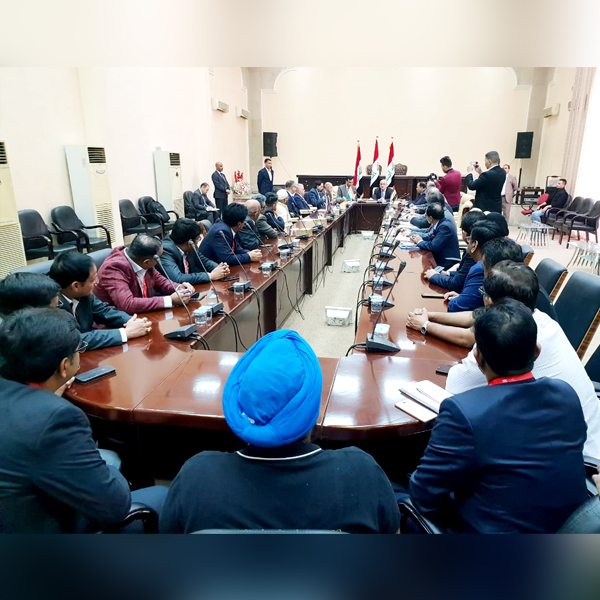
Emerging opportunities for Indian businessmen as TPCI organizes a successful BSM in 4 cities in Iraq
Baghdad, Najaf, Karbala and Erbil were the 4 destination points for Trade Promotion Council of India (TPCI) to hold BSM meetings of Indian company representatives with prominent buyers from Iraq. The event, executed by the Indian Embassy in Iraq, was also a confidence building exercise for Indian exporters, many of whom quit doing business with Iraq when the country went into turmoil post 2002. H.E. Pradeep Singh Rajpurohit, India’s Ambassador to Iraq ably assisted by Mr. Rajinder Kumar, Commercial Attache in the Indian Embassy in Iraq, orchestrated the proceedings including arranging meetings with Senior Officials, Trade bodies and Ministries. The four-day business delegation met prominent businessmen and interacted with Trade bodies in each of the four cities besides getting a chance to meet the Hon’ble Minister of Trade in the Iraqi government HE Mr. Mohammed Hashim Al Ani, in the company of Senior Officials of Ministry of Trade and of Foreign Economic Relations Department of Iraq. It was the first delegation of its type that visited Iraq since 2003. During the interactive session that followed, the Hon’ble Minister assured of his best cooperation to enhance bilateral trade between India and Iraq. The delegation comprised of more than 30 representatives from Companies dealing in various different commodities. While Chaizup Beverages LLP, Es Pee International, Swiss Singapore India Pvt. Ltd., McLeod Russel India Ltd., Team United Marketing Pvt. Ltd. and Indian Tea Association representative Sujit Patra belonged to the Tea industry, DP Chocolates, DP Cocoa Products LLP and DP Chocolates represented Confectionary Industry. Shellz Overseas Pvt. Ltd. also dealt in Confectionary besides sugar and juices. Delegation comprised of PCL Foods, Bhole Nath Foods Ltd. and Veer Overseas Ltd. dealing in Rice and Grow Global, India Global Foods Pvt. Ltd. and Agro Crop dealing primarily in Rice, Spices, Ready to Eat Food and other Grains. Shri Hari industries took Sesame Seeds and Basil Seeds to export while Indian Garden was looking for buyers dealing in fresh fruits and vegetables. During the subsequent meetings with DG-Food Stuffs Eng. Kassim H. Mansoor and with Iraqi Indian Economic Cooperation Council, Iraqi Indian Business Council and Federation of Iraqi Chamber of Commerce, certain key points related to furtherance of trade and commerce between Iraq and India were discussed. This was followed by a meeting with Mr. Bahaa Hameed Abdulridha, GM and his team at Noor Alkafeel Company in Karbala. In Najaf, the TPCI delegation got a chance to interact with Najaf Chamber of Commerce while in Erbil they had an interaction with Salahaddin Investment Company. A remarkable policy change that was discussed was that the tenders floated till date by the Grain Board of Iraq for rice were of quantity of 30000 tons which was a hindrance to small players. Moreover, the date for finalization of tender was always over one month before and with rice price fluctuating on daily basis, it was not possible to quote so much in advance. It was suggested that the timeline be reduced to the extent possible and the quantity of purchase be reduced. Eng. Kassim Mansoor took an immediate decision by assuring that the tenders would be open only a week after announcement and would consider that quantity of 30,000 tons be distributed between at least 3 players to ensure surety of supply. This first delegation visit to Iraq after 2002 thus turned out to be a very productive one. Apart from acting as a confidence building exercise between Indian sellers and Iraqi buyers, it greatly changed the perception of Iraq market and brought to focus the existing bottlenecks, including lack of direct banking and sea route as top concerns. All the 30-odd members of the delegation were greatly pleased that the Iraq trip gave them an opportunity to re-enter this emerging market of Food & Beverage. The feedback by some of the delegates from representing companies showed they found immense business opportunity in the new Iraq and were overall appreciative of TPCI and Indian embassy’s efforts to create better business opportunities for Indian companies. Present here are some of the observations: Sanjib Das, Swiss Singapore (I) Pvt Ltd. Overall good experience in Baghdad. Also got good exposure in the wholesale market in Najaf. The support from the Embassy as well as TPCI was outstanding though more tea buyers would have been welcome. Prakash Patel, Shri Hari Industries First time in my life, I had such a good experience while indulging in B2B meetings. It was an excellent experience dealing with the Kurdish people who are good. Vishal Goel, Indies Global Foods Pvt. Ltd. Got very good support from the Indian embassy especially Rajpurohit ji who was with us for the entire tour carrying Indian flag and promoting Indian business community. TPCI is putting great efforts in providing opportunities to Indian business houses. Mr. Ashok Sethi’s role is remarkable as he drives and promotes opportunities for all of us. Erbil was a great opportunity for us. We are awaiting response to the Minister of Trade’s promise that he will get us associated with right partner for business. Rakesh Kumar, Bholenath Foods Ltd. It was a good effort by the Indian Ambassador to Iraq and the TPCI team who supported us by making us meet with the big buyers from Iraq. We are sure to get business from this country. Indian foreign trade minister should advise Iraq to have a better banking system in place, like we have with Iran. Laxmikant Taunk, Chaizup Beverages Well organized and well-planned trip by TPCI and their team comprising of Mr. Ashok Sethi and Mr. Fraz Khan. Excellent support by Indian embassy and team too. I am sure I will have good business in Iraq. Shiv K Batra, Veer Overseas Ltd. Great effort put up by TPCI and the Indian embassy in organizing this trip. It was comfortable and informative trip, though hectic. Could have been better if we had stayed for two full days at each destination. Sandeep Khaitan, Team United Marketing (P) Ltd. A splendid effort by TPCI to organize the trip.
India Plans to Discuss Duty Cuts with China: Are we moving beyond RCEP?
India plans to have bilateral discussions with China on duty cuts under the Regional Comprehensive Economic Partnership (RCEP) trade agreement. However, how much we can give to China in the absence of reciprocity framework, is a challenge to work upon? The conclusion of the agreement has been pushed to next year with the crucial issues of goods, services including easier movement of professionals, and investment still being negotiated. RCEP is a mega-trade agreement, spanning across 10 ASEAN countries and its six free-trade agreement partners which includes Australia, New Zealand, Japan, China, Korea and India. China and India have enough time to decide upon the course in market access, as, still fifteen months are left to intensify the market access negotiations. India will have to allow duty cuts on more than 80% of the goods imported from China over a period of 20-years. India can, however, exclude 20% of its tariff lines, including agriculture, finished goods, automobiles and textiles from duty cuts. In 20 years, India is expected to create capacity and competitiveness. RCEP will buttress in creating markets for Make in India. For ASEAN, Japan and Korea, India will need to eliminate or reduce duties for 90% of the products. The India-China bilateral meetings could take place before the RCEP countries meet for a round of negotiations in Indonesia in February and the ministerial in Thailand in April followed by another round of talks in Australia in May. On the other hand China is expected to give higher duty concessions for India’s exports because of the trade imbalance. India’s exports to China amounted to $12.5 billion in 2017 while imports from that country stood at $72.0 billion. Policy makers complain that exports from ASEAN into India have surged far quicker than Indian exports to the bloc, which they attribute to the fact that India is a “services economy.” Thus, they’re willing to hold up RCEP until Indian companies are granted more market access for services than is currently the case. India has largely failed to develop a manufacturing sector because its factories aren’t competitive and aren’t plugged into global supply chains. Over the past few years, tariffs have started rising as well, often in an ad hoc and arbitrary manner, which means that becoming part of spread-out value chains will be even tougher. As for Indian services exports, the truth is that market access isn’t as straightforward as all that. Services trade requires harmonized rules and regulations — something that RCEP isn’t prioritizing in the first place. And, in fact, many bits of the agreement that do focus on convergence of rules, are also unacceptable to India. It will object, for example, to any clause that forbids laws mandating data localization, having already clamped down on foreign payments networks and internet companies. Given the difficulty of getting Indian negotiators to the table for bilateral trade deals, the RCEP remains the best chance to incorporate India into a genuinely open trading bloc. In the end, success will come down to give and take, and one country will have to give the most: China. India’s concerns about hidden Chinese subsidies and closed Chinese markets are shared now by much of the world. While RCEP may appear to be a multilateral deal, negotiations between China and India lie at its heart. Other countries have now accepted that fact, allowing India to also negotiate separately with China, as well as Australia and New Zealand, under a “bilateral pairing mechanism.” For Chinese economy, this is an opportunity to demonstrate not just its continuing commitment to free trade but also its willingness to make trade fairer than it’s been in the past. If the 2019 deadline is to mean anything, then both India and China will have to think very hard about where their national interests really lie. The conclusion of the RCEP agreement has been pushed to next year, though negotiations on seven chapters of the agreement have concluded, market access negotiations are in final stages. Consensus could not be reached on ecommerce, competition and investment chapters. Henceforth the mega trade agreement may look to cross its penultimate round of negotiations and has entered into its ultimate phase. Currently it looks equivocal as it is daunting to figure it out the priority route.
Shaping Agri Export Policy: What Cabinet Can Discuss?
The Union Cabinet is likely to take up agriculture export policy in the first week of December. The proposed agriculture export policy aims at doubling outbound shipments of farm products and increasing their share in the world market, The Commerce Ministry having already finalized the policy and forwarded it for the consideration by the Government. The emphasis is likely to be on all aspects of agricultural exports, including modernizing infrastructure, streamlining regulations, curtailing knee-jerk decisions, standardization of products, focusing on research and development activities, and setting up of an agency in line with the European Food Safety Authority for framing, regulating and implementing rules related to both production and trade. The proposed National Agriculture Export Policy also needs to provide an assurance that the processed agricultural products and all kinds of organic goods will not be brought under the ambit of any kind of export restriction such as imposing minimum export price, export duty and ban etc. The draft policy, prepared by the Ministry, has suggested bringing in a stable trade policy regime, reforming the APMC (Agricultural Produce Market Committee) Act, streamlining of Mandi fee, and liberalizing land leasing to double the agricultural shipments to over USD 60 billion by 2022. It has also pitched for greater participation of states, enhancement in infrastructure and logistics and research and development (R&D) activities for new product development for the upcoming markets. There has been a penchant to utilize current norms as an instrument to attain short-term goals of taming inflation, providing price support to farmers and protecting the domestic industry, given the domestic price and production volatility of certain agricultural commodities. Precise forecasting of agri production would benefit a lot and even occasional shortfall should be met through imports rather than restraining exports. Freight subsidy for value-added agri products, floriculture and horticulture would be of enormous support. India’s exports in 2017 was about USD 35 billion, which is over 2.2 per cent of the world agriculture trade. Agricultural products constitute over 10 per cent of the country’s total merchandise exports. The main commodities exported by India include tea, coffee, rice, cereals, tobacco, spices, cashew, oil meals, fruits and vegetables, marine products, meat, dairy and poultry products. However the worrying factor is that exports of value-added items is significantly low. The proposed policy advocates for adoption of a cluster based approach for agriculture commodity exports so that quality products can be exported. The clusters will now be also concentrating to produce world class products which complies with the international phytosanitary standards. What Cabinet must include? Mapping Food Product for each specific food importing economy: This will facilitate in analyzing the kind of food/agricultural produce India needs to cultivate / process to cater to the demand of individual economy. Reverse Engineering Approach: Instead of identifying the potential product which Indian region is specialized in cultivating, we need to cultivate and process such products that are required and imported by specific food importing economies, including synergy on SPS and TBT and Codex Alimentarius. In a pre-determined manner, cultivation will take place from stage 1 taking care about the exports requirement of a particular Economy / Market. Agricultural Enclaves can also be considered as part of a bigger value chain mechanism (raw materials, intermediates, finished products and marketing) where the value chain extends beyond geographically defined boundaries. ATP Agreement: There is an agreement, adopted by no less than 20 countries, titled “Agreement on the International Carriage of Perishable Foodstuffs and on the Special Equipment to be used for Such Carriage” “(ATP)”. Its purpose is to direct participants to follow common standards for the temperature-controlled equipment (road vehicles, railway wagons, containers etc.) within Europe, thereby facilitating international traffic in certain perishable foodstuffs. The Cabinet decision addressing and approving these issues is crucial for India to speed up the pace in adopting the modern practices, to be implemented in agricultural exports, to fetch the desired export figures.
Product Profile- Organic Food Products
APEDA, Ministry of Commerce and Industry defines Organic products as “the products grown under a system of agriculture, without the use of chemical fertilizers and pesticides with an environmentally and socially responsible approach”. Organic farming has several benefits beyond widely publicised reduced exposure to pesticides and other chemicals entailing food safety. The system of organic farming impacts the sustainability of agro ecosystem as a whole. It builds the fertility of soil by encouraging growth of soil based flora and fauna. It also allows for better water retention capacity of soil, immunity from diseases and sound soil management. It mitigates the effect of harmful chemicals, greenhouse gas and global warming. FAO claims that organic farming produces more biodiversity than other farming systems. India is endowed with large agricultural land and has the potential produce almost all varieties of organic products due to its diverse range of agro-climatic conditions. Infact, organic farming is a tradition in many parts of the country. As per FIBL & IFOAM Year Book 2018 India is ranked 9th in in terms of World’s Organic Agricultural land and 1st in terms of total number of organic producers. As per the APEDA database total number of operators involved in organic cultivation are over 7 thousand while the farmers engaged in organic cultivation are close to 11 lakh. Detailed distribution of the operators and farmers engaged in organic cultivation are- Individual farm producers 1918 No. ICS Groups 3488 (10.91 lakh farms) Total Processors 1081 No. Total Trader 822 No. Wild harvest Operators 79 No. Total Operators 7388 No. Total Farmers 10,93,288 Total area under organic cultivation in India in 2017-18 as per APEDA is 3.5 million hectares. Madhya Pradesh leads the list of largest area under organic certification with an area of 1.1 million hectares under certification followed by Rajasthan, Maharashtra and Uttar Pradesh. One remarkable achievement of Sikkim has been that it has been able to convert its entire cultivable land i.e. 76 thousand hectares under organic certification in 2016. APEDA database mentions that India produced around 1.70 million metric tonnes (2017-18) of certified organic products in 2017-18. Oil seeds are the single largest category in terms of total production of organic products with a production of 5.4 lakh metric tonnes followed by Sugar crops, Cereals and Millets, Fiber crops, Pulses, Medicinal, Herbal and Aromatic plants and Spices. India produced 46 thousand metric tonnes of organic Medicinal/Herbal/Aromatic Plants, 45 thousand metric tonnes of spices, 54 thousand metric tonnes of organic fruits and vegetables and 7 thousand metric tonnes of organic ornamental flowers in 2017-18. Total export of organic food products from India in 2017-18 was 4.58 lakh metric tonnes in terms of quantity and in value terms total export was worth 515.44 million USD. Top 3 export destinations of Indian organic produce are USA (export value – USD 234.6 million), European Union (export value – USD 196.8 million) and Canada (export value – USD 51.8 million). Oilseeds (47.6%) lead the list of organic product export from India with a share of 48% of total organic food products export from India. It is followed by Cereals and millets (10.4%), Plantation crop products such as Tea and Coffee (8.96%), Dry fruits (8.88%), Spices and condiments (7.76%) and others. As per Euro monitor International ‘Sresta natural bio products’ is India’s largest organic foods company followed by ‘organic India’ and ‘chamong tee exports’. It also estimates India’s organic food market size of INR 378 cr at a growth rate of 19% in 2017. India is evidently not just a major producer but also a big market of organic food products.
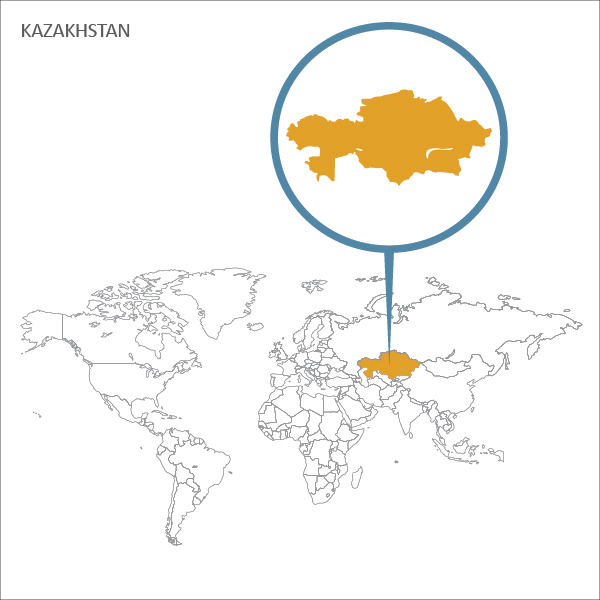
Country Profile- Kazakhstan
Kazakhstan is located in the Central Asia. It is the world’s largest landlocked country. The country is endowed with natural resources such as petroleum, gas, chromium, lead, zinc and uranium. The United Nations Development Programme ranks Kazakhstan 58th in terms of Human Development Index with the value of 0.800. It is ranked 28th in ‘Ease of Doing Business’ by World Bank released in 2018 with 1st rank in protecting minority investors and 4th in enforcing contracts. As per World Economic Outlook Database, 2018 estimate Kazakhstan is ranked 42nd in world in GDP in PPP terms at a value of US$ 508 billion while ranked 50th in GDP in nominal terms at a value of US$ 184 billion. The per capita GDP of Kazakhstan in PPP terms is estimated to be US$ 27494 and in nominal terms it is estimated to be US$ 9977 in 2018 by World Economic Outlook Database. TRADE STATISTICS In 2017, Kazakhstan imported US $ 29.3 billion worth of goods. Its export was over US $ 48.3 billion in value in 2017 which accounted for 0.3 % of the total exports in the world. As per ITC trade map Kazakhstan ranks 50th among the top world exporters, list is led by China. The top trading partner of Kazakhstan is Russia, followed by China and Italy. India does not rank in the list of top 10 trading partners of Kazakhstan, but has a significant import from Kazakhstan of worth US$ 1.04 billion and an export value of US$ 118 million from India to Kazakhstan, resulting into a trade deficit of US$ 921 million for India. KAZAKHSTAN’S MERCHANDISE TRADE WITH WORLD Kazakhstan’s exports to the world have followed its path of imports throughout, as can be seen in the graph below. The country has maintained a trade surplus throughout the past decade but the trade surplus is consistently declining post 2011. In 2017 it had a trade surplus of US $ 18.9 billion. In the last 10 years trade surplus was highest in the year 2011 at US$ 50.1 billion. KAZAKHSTAN’S EXPORT TO THE WORLD Kazakhstan’s total export in 2017 amounted to US $ 48.34 billion. Natural resources are the primary export products of Kazakhstan. Its top export product at HS-6 digit level last year was Crude petroleum oil, Copper cathodes, Ferro chromium, Natural gas and Natural uranium. These products constitute 71% of the total export basket of Kazakhstan. KAZAKHSTAN’S IMPORTS FROM THE WORLD Kazakhstan’s import basket is primarily led by Medicaments, Telephones for cellular networks, Medium oils, Light oils, Motor cars and other motor vehicles and Appliances for pipes, boiler shells, tanks which together make up the Top 5 imports of Kazakhstan. These products constitute 10 % of the total import basket of Kazakhstan. INDIA- KAZAKHSTAN MERCHANDISE TRADE Barring the year 2011 and 2012 India consistently maintained a trade deficit with Kazakhstan. Deficit reached the highest i.e. turned worse in 2017 with a deficit of 921 million. India’s export is following a declining trend year on year after 2013. Barring the dip in 2014 and 2015 Indian’s import from Kazakhstan followed an upward trend. INDIA’S EXPORT TO KAZAKHSTAN India’s total exports to Kazakhstan amounted to US $ 118.4 billion in 2017. Its top five exports at HS-6 digit level were Tea, Medicaments, Refractory cements, mortars, concretes, Vaccines for human medicine and Cashew nuts (Shelled). It amounts to 59.6% of the total export to Kazakhstan from India. INDIA’S IMPORT FROM KAZAKHSTAN India’s total import from Kazakhstan in 2017 was US $ 1.04 billion. India’s import was dominated by Crude Petroleum oils, Medium oils and preparations, Asbestos, Ferro-chromium and Phosphorus. The import basket of India for the products imported from Kazakhstan is highly skewed, such that the top 5 products amount to 97 % of total imports by India from Kazakhstan. India-Kazakhstan economic relationship is primarily influenced by energy resources. India is not just an important oil importer but proposed TAPI pipeline – The Turkmenistan–Afghanistan–Pakistan–India Pipeline (TAPI), also known as Trans-Afghanistan Pipeline may boost the import of natural gas by India from Kazakhstan. Besides the traditional source of energy the two nations are also collaborating on clean nuclear energy since Kazakhstan is endowed with large nuclear reserves and India is a large energy consumer. India has a civil nuclear pact with Kazakhstan for the purchase of uranium from Kazakhstan. As per UNCTAD investment report, from 2001 to 2012, Kazakhstan received US$ 200 million of FDI from India while India received US$ 29 million of FDI from Kazakhstan from 2001 to 2012. Both nations have sought to establish extensive collaboration and commerce in information technology, space research and defence technology.